
Trump's Tariff Cuts: A Game Changer for Global Agricultural and Consumer Goods Sectors
Tariff Cuts and Trade Agreements: A Strategic Overhaul
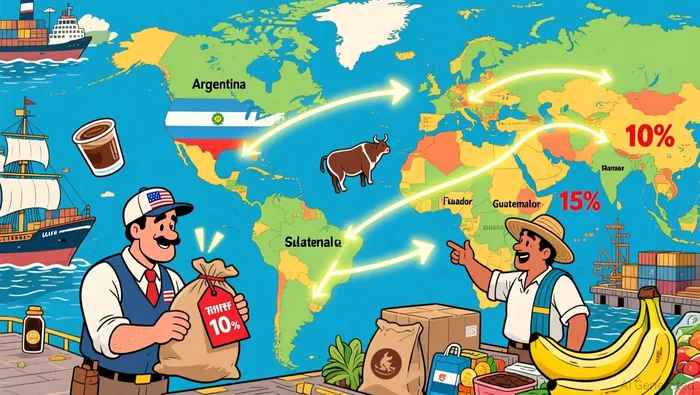
According to a report by Bloomberg Law, Trump's administration has announced significant reductions on tariffs for agricultural products, including 10% on most goods from El Salvador, Guatemala, and Argentina, and 15% on imports from Ecuador. These cuts are paired with new trade framework agreements designed to remove barriers on key food items, such as coffee and bananas as reported by Investing.com. The move reflects a dual objective: addressing voter concerns over affordability and fostering economic ties with Latin American and South American partners.
For example, the U.S. imports 99% of its coffee, a dependency that could see immediate relief as tariffs on Ecuadorian and Guatemalan beans are slashed according to USA Today. Similarly, beef imports from Argentina-where tariffs are being phased out-may gain a foothold in U.S. markets, challenging domestic producers. These changes are not merely transactional; they signal a strategic pivot toward leveraging global agricultural hubs to stabilize pricing and supply.
Supply Chain Adjustments: Opportunities and Challenges
Multinational agribusinesses are already recalibrating their supply chains to capitalize on these shifts. The removal of reciprocal tariffs on products like coffee and beef, as noted by Reuters, is expected to ease sourcing costs for importers. Companies with established relationships in Argentina, Ecuador, and Guatemala may gain a competitive edge, as lower tariffs reduce the cost of transporting goods to U.S. markets.
However, the transition is not without friction. For instance, while lower tariffs on bananas from Ecuador could benefit retailers, global factors such as Brazil's coffee-producing droughts may temper price declines. This underscores a critical challenge: even with reduced trade barriers, agribusinesses must navigate volatile production conditions and geopolitical risks.
Competitive Dynamics: Winners and Losers
The competitive landscape is shifting as U.S. importers and agribusinesses adjust to the new tariff regime. Companies that can swiftly integrate suppliers from Trump's partner nations-such as Cargill or Archer Daniels Midland-may dominate the post-tariff market. Conversely, domestic producers in sectors like beef and coffee face intensified competition, potentially squeezing profit margins unless they innovate or diversify.
Moreover, the trade agreements include provisions beyond tariffs, such as commitments to avoid digital services taxes on U.S. companies as reported by Investing.com. This could incentivize tech-driven agribusinesses to expand operations in partner countries, further altering the competitive playing field.
Risk and Uncertainty: The Unseen Variables
While the immediate benefits for consumers are clear, industry analysts caution about long-term economic ripple effects. For example, the Supreme Court's ongoing review of Trump's tariff authority could introduce legal uncertainty, delaying implementation or forcing revisions. Additionally, the U.S. trade deficit with Ecuador-driven by its 15% tariff rate-remains a point of contention, highlighting the delicate balance between affordability and economic equity.
Conclusion: A Game Changer, But With Caveats
Trump's 2025 tariff cuts and trade agreements are undeniably reshaping the global agricultural and consumer goods sectors. For multinational agribusinesses, the policy offers opportunities to optimize supply chains and reduce costs, but it also demands agility in the face of global volatility. Importers stand to benefit from lower tariffs, yet they must contend with market saturation and shifting consumer demands.
As the dust settles, investors and industry leaders must monitor how these changes translate into sustained cost savings for consumers and profitability for corporations. The true test of this policy's success will lie in its ability to balance affordability with economic resilience-a challenge that will define the next chapter of global trade.







Comentarios
Aún no hay comentarios