
Trump's Supply-Side Gambit: Weighing Risks and Opportunities in a Fractured Market Landscape
Deregulation and Tax Policies: A Double-Edged Sword
The Trump administration's deregulatory agenda, including the repeal of environmental and 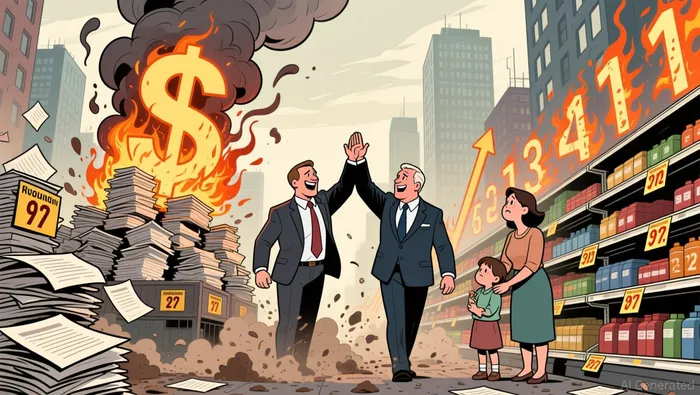 labor regulations, sought to reduce compliance costs for businesses and spur innovation. Concurrently, tax cuts and increased tariffs-such as the 153% surge in customs duties in FY2025- were designed to protect domestic industries and boost corporate profits. While these measures initially drove short-term gains in sectors like manufacturing and energy, they also exacerbated federal deficits, which ballooned to $1.8 trillion in FY2025.
Critics argue that the lack of a cohesive plan to offset revenue losses has left the economy vulnerable. The national debt, projected to reach 180% of GDP by 2050, underscores the long-term fiscal risks of prioritizing short-term growth over fiscal sustainability.
Market Volatility and Investor Confidence: A Shattered Equilibrium
The administration's trade policies, particularly the 2020-2024 trade war with China, have been a primary driver of market instability. According to J.P. Morgan Global Research, the effective U.S. tariff rate surged to 15.8% by August 2025, up from 2.3% at the end of 2024. This escalation created material headwinds for global growth, with Bruce Kasman, J.P. Morgan's chief global economist, warning of heightened recession risks.
Investor confidence has waned amid the uncertainty. A 90-day pause in tariff escalations between the U.S. and China briefly stabilized markets, but the underlying volatility persists. Foreign investors, wary of supply chain disruptions and inflationary pressures, have reduced exposure to U.S. assets, contributing to a decline in the dollar's value. Moody's analysis further highlights how these policies have disrupted global supply chains, adding structural headwinds for businesses.
Sector-Specific Impacts: Winners and Losers
While the broader market grapples with instability, certain sectors have thrived. The Center for American Progress notes that protectionist tariffs have shielded domestic manufacturers from foreign competition, albeit at the cost of higher input prices for businesses and consumers. Conversely, sectors reliant on global supply chains-such as technology and retail-have faced operational challenges, with tariffs increasing costs by an estimated $1.5 billion annually.
The regressive nature of these policies also raises equity concerns. Lower-income households, already strained by inflation, bear a disproportionate burden as tariffs drive up the cost of essential goods.
Long-Term Risks: A Fragile Foundation
Financial institutions have sounded alarms about the long-term implications of Trump's approach. The Bipartisan Policy Center's Deficit Tracker underscores that fiscal imbalances, if left unaddressed, could undermine economic resilience. Meanwhile, the Center for Economic Policy Research (CEPR) warns that erratic tariff policies have created a "turbulence tax," eroding consumer and business confidence.
Opportunities in Uncertainty
Despite the risks, the non-holistic supply-side approach has unlocked niche opportunities. For instance, the focus on reshoring manufacturing has spurred investment in automation and domestic supply chains. Additionally, sectors benefiting from reduced regulations-such as energy and agriculture-have seen short-term gains. Investors with a contrarian outlook may capitalize on undervalued assets in volatile markets, though this requires a high tolerance for risk.
Conclusion: A Precarious Balance
Trump's supply-side strategy exemplifies the tension between short-term gains and long-term stability. While deregulation and protectionism have provided temporary boosts to certain sectors, the lack of a holistic framework has amplified systemic risks. Investors must navigate this landscape with caution, hedging against volatility while identifying pockets of opportunity. As global markets remain tethered to policy uncertainty, the path forward demands a recalibration of priorities-balancing growth with fiscal prudence and global cooperation.







Comentarios
Aún no hay comentarios