
Trump Signs First U.S. Federal Stablecoin Law Mandating 1:1 Reserves, Monthly Audits
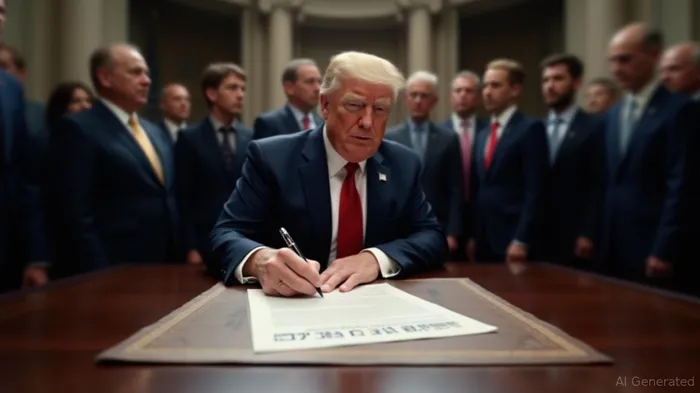
President Trump signed the GENIUS Act into law, establishing the first federal regulatory framework for payment stablecoins in the U.S. The "Guiding and Establishing National Innovation for U.S. Stablecoins Act" mandates that stablecoin issuers maintain 1:1 cash or Treasury-backed reserves, undergo monthly third-party audits, and submit financial records to regulators like the Office of the Comptroller of the Currency (OCC) and the Federal Reserve. A Stablecoin Certification Review Committee, comprising representatives from the Treasury, Fed, and FDIC, will evaluate state-level programs. Smaller issuers with under $10 billion in circulation can operate under state charters if federally approved. The law also imposes a two-year moratorium on new algorithmic stablecoins, a measure critics argue stems from lessons learned during the 2022 TerraUSD collapse [1].
The act redefines regulatory roles, explicitly excluding the SEC and CFTC from overseeing payment stablecoins. This shift aims to reduce legal ambiguity and litigation risks for compliant issuers. However, challenges remain for major stablecoins like USDTUSDT--, USDCUSDC--, and DAI. TetherUSDT--, which has faced scrutiny over reserve transparency, will need to overhaul its operations to meet the new audit requirements. Circle’s USDC, already aligned with regulatory standards, must still comply with CEO and CFO-certified disclosures. DAI, issued by decentralized MakerDAO, presents a unique hurdle due to its lack of a traditional issuer structure, raising questions about audit accountability. Neeraj Agrawal of Coin Center noted the law’s failure to address decentralized governance models, leaving DAI’s compliance path unclear [2].
The GENIUS Act also includes provisions from the Anti-CBDC Surveillance State Act, prohibiting the Federal Reserve from issuing direct-to-consumer digital currency accounts. Proponents like Senator Cynthia Lummis argue this protects privacy by preventing government surveillance through digital wallets. Critics, however, warn it could enable regulatory overreach by allowing asset freezes or destruction, potentially violating the Fourth Amendment. Legal experts anticipate court challenges to these provisions in the coming months [3].
The law places the U.S. in regulatory competition with Europe’s MiCA framework, which offers a unified licensing system across EU member states. U.S. lawmakers defend their hybrid federal-state model as fostering local innovation and public-private collaboration, though critics highlight potential friction. Both regions now aim to define global standards for digital finance.
Implementation risks include state regulatory interactions, decentralized project compliance, and enforcement uncertainties. While the act is praised for providing clarity, its long-term impact—whether fostering adoption or fragmentation—remains to be seen.
Sources:
[1] [AP News](https://coinmarketcap.com/community/articles/68834fc132b65702e7fcfeeb/)
[2] [Reuters](https://coinmarketcap.com/community/articles/68834fc132b65702e7fcfeeb/)
[3] [Axios](https://coinmarketcap.com/community/articles/68834fc132b65702e7fcfeeb/)





Comentarios
Aún no hay comentarios