
Trump's Secondary Tariffs on Russian Oil Buyers and the Risks to Global Energy Markets
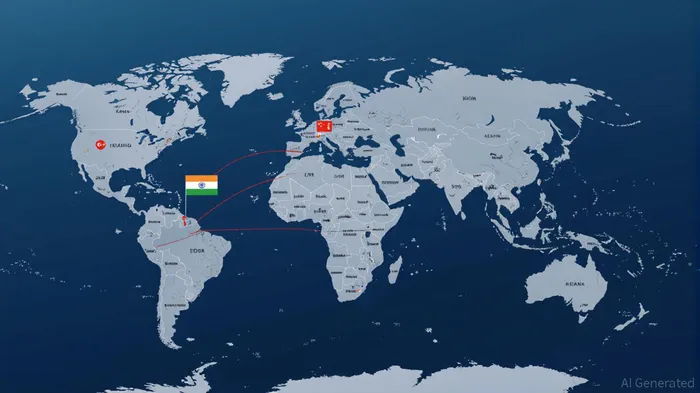
In 2025, U.S. President Donald Trump's secondary tariffs on countries importing Russian oil have reignited debates about the intersection of geopolitics and energy markets. These tariffs, targeting India and potentially China, aim to pressure Russia into a ceasefire in Ukraine by disrupting its oil revenue. However, the strategy carries profound risks for global oil prices, trade relations, and energy equity valuations. For investors, understanding these dynamics is critical to navigating a landscape where policy decisions can swiftly reshape market fundamentals.
The Tariff Gambit: Disruption and Uncertainty
Trump's tariffs—up to 100% on goods from countries importing Russian oil—represent a bold but precarious move. India, Russia's largest oil buyer, has already faced a 25% tariff hike, while China remains a looming target. The logic is straightforward: by raising the cost of Indian and Chinese goods, the U.S. hopes to deter these nations from purchasing Russian oil, thereby reducing Moscow's war-funding capabilities.
Yet, the market's response has been skeptical. Despite Trump's rhetoric, Brent crude prices have dipped post-announcement, with traders viewing the tariffs as a negotiation tactic rather than a binding policy. Analysts like Bob McNally of Rapidan Energy argue that India is more likely to absorb the tariffs than abandon Russian oil, given the lack of viable alternatives. This could force Russia to cut production, creating a supply shock that drives global prices into the $80s or higher—a scenario that would backfire on U.S. consumers already grappling with inflation.
Energy Equity Valuations: Volatility and Rebalancing
The energy sector's equity valuations are now inextricably tied to geopolitical risks. For instance, U.S. oil producers like ChevronCVX-- and ExxonMobil may benefit from higher prices, but the broader market faces headwinds. Rising oil prices could trigger inflationary pressures, prompting central banks to tighten monetary policy and dampen demand. This duality creates a volatile environment for energy stocks, where short-term gains may clash with long-term uncertainty.
Meanwhile, alternative energy sectors face a dual challenge. Tariffs on Chinese solar panels and EVs threaten to slow the adoption of renewables, particularly in the U.S. and EU. Under high-tariff scenarios, solar capacity in the U.S. could lag by 9% by 2035, while battery storage systems (BESS) may see a 10% reduction in the EU. These disruptions risk delaying the energy transition, forcing investors to weigh the trade-offs between short-term cost savings and long-term sustainability.
Strategic Positioning: Energy Infrastructure as a Hedge
Given these risks, investors should prioritize sectors with resilience to geopolitical shocks. Energy infrastructure—particularly digital infrastructure and domestic renewable manufacturing—offers a compelling hedge.
Digital Infrastructure: The surge in AI-driven demand for data centers has created a robust subsector. Companies like MicrosoftMSFT-- and AmazonAMZN-- are expanding cloud infrastructure in Europe, where geopolitical tensions are pushing firms to diversify supply chains. With vacancy rates in U.S. data centers hitting historic lows, this sector is well-positioned to absorb inflationary pressures.
Domestic Renewable Manufacturing: While tariffs on Chinese imports raise costs, they also incentivize U.S. and EU firms to scale domestic production. The American Clean Power Association's $100 billion commitment to battery manufacturing, for example, signals a shift toward self-sufficiency. Investors should focus on firms with strong R&D pipelines and access to critical minerals, such as lithium and cobalt.
Natural Gas as a Transition Fuel: In a high-tariff world, natural gas is likely to maintain a larger role in the energy mix. U.S. firms like NRG EnergyNRG-- are acquiring gas-fired generation capacity to meet rising electricity demand, particularly in a post-AI economy. While renewables remain the long-term goal, gas offers a near-term buffer against supply chain disruptions.
Conclusion: Navigating the New Energy Normal
Trump's secondary tariffs underscore a broader trend: energy markets are increasingly shaped by geopolitical decisions rather than purely economic forces. For investors, this means adopting a dual strategy. Short-term positioning should focus on sectors insulated from trade volatility, such as energy infrastructure and digital assets. Long-term, however, the energy transition remains intact, albeit at a slower pace.
The key is to balance exposure to high-growth renewables with defensive plays in infrastructure and natural gas. By diversifying supply chains, hedging against price swings, and prioritizing domestic production, investors can mitigate the risks of a fragmented global energy landscape. In an era where tariffs and geopolitics reign supreme, adaptability—not just in policy but in portfolios—will define success.





Comentarios
Aún no hay comentarios