
Trump's Rate Cap: A Tactical Play on Two Beneficiary Stocks
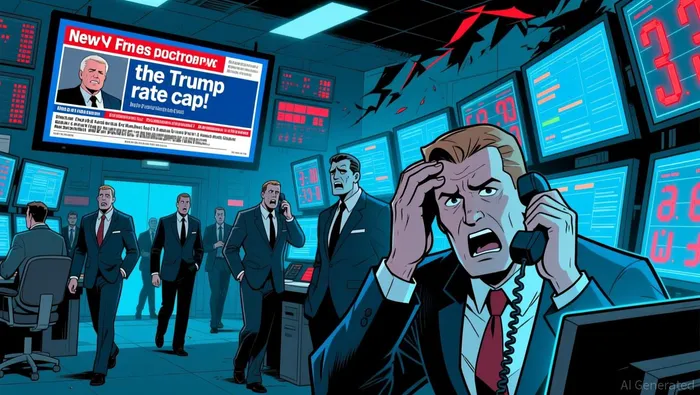
The market's reaction was immediate and severe. On Friday night, President Trump announced a one-year, 10% cap on credit card interest rates starting January 20, 2026, via a post on Truth Social. The proposal, framed as a move to address affordability, sent shockwaves through financial markets. By Monday morning, major lender shares were falling sharply, with JPMorgan Chase dropping 2.5% and Bank of AmericaBAC-- down 1.6%. The pain was concentrated on pure-play lenders, where Capital One and Synchrony Financial shares fell as much as 10%.
The catalyst's impact hinges on a critical uncertainty: the lack of a clear enforcement mechanism. Trump's call is a presidential directive, not a law. As analysts noted, such a measure could only be enacted by Congress, and even then, it would face overwhelming legal challenges. This makes the financial threat speculative, resting on an unlikely legislative outcome. The context for the proposed cap is stark: the average interest rate on credit cards stood at 20.97% in November, meaning the proposed 10% cap would represent a dramatic reduction.
The market's sell-off reflects this risk. For lenders like Capital OneCOF-- and SynchronySYF--, which are heavily reliant on credit card revenue, a cap could wipe out earnings. Wells Fargo estimates the toll on large banks' earnings before tax could be between 5% and 18%. This sets up a classic event-driven trade: the proposal creates a temporary mispricing based on political fear, but the actual financial impact depends entirely on a future, uncertain legislative process.
The Setup: Identifying the Most Exposed Targets and Their Winners
The market's initial reaction pinpointed the pure-play lenders as the most exposed. Shares of Capital One dropped more than 6% and Synchrony Financial fell 7% on Monday, signaling a direct hit to earnings for companies where interest income is the core profit engine. This is the tactical trade's foundation: the proposal threatens to cut their revenue stream by half, from an average rate near 20% to a capped 10%.
The beneficiary thesis, however, is more nuanced. Raymond James identifies alternative lenders as potential winners if the cap becomes reality. The logic is straightforward: if traditional card issuers are forced to tighten lending standards or exit the market, consumers will seek substitutes. Global Payments (GPN), a major payment processor, is highlighted as a potential beneficiary. The firm notes that such a regulatory shift could accelerate adoption of services like earned wages access, funneling activity toward non-traditional lenders.
For buy-now-pay-later (BNPL) operators, the picture is structural. While stocks like Block (XYZ) and Affirm (AFRM) also saw declines on the news, their business models are less reliant on high interest rates. They typically charge fees or fixed rates, not the variable APRs that would be capped. In a lower-rate environment, their cost of capital could actually improve, making them long-term structural winners from a regulatory shift. The event-driven play here is about relative resilience versus pure-play vulnerability.
The Trade: A Tactical Long on Two Winners
The setup is clear. The market has overreacted to a political proposal with near-zero odds of becoming law. The sell-off in traditional lenders is a tactical mispricing. The beneficiary thesis, however, requires a re-rating. The trade is to buy into that re-rating, betting the political noise will fade and alternative lenders will be rewarded for their structural resilience.
The specific entry is a long position in either Global Payments (GPN) or Block (XYZ) at current depressed levels. The catalyst for the re-rating is the lack of a legislative path. As Jefferies analyst John Hecht noted, the proposal is "highly unlikely" to become reality because it would be "dead on arrival" in Congress. This is the core of the trade: the market is pricing in a high-probability regulatory shock, but the actual risk is low. A bounce back to pre-catalyst prices represents a mean reversion to a more rational assessment.
Target a 5-10% move higher as the market digests the noise. This is not a bet on a new law, but on the correction of a knee-jerk reaction. The primary risk is that the proposal is a political tactic to pressure banks into voluntary action, which would make the current sell-off in traditional lenders a tactical opportunity for beneficiaries. If that happens, the regulatory tailwind for alternative lenders could be muted, but the initial mispricing would still be the trade.
Exit the position on any sign of serious legislative progress for a cap. Monitor for a bill introduction in Congress; the lack of one is the current reason for the sell-off in traditional lenders, creating the mispricing for beneficiaries. The bottom line is a short-term event-driven play on a temporary overreaction. The trade works if the political shock is just that-a shock-rather than the start of a new regulatory era.
The Watchlist: Key Catalysts to Monitor
The market's overreaction is a function of political noise, not a new regulatory reality. The critical path forward hinges on a few near-term events that will separate the tactical trade from a genuine regime shift.
The primary watchpoint is Congress. For the cap to become law, a bill must be introduced and advanced. Bipartisan efforts have been tried before, like the bill introduced by Senators Hawley and Sanders, but it has gotten little traction. The lack of a credible legislative path is the core reason the market's sell-off is a mispricing. Monitor for any formal bill introduction; the absence of one is the current baseline.
Bank earnings calls will provide early operational commentary. JPMorgan Chase's call on Tuesday is a key event. Management's tone on potential business model adjustments-like scaling back rewards or tightening credit standards-will signal how seriously the industry is treating the threat. Their perspective will be a real-time read on the practical impact versus the political rhetoric.
Finally, watch for any executive action or regulatory moves from the Treasury or Fed. The proposal's enforcement mechanism remains unclear, with analysts noting the administration has repeatedly tried to shutter the Consumer Financial Protection Bureau. Any move from these agencies to pressure banks could be a sign of a shift in stance, but it would also likely face immediate legal challenges. The industry's joint warning that a cap would be "devastating for millions of American families" underscores the high stakes and the political difficulty of implementation.
The bottom line: the trade is a bet on the political shock fading. The catalysts to watch are the ones that would prove the shock is real.





Comentarios
Aún no hay comentarios