
Trump-Putin Summit and Inflation Data: Geopolitical and Macroeconomic Risks for Global Markets
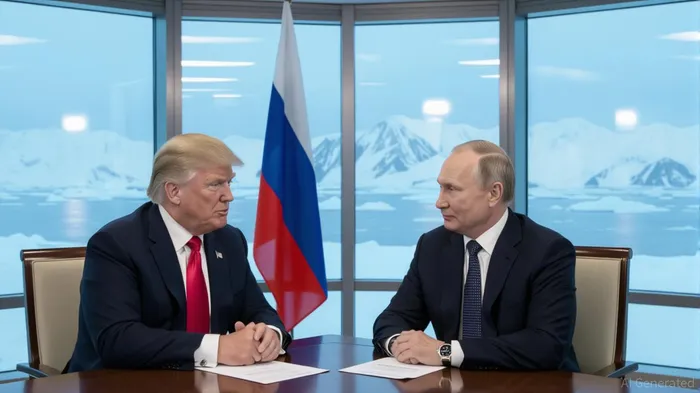
The August 15, 2025, Trump-Putin summit in Alaska has emerged as a pivotal event with far-reaching implications for global markets. As the U.S. and Russia engage in direct talks to broker a peace deal in Ukraine, investors are grappling with the dual pressures of geopolitical uncertainty and eroding trust in macroeconomic data. The summit's outcome could reshape energy flows, defense spending, and inflationary dynamics, while the credibility of inflation metrics—already under scrutiny—adds another layer of complexity to strategic asset reallocation.
Geopolitical Leverage and Energy Market Volatility
The summit's location in Alaska—a region historically tied to U.S.-Russia relations—highlights the symbolic and strategic significance of the meeting. Trump's aggressive tariff policies, including a 100% levy on countries importing Russian oil, have created a fragile equilibrium in energy markets. While OPEC+'s September production hike of 547,000 barrels per day has temporarily pressured oil prices downward, the dual pricing system—where Asian buyers benefit from discounted Russian crude while Western markets face tighter supply—remains a source of volatility.
Investors are advised to hedge against energy market fragmentation by diversifying into U.S. shale producers and renewable energy ETFs. For example, companies like Pioneer Natural Resources (PXD) and NextEra Energy (NEE) offer exposure to both traditional and emerging energy sectors. Additionally, gold—a traditional safe haven—has surged to $3,500 per ounce amid central bank gold purchases (notably by China, India, and Russia). Analysts project gold prices could reach $4,500 by mid-2026, driven by inflationary pressures and geopolitical risk premiums.
Inflation Data Credibility and Policy Uncertainty
The credibility of inflation data has become a critical concern for investors. The recent firing of the Bureau of Economic Analysis (BEA) director under Trump's administration has fueled fears of politicized economic reporting. This, combined with geopolitical shocks like the India-Pakistan nuclear-armed drone war and the Ukraine conflict, has eroded trust in macroeconomic indicators.
The Federal Reserve's policy trajectory is now clouded by uncertainty. While the CME Group's FedWatch tool assigns an 89.4% probability of a 25-basis-point rate cut in September 2025, Trump's nomination of Stephen Miran to the Federal Reserve Board signals a potential shift toward dovish monetary policy. This could lower borrowing costs for capital-intensive sectors like defense, where demand for precision-guided systems and drone technology is surging.
Strategic Asset Reallocation: Defense and Emerging Markets
The Ukraine war has accelerated the adoption of advanced military technologies, creating long-term demand for defense contractors. South Korea's Hanwha Aerospace and Israel's Elbit Systems are well-positioned to benefit from this trend. Meanwhile, emerging markets are navigating a complex landscape shaped by U.S. tariffs and BRICS realignment.
India and China, for instance, have leveraged energy trade amid geopolitical tensions. However, India's 50% tariff on its goods poses inflationary risks. Turkey and Brazil, by contrast, could gain from a U.S.-Russia truce, with Turkey's strategic neutrality attracting foreign investment in energy infrastructure and Brazil's BRICS alignment positioning it to capitalize on a multipolar trade system.
Navigating the Uncertain Landscape
For investors, the key to resilience lies in diversification and agility. Energy markets require a balanced approach, with exposure to both U.S. shale and renewable energy. Defense sectors should prioritize emerging market equities with robust tech capabilities. In emerging markets, diversifying across BRICS nations while avoiding overexposure to debt-heavy economies is advisable.
The Trump-Putin summit is not merely a diplomatic event—it is a catalyst for structural shifts in global markets. Whether it leads to a ceasefire or prolonged conflict, the outcome will reverberate through commodities, defense, and emerging economies. Investors who adapt to this fluid landscape will find opportunities in the uncertainty, as geopolitics increasingly becomes the engine driving market dynamics.
In conclusion, the interplay of geopolitical risks and data credibility concerns demands a strategic, forward-looking approach. By prioritizing resilience, diversification, and real-time risk monitoring, investors can navigate the turbulence and position themselves for long-term gains in an era of unprecedented uncertainty.





Comentarios
Aún no hay comentarios