
Trump's Push for a Funding Bill and Its Implications for U.S. Fiscal Policy and Markets
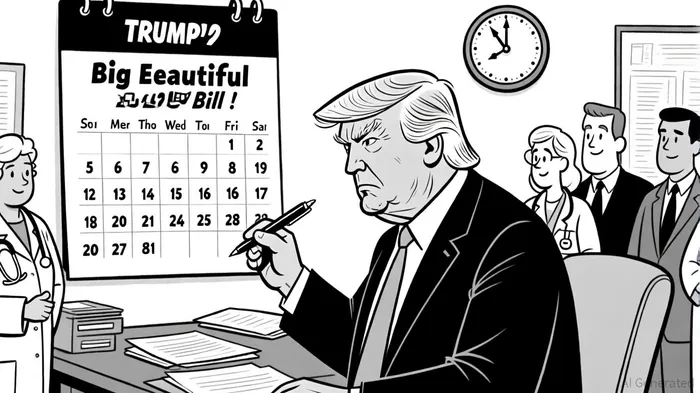
The passage of President Donald Trump's "Big Beautiful Bill," formally the One, Big Beautiful Bill Act, marks a seismic shift in U.S. fiscal policy, with profound implications for markets and political stability. This sweeping legislation, which combines permanent tax cuts, expanded border security funding, and controversial reforms to social safety nets, has already triggered a recalibration of investor strategies. As the bill's staggered implementation unfolds, the interplay between fiscal expansion, political uncertainty, and sectoral dynamics will define the next phase of U.S. economic policy and market behavior.
Fiscal Policy Shifts: A Double-Edged Sword
The bill's core provisions—permanent tax cuts for corporations and individuals, a $350 billion boost for border security, and work requirements for Medicaid and SNAP—reflect a stark ideological pivot. Corporate tax rates have been slashed to as low as 12%, the lowest in U.S. history[1], while the SALT deduction cap has been quadrupled to $40,000 for five years[1]. These measures aim to stimulate private investment and reduce reliance on federal aid, but they come at a steep cost: a projected $4 trillion increase in the federal deficit over 10 years[3].
The delayed implementation of contentious provisions, such as Medicaid work requirements and cuts to SNAPSNAP--, underscores the administration's strategic approach to managing political backlash. By staggering these changes until 2028, the bill avoids immediate electoral consequences while embedding long-term fiscal risks[1]. This approach mirrors Trump's 2017 tax cuts, which initially boosted markets but contributed to a surge in public debt.
Market Implications: Winners and Losers in a Polarized Landscape
The bill's sectoral impact is uneven, creating both opportunities and vulnerabilities. Advanced technology and defense industries stand to benefit significantly. The 100% bonus depreciation and expensing of manufacturing structures are expected to accelerate onshoring of semiconductor and AI infrastructure projects[1]. Defense contractors, including Lockheed MartinLMT-- and Raytheon, are set to gain from a $150 billion boost in funding[3].
Conversely, renewable energy and electric vehicle (EV) sectors face headwinds. The phaseout of solar and EV tax credits threatens to destabilize companies reliant on these incentives, while fossil fuel firms gain from preserved carried interest loopholes and metallurgical coal tax breaks[1]. Social safety net cuts could also ripple through state budgets, dampening consumer demand in retail and healthcare[2].
Political uncertainty, meanwhile, has amplified market volatility. J.P. Morgan Wealth Management notes that while stocks have rallied 30% year-to-date, this growth is accompanied by "elevated volatility," driven by shifting labor market data and anticipation of Federal Reserve rate cuts[1]. The Fed's pivot from restrictive to accommodative policy may cushion economic activity but risks exacerbating inflation if fiscal stimulus outpaces monetary restraint[1].
Sectoral Opportunities: Beyond the Obvious
While the bill's immediate effects are clear, emerging sectors like biotechnology and cybersecurity present untapped opportunities. The U.S.-China biotech rivalry, fueled by national security imperatives, is driving investment in gene editing and synthetic biology[4]. Trump's National Biotechnology and Biomanufacturing Initiative aims to reduce import dependence, creating a favorable environment for domestic biotech firms[4].
Cybersecurity, though not explicitly mentioned in the bill, is indirectly bolstered by heightened focus on securing biotech supply chains and data infrastructure[4]. As trade tensions escalate, firms specializing in AI-driven threat detection and secure data handling could see increased demand.
Navigating Uncertainty: Investor Strategies
Political uncertainty demands a nuanced approach to portfolio construction. Defensive sectors like utilities and healthcare may offer stability, while high-quality bonds and municipal securities provide downside protection[1]. For growth-oriented investors, sectors aligned with the bill's priorities—defense, AI, and biotech—present compelling long-term opportunities, albeit with elevated short-term risks.
Academic research underscores the asymmetric impact of policy uncertainty on sectoral volatility. For instance, economic policy uncertainty (EPU) has been shown to reduce industrial production by up to 0.5% and investment by 1% during periods of high uncertainty[2]. This suggests that firms with flexible capital structures and diversified revenue streams will be better positioned to weather fiscal and political turbulence.
Conclusion
Trump's "Big Beautiful Bill" represents a bold reimagining of U.S. fiscal policy, with far-reaching consequences for markets and political stability. While the bill's tax cuts and defense spending are likely to boost corporate profits and capital investment, its long-term fiscal sustainability remains questionable. Investors must balance the allure of high-growth sectors like defense and biotech with the risks posed by rising deficits and policy uncertainty. As the 2028 election approaches, the bill's delayed provisions will test the resilience of both markets and the political class, making adaptability a critical asset for investors.







Comentarios
Aún no hay comentarios