
Trump's Proposed EU Tariffs and the Reshaping of Global Trade-Exposed Sectors
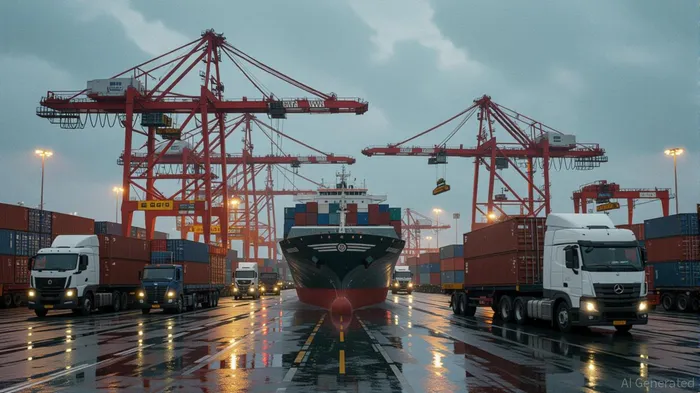
The U.S. and EU trade war, now entering its most volatile phase under President Donald Trump's 2025 tariff regime, is forcing investors to rethink their exposure to global supply chains. With tariffs ranging from 4.4% to 50% on €8 billion worth of goods—coupled with EU retaliatory threats—the manufacturing, logistics, and aerospace sectors face a seismic shift in risk profiles. For investors, the challenge is twofold: hedging against near-term volatility while identifying opportunities in companies adapting to this new reality.
The Tariff Landscape: A Timeline of Escalation
Trump's August 1, 2025, deadline for implementing 30% reciprocal tariffs on EU goods has created a binary market environment. The EU's retaliatory list of $117 billion in U.S. goods, including luxury goods, bourbon, and agricultural products, adds a layer of asymmetry. Meanwhile, the U.S. Court of International Trade's recent ruling that IEEPA tariffs are illegal introduces legal uncertainty, yet the administration's refusal to back down suggests a prolonged standoff.
Sector-Specific Impacts and Stock Performance
1. Manufacturing: Steel, Aluminum, and Automotive
The 25% tariffs on steel and aluminum—already in place under Section 232—have been exacerbated by new reciprocal duties. For U.S. automakers like Ford and General MotorsGM--, the cost of imported parts has surged, squeezing profit margins. Conversely, domestic steel producers such as NucorNUE-- (NUE) and U.S. Steel (X) have seen their stock prices rise on the back of reduced foreign competition.
2. Logistics: A Bottleneck in the Bottleneck
Tariffs on transportation equipment (e.g., trucks, railcars) and the EU's retaliatory duties on U.S. logistics services have disrupted supply chains. Companies like Maersk and Hapag-Lloyd have seen their shares drop 9% combined in recent weeks, reflecting investor fears of prolonged trade disruptions. Meanwhile, U.S. logistics firms with domestic-centric operations, such as C.H. Robinson (CHRW), are gaining traction as investors seek resilience.
3. Aerospace: A High-Stakes Game of Precision
The aerospace sector, with its intricate global supply chains, is particularly vulnerable. BoeingBA-- (BA) and Lockheed MartinLMT-- (LMT) face higher costs for EU-sourced components, while European rivals like Airbus (AIR.PA) threaten to retaliate with duties on U.S. exports. RTX (Raytheon Technologies), however, has leveraged its Collins Aerospace and Pratt & Whitney divisions to offset some losses, showcasing the importance of diversification.
Strategic Reallocation: Hedging and Opportunities
1. Diversify Supply Chains, Diversify Portfolios
Investors should prioritize companies with localized production or dual sourcing strategies. For example, TeslaTSLA-- (TSLA) has shifted some EV battery production to the U.S., reducing exposure to EU tariffs. Similarly, semiconductor firms like ASML (ASML), which operates in both the U.S. and EU, may benefit from geopolitical diversification.
2. Hedge with Tariff-Resistant Sectors
Energy, healthcare, and consumer staples are less exposed to trade wars. Companies like ChevronCVX-- (CVX) and Johnson & Johnson (JNJ) offer defensive positioning. Consider overweighting these sectors in portfolios to balance trade-sensitive holdings.
3. Capitalize on Reshoring Trends
The U.S. government's incentives for reshoring (e.g., the CHIPS Act, infrastructure spending) are creating opportunities for companies like IntelINTC-- (INTC) and CaterpillarCAT-- (CAT). These firms are not only mitigating tariff risks but also aligning with long-term policy tailwinds.
Actionable Steps for Investors
- Short-Term: Short EU-exposed sectors (e.g., luxury goods, automotive) and long U.S. steel/aluminum producers.
- Long-Term: Invest in logistics firms with domestic infrastructure (e.g., C.H. Robinson) and aerospace companies with diversified supply chains (e.g., RTX).
- Hedging Tools: Use ETFs like the Invesco Steel (SLX) and iShares U.S. Transportation (IYT) to gain sector exposure while managing risk.
Conclusion: Navigating the New Trade Normal
The Trump-EU tariff war is not a temporary disruption but a structural shift in global trade dynamics. Investors who adapt their strategies to this new reality—by hedging against volatility, reallocating toward resilient sectors, and capitalizing on reshoring trends—will be better positioned to thrive. As the August 1 deadline looms, the key will be agility: balancing caution with conviction in a market where uncertainty is the only certainty.





Comentarios
Aún no hay comentarios