
Trump's Pro-Foreign Investment Stance and Its Implications for U.S. Tech Immigration Policy
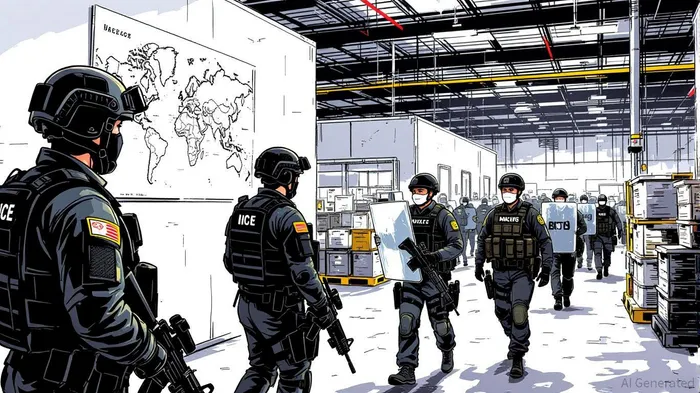
In 2025, President Donald Trump's administration has unveiled a paradoxical immigration and investment strategy: a simultaneous push to attract foreign capital to the U.S. tech sector while enforcing stricter immigration controls. This duality has created a volatile environment for global tech firms, particularly South Korean companies like Hyundai and LG, which are navigating the fallout from aggressive ICE raids and visaV-- restrictions. The implications extend beyond bilateral relations, reshaping global capital flows and innovation ecosystems in ways that demand careful analysis for investors.
The Dual Mandate: Attracting Capital vs. Enforcing Immigration Controls
Trump's 2025 executive orders emphasize economic nationalism, with a focus on revitalizing U.S. manufacturing through foreign investment. Policies such as the American AI Exports Program and Accelerating Federal Permitting of Data Center Infrastructure aim to create a favorable climate for international tech collaboration. However, these initiatives coexist with a hardline immigration enforcement agenda, exemplified by the June 2025 travel ban targeting 19 countries and the Georgia raid on a Hyundai-LG battery plant.
The raid, which detained 475 workers (300 South Korean nationals), exposed the fragility of U.S. immigration policies for foreign firms. While Trump publicly urged foreign companies to “respect U.S. immigration laws” in exchange for access to the American labor market, the incident underscored the risks of relying on immigrant labor in a regulatory environment prone to abrupt enforcement actions. South Korean firms, which have pledged $350 billion in U.S. investments since 2024, now face a dilemma: how to scale operations in a market that simultaneously rewards and penalizes foreign capital.
South Korea: A Case Study in Policy Tension
South Korea's experience highlights the broader challenges for tech-driven nations. The country's reliance on the ESTA visa waiver program—designed for short-term business trips—has become a workaround for deploying technical workers to the U.S., despite its incompatibility with long-term project needs. The Georgia raid forced Hyundai and LG to suspend operations and repatriate workers, disrupting their $26 billion and $150 billion investments in U.S. electric vehicle and shipbuilding sectors.
South Korean officials have since demanded clearer visa policies and assurances for foreign workers. However, Trump's administration has shown no inclination to relax enforcement, instead signaling a willingness to expand the travel ban to 36 additional countries if they fail to meet U.S. immigration compliance standards. This creates a high-stakes game for South Korean firms: they must balance their U.S. expansion ambitions with the risk of sudden regulatory shifts.
Global Capital Flows and Innovation Ecosystems
The U.S. is not the only nation recalibrating its immigration policies to attract tech investment. A comparative analysis reveals divergent strategies:
- China continues to prioritize domestic talent through its “Made in China 2025” initiative, limiting foreign ownership in critical sectors.
- Germany has introduced streamlined visa processes for STEM professionals, positioning itself as a hub for European tech innovation.
- India faces similar challenges to South Korea, with its IT sector grappling with U.S. H-1B visa restrictions and ICE scrutiny.
The U.S. remains a dominant destination for foreign tech investment, but Trump's policies risk fragmenting global innovation ecosystems. The June 2025 travel ban, for instance, could deter skilled professionals from countries like India and China, which supply a significant portion of U.S. tech labor. This could accelerate a shift toward regional innovation hubs in Asia and Europe, where immigration policies are more aligned with global talent mobility.
Investment Implications and Strategic Recommendations
For investors, the key takeaway is the need to hedge against policy-driven volatility in the U.S. tech sector. Here are three actionable strategies:
1. Diversify Workforce Strategies: Tech firms should explore hybrid models that combine automation, local hiring, and short-term visa programs to mitigate enforcement risks. South Korean companies like Samsung and SK Hynix are already investing in AI-driven manufacturing to reduce reliance on immigrant labor.
2. Monitor Policy Shifts in Competitor Nations: As the U.S. tightens immigration, investors should track developments in Germany, Singapore, and Canada, which are positioning themselves as alternatives for global tech talent.
3. Leverage U.S. Infrastructure Incentives: Despite enforcement challenges, Trump's Accelerating Federal Permitting of Data Center Infrastructure and American AI Exports Program offer lucrative opportunities for firms willing to navigate the regulatory maze.
Conclusion: Navigating the New Normal
Trump's 2025 immigration policies reflect a broader global trend: the tension between open markets and closed borders. For South Korean and other tech-driven firms, the U.S. remains a critical market, but success now requires a nuanced approach that balances compliance with innovation. Investors must remain agile, leveraging U.S. incentives while diversifying their geographic and labor strategies to withstand policy shocks. In this evolving landscape, adaptability—not just capital—will determine who thrives in the next era of global tech competition.







Comentarios
Aún no hay comentarios