
Trump's Pressure on the Fed and the Housing Market: A New Era for Real Estate and Fixed-Income Strategies
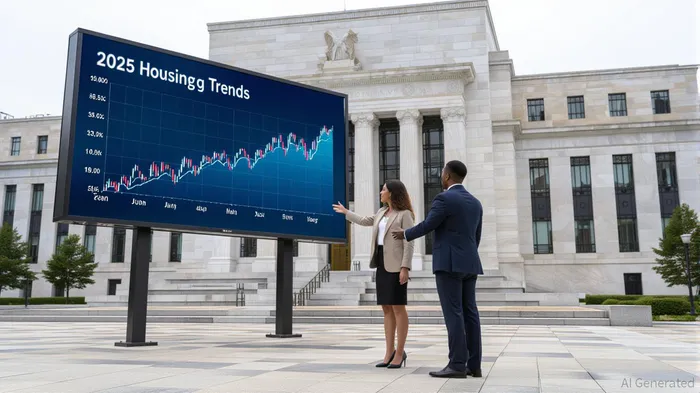
The U.S. housing market and fixed-income landscape are entering a period of unprecedented political turbulence. President Donald Trump's relentless criticism of Federal Reserve Chair Jerome Powell—coupled with his calls for aggressive rate cuts and policy interventions—has ignited a broader debate about the independence of monetary policy. For investors, the implications are clear: the interplay between political pressure and central bank decisions is reshaping risk-return profiles across real estate and bond markets.
The Fed's Tightrope: Independence vs. Political Pressure
Trump's rhetoric has escalated to a near-daily barrage against Powell, whom he has derisively labeled a “numbskull” and “Too Late.” The President argues that the Fed's 6.7% mortgage rate target is stifling affordability, particularly for first-time buyers. While the Fed maintains its mandate to prioritize inflation and employment, its independence is now under a microscope. Historically, central banks have navigated political pressures by anchoring decisions to data. But in 2025, the Fed faces a unique challenge: balancing the risk of inflationary spikes from Trump's tariffs with the demand for rate cuts to revive a sluggish housing market.
The 10-year Treasury yield, a critical benchmark for mortgage rates, remains stubbornly above 4.2%, reflecting investors' skepticism about a near-term rate cut. ComericaCMA-- Bank's Bill Adams notes that the Fed's caution is warranted, given the potential for Trump's trade policies to disrupt global supply chains and reignite inflation. Yet, the housing market's stagnation—marked by 3.96 million existing home sales in October 2024 and a 3% projected price increase for 2025—has created a political imperative for action.
Real Estate: A Market Locked in by Rates
The “lock-in effect” is a defining feature of today's housing crisis. Over 80% of homeowners are “out-of-the-money” by more than 100 basis points, meaning they face significant financial penalties for selling. This has created a paradox: while housing starts remain flat, the supply of available homes is dwindling. Multi-family construction, which could alleviate shortages, has also slowed due to high borrowing costs.
For investors, this dynamic suggests a bifurcated real estate landscape. Traditional single-family residential (SFR) markets may remain unattractive due to low turnover and high financing costs. However, alternative assets—such as affordable housing developments or manufactured housing—could benefit from policy-driven incentives like Trump's proposed capital gains tax cuts. Additionally, investors with a long-term horizon might consider value-added opportunities in distressed markets, where undervalued properties could appreciate as rates eventually ease.
Fixed-Income: Navigating Uncertainty
The fixed-income market is equally vulnerable to political interference. Treasury yields are closely tied to Fed expectations, and Trump's pressure for rate cuts has introduced volatility into the curve. Short-term bond indices have outperformed long-term counterparts in 2025, as investors hedge against the risk of inflationary surprises from tariffs or delayed rate cuts.
A key risk for bondholders is the potential for a “k-shaped recovery,” where short-term rates decline while long-term yields remain anchored by inflation expectations. Investors should prioritize liquidity and consider laddering maturities to mitigate duration risk. Municipal bonds, particularly in states with pro-development policies, may also offer a hedge against federal policy shifts.
Strategic Recommendations for Investors
- Real Estate: Focus on alternative assets (e.g., multi-family, manufactured housing) and regions with pro-growth zoning reforms. Avoid overexposure to high-rate-dependent markets.
- Fixed-Income: Shorten duration in bond portfolios and allocate to inflation-linked Treasuries (TIPS) to hedge against rate volatility. Monitor the Fed's response to Trump's tariff policies.
- Hedging Political Risk: Consider defensive equities in construction and housing services, which could benefit from policy-driven stimulus.
The Fed's independence is a cornerstone of U.S. economic stability, but Trump's pressure highlights the fragility of this system in the face of political brinkmanship. For investors, the lesson is clear: diversification and agility will be critical in a world where monetary policy is increasingly entangled with electoral cycles. As the 2026 Fed transition looms, the next 12 months will test whether the U.S. can maintain its monetary credibility—or risk repeating the cautionary tales of hyperinflation seen in other democracies.







Comentarios
Aún no hay comentarios