
Trump's Potential Nomination of Christopher Waller as Fed Chair and Its Implications for Cryptocurrency Markets
The U.S. Federal Reserve's next chair will play a pivotal role in shaping monetary policy, regulatory frameworks, and macroeconomic stability. With President Donald Trump set to interview Federal Reserve Governor Christopher Waller for the position on December 17, 2025, the cryptocurrency market is bracing for potential shifts in liquidity, regulatory clarity, and investor sentiment. Waller, a vocal advocate for rate cuts and crypto-related innovations, could catalyze a dovish pivot in Fed policy, with cascading effects on digital assets. This analysis explores how Waller's nomination-should it materialize-might influence crypto markets through monetary policy adjustments and regulatory developments.
Waller's Policy Stance: Dovish Advocacy and Crypto-Friendly Leanings
Christopher Waller has consistently positioned himself as a proponent of accommodative monetary policy. In November 2025, he argued that the U.S. labor market is near stall speed and justified a December rate cut to mitigate further deterioration. His stance aligns with broader market expectations, which now price in an 80% probability of a Fed rate cut by year-end. Waller's dovishness extends to his views on inflation, where he noted that core inflation (excluding tariff-driven distortions) is close to the Fed's 2% target and unlikely to accelerate.
Beyond traditional monetary policy, Waller has shown openness to crypto innovations. He has publicly endorsed stablecoins and decentralized finance (DeFi) as tools for modernizing financial systems. This contrasts with more hawkish Fed officials who have expressed caution about crypto's risks. If confirmed as chair, Waller could push for regulatory frameworks that integrate digital assets into mainstream finance, potentially reducing institutional barriers to crypto adoption.
Potential Monetary Policy Shifts: Rate Cuts and Liquidity Injections
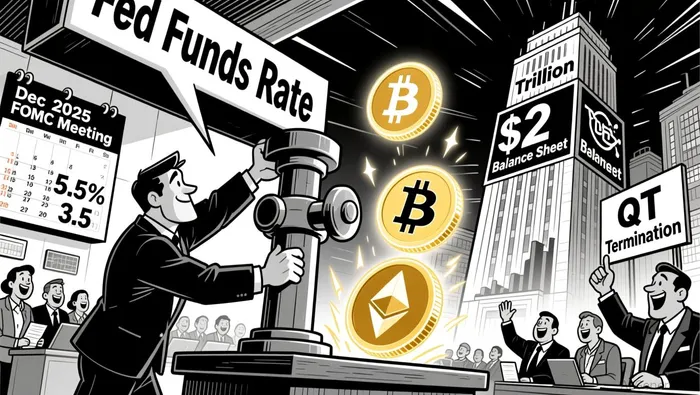
A Waller-led Fed would likely prioritize rate cuts and liquidity expansion. Trump's emphasis on aggressive rate reductions-reflected in his candidate shortlist-suggests a preference for policies that stimulate economic growth. Ending the Fed's Quantitative Tightening (QT) program, which has reduced the central bank's balance sheet by $340 billion since 2025, could inject trillions into financial markets. Such liquidity injections historically benefit risk assets like cryptocurrencies, which thrive in low-interest, high-liquidity environments. According to analysis, the Fed's policies have historically shaped Bitcoin's future.
The December 2025 FOMC meeting, where a rate cut is anticipated, will be a critical test. If Waller's influence leads to a more dovish policy trajectory, crypto markets could see renewed inflows. For instance, BitcoinBTC-- and EthereumETH-- often react positively to rate-cut expectations, as lower borrowing costs reduce the opportunity cost of holding volatile assets. Conversely, stablecoins like TetherUSDT--, which rely on inelastic supply, may face downward pressure in a dovish environment.
Implications for Cryptocurrency Markets: Volatility and Regulatory Clarity
The interplay between Fed policy and crypto markets is complex. Historical data from 2015–2025 shows that Bitcoin ETFs lost $3.79 billion in November 2025 amid shifting rate expectations and regulatory uncertainty. However, a dovish Fed Chair could stabilize these dynamics. For example, the GENIUS Act of 2025, which standardized stablecoin reserves, boosted demand for dollar-backed tokens as inflation hedges. A Waller-led Fed might extend such regulatory clarity to DeFi and institutional-grade crypto products, fostering broader adoption.
Waller's potential nomination also introduces volatility. While prediction markets give him a 15% chance of securing the role, his dovish stance could drive speculative trading in crypto markets. For instance, Bitcoin's price surged 12% in early 2025 following hints of rate-cut optimism. According to market analysis, similar patterns could emerge, particularly in altcoins, which are more sensitive to liquidity changes.
Conclusion: Balancing Policy Uncertainty and Market Opportunities
Christopher Waller's nomination as Fed Chair remains speculative, with Kevin Hassett and Kevin Warsh as stronger contenders. However, his dovish policy preferences and crypto-friendly views make him a wildcard candidate. A Waller-led Fed could accelerate rate cuts, end QT, and foster regulatory frameworks that integrate digital assets into mainstream finance. These shifts would likely benefit cryptocurrencies, particularly Bitcoin and altcoins, by enhancing liquidity and reducing institutional friction.
Investors should remain cautious, though. The Fed's policy decisions are inherently uncertain, and Trump's final choice will hinge on political considerations beyond economic arguments. For now, the December 2025 FOMC meeting and Waller's interview on December 17 will be key inflection points. Those with exposure to crypto markets should monitor these developments closely, as they could redefine the sector's trajectory in 2026.






Comentarios
Aún no hay comentarios