
Trump’s Political Moves and Their Impact on Global Markets: A Contrarian Tactical Positioning in USD, Oil, and Geopolitical Risk Assets
The Contrarian Case for USD: Defying the “Dollar Weakness” Narrative
While many analysts have positioned against the U.S. dollar amid Trump’s trade war escalation and foreign investor outflows, a contrarian view emerges from the interplay of reflationary policies and central bank dynamics. According to a report by J.P. Morgan Global Research, Trump’s reflationary agenda—including tax cuts, tariffs, and reduced immigration—has delayed Federal Reserve rate cuts, which in turn constrains emerging market (EM) central banks from easing monetary policy [2]. This creates a relative advantage for the USD, as EM currencies face downward pressure from capital flight and inflationary shocks.
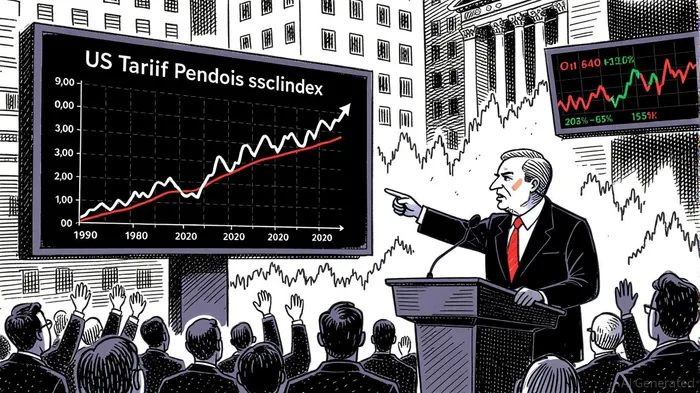
For instance, Brazil and India now face 50% tariffs on their exports to the U.S., exacerbating trade deficits and currency volatility [4]. A tactical long position in the USD against EM currencies (e.g., BRL, INR) could capitalize on this structural imbalance, particularly as Trump’s IEEPA tariffs threaten to push the average effective U.S. tariff rate to 18–20% by year-end [1].
Oil Markets: Navigating the Paradox of “Demand Destruction” and Geopolitical Volatility
The oil market presents a dual-edged sword. On one hand, Trump’s trade policies have reduced Chinese demand for energy, traditionally a key driver of global oil consumption. A study in Energy Economics notes that U.S.-China political tensions have led to a 12% drop in Chinese oil imports, paradoxically pushing prices higher due to reduced supply flexibility and market uncertainty [1]. On the other, geopolitical flare-ups—such as the June 2025 Twelve-Day War between Iran and Israel—have caused oil prices to spike before retreating on de-escalation signals [3].
A contrarian approach here would involve hedging against both scenarios. Short-term volatility could favor energy infrastructure plays (e.g., pipeline operators) insulated from price swings, while long-term investors might overweight oil producers in regions less exposed to Chinese demand, such as the U.S. shale sector. The key is to balance exposure to geopolitical risk with structural supply constraints, as Trump’s tariffs on Russian oil imports further fragment global energy markets [3].
Geopolitical Risk Assets: The “Winners” in a Fractured Trade Order
Geopolitical risk assets—typically underperforming during trade wars—have seen a surge in risk premia due to Trump’s “Liberation Day” policies. However, not all EM economies are equally vulnerable. The U.S.-EU and U.S.-Japan trade deals, which reduced tariffs to 15% on most goods, position these markets as relative safe havens in a fragmented global trade landscape [4]. Conversely, countries like Canada and Mexico, facing delayed but inevitable tariff hikes, remain exposed to capital outflows.
A tactical shift toward EM equities in the EU and Japan—particularly in sectors benefiting from U.S. tariff exemptions (e.g., automotive, technology)—could yield asymmetric returns. For example, Japan’s commitment to a $50 billion U.S. investment package under the new trade deal suggests a strategic realignment that could attract inflows [4]. Meanwhile, EM markets reliant on Chinese supply chains (e.g., Vietnam, Indonesia) may see short-term gains from export rerouting but face long-term fragility as Trump’s 60% tariff on China disrupts global manufacturing [2].
Conclusion: Positioning for a “Trump 2.0” World
Trump’s 2025 trade policies have created a landscape of heightened uncertainty but also asymmetric opportunities. A contrarian tactical portfolio might include:
- Long USD/short EM currencies to exploit reflationary divergence.
- Energy infrastructure and U.S. shale producers to hedge oil price volatility.
- EU and Japanese EM equities to capitalize on trade deal-driven inflows.
These positions require vigilance, as Trump’s IEEPA tariffs and geopolitical escalations could trigger sudden reversals. Yet, for investors willing to navigate the noise, the current environment offers a rare chance to profit from the unintended consequences of a fractured global order.
**Source:[1] US partisan conflict, Sino-US political relation news, and oil ... [https://www.sciencedirect.com/science/article/pii/S0140988325006474][2] What Trump 2.0 could mean for emerging markets [https://www.aberdeeninvestments.com/en-us/investor/insights-and-research/what-trump-2-0-could-mean-for-emerging-markets][3] To end Putin's war on Ukraine, Trump should sanction Russian oil [https://www.atlanticcouncil.org/blogs/new-atlanticist/to-end-putins-war-on-ukraine-trump-should-sanction-russian-oil/][4] Update on global tariffs for major countries [https://tax.thomsonreuters.com/blog/update-on-global-tariffs/]







Comentarios
Aún no hay comentarios