
Trump's Policy Shift and Its Impact on the U.S. Dollar and Global Capital Flows
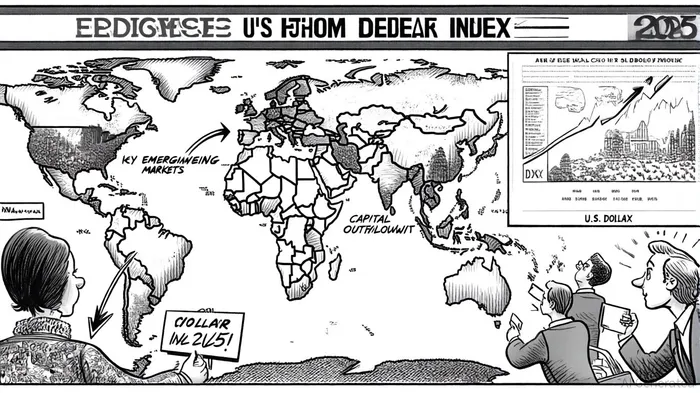
The 2025 re-election of Donald Trump has ignited a seismic shift in global economic dynamics, with his aggressive tariff policies and "America First" agenda reshaping the U.S. dollar's role in international finance and exacerbating risks for emerging markets. According to a report by Econotimes, Trump's 60% tariff on Chinese imports and 25% tariffs on goods from Mexico and Europe have triggered a 3% decline in the U.S. Dollar Index (DXY), signaling a weakening greenback amid fears of retaliatory trade measures and supply chain disruptions [2]. This volatility underscores the fragility of the dollar's status as the world's reserve currency, as policymakers and investors grapple with the implications of Trump's protectionist turn.
The U.S. Dollar: A Double-Edged Sword
While Trump's tariffs aim to bolster domestic manufacturing, they paradoxically risk strengthening the dollar in the short term. A report by Capital Group notes that higher tariffs reduce foreign demand for U.S. goods, shrinking trade deficits and attracting capital inflows to Treasuries, which have seen yields surge to 4.5% in 2025 [4]. However, this strength is a double-edged sword for emerging markets. As the dollar appreciates, countries with U.S. dollar-denominated debt—such as Argentina and Turkey—face heightened repayment burdens. The International Monetary Fund (IMF) warns that these pressures could trigger a "sudden stop" in capital flows to emerging markets, with JPMorganJPM-- forecasting $19 billion in net outflows in Q4 2024 alone [1].
Emerging Markets: A Tale of Two Responses
The impact on emerging markets is uneven. Nations like Vietnam and Malaysia are capitalizing on Trump's "reshoring" agenda, attracting redirected foreign direct investment (FDI) as companies seek alternatives to China [3]. Conversely, South Korea and Mexico—deeply integrated into U.S. supply chains—face existential threats from potential auto and steel tariffs. For example, South Korea's automotive sector, which exports 60% of its production to the U.S., could see a 15% revenue drop if Trump's 25% tariff on Korean vehicles is enacted [3].
Central banks in emerging markets are adopting divergent strategies to mitigate these risks. India's Reserve Bank of India (RBI) has signaled aggressive rate cuts to stimulate growth, despite currency depreciation risks [1]. Meanwhile, Indonesia's central bank has intervened heavily to stabilize the rupiah, which has fallen to levels not seen since the 1998 Asian crisis [1]. The U.S. Federal Reserve, under Chair Jerome Powell, has adopted a cautious stance, delaying rate cuts until the economic impact of tariffs becomes clearer [1].
Hedging Strategies and Institutional Recommendations
To navigate this uncertainty, corporations and investors are extending currency hedging strategies. A Reuters analysis reveals that multinational firms are increasingly using cross-currency swaps and options to protect against volatility in the Canadian dollar (CAD) and Mexican peso (MXN) [5]. For instance, a European healthcare company has expanded its hedging exposure to shield against potential devaluation of the Chinese yuan [5].
Institutional investors are advised to prioritize emerging markets with strong fundamentals and policy flexibility. Wellington Institutional recommends overweighting India and China, where improving credit quality and monetary easing offer resilience against Trump-era turbulence [1]. Defensive sectors like utilities and healthcare are also gaining favor, as they are less exposed to trade disruptions. Conversely, technology and energy sectors face headwinds due to their reliance on global supply chains [5].
The Road Ahead
The Trump administration's policies have created a landscape of both risk and opportunity. While the U.S. dollar's short-term strength may provide a tailwind for Treasuries, the long-term sustainability of the dollar's dominance remains uncertain. Emerging markets, meanwhile, must balance growth stimulation with currency stability, a task complicated by Trump's unpredictable trade agenda. As the IMF and central banks monitor these developments, investors are advised to adopt a diversified, active approach—leveraging value opportunities in resilient markets while hedging against geopolitical volatility.







Comentarios
Aún no hay comentarios