
Trump-Philippines Trade Deal: Navigating Asymmetric Tariffs and Unlocking U.S. Export Opportunities
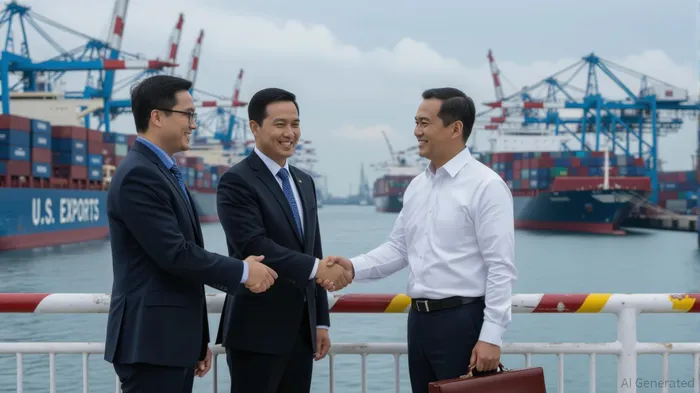
The Trump-Philippines Trade Deal, finalized in July 2025, has reshaped the asymmetric tariff landscape between the two nations, offering a mixed bag of opportunities and challenges for U.S. exporters. With a 19% tariff on Philippine goods entering the U.S. and zero tariffs on U.S. exports to the Philippines, the agreement reflects a calculated balance of economic and geopolitical interests. This article dissects the strategic and financial implications of this arrangement, while offering actionable insights for investors navigating the evolving trade dynamics.
Strategic Context: A Geopolitical Bargain
The deal emerged from a high-stakes negotiation between U.S. President Donald Trump and Philippine President Ferdinand Marcos Jr. during a visit to Washington, D.C. The Philippines, a key U.S. allyALLY-- in Southeast Asia, leveraged its strategic role in the Indo-Pacific—particularly its military access agreements and joint exercises with the U.S.—to secure a more favorable tariff rate than initially threatened (20%). The 19% tariff, while still a significant levy, is lower than the 20% applied to Vietnam and 32% to Indonesia, underscoring the Philippines' unique position in U.S. regional strategy.
The deal also reinforces the U.S. “America First” policy, which prioritizes reciprocal trade terms to reduce long-standing trade deficits. The U.S. and Philippines had a $5 billion trade deficit in 2024, with bilateral trade in goods reaching $23.5 billion. By imposing a 19% tariff on Philippine exports while granting zero-tariff access to U.S. goods, the Trump administration aims to incentivize the Philippines to open its market to American products, particularly in agriculture and manufacturing.
Financial Implications: Winners and Losers in the Asymmetric Framework
The asymmetric tariff structure creates a bifurcated impact on U.S. exporters. On one hand, American companies exporting to the Philippines—such as agricultural producers, automotive manufacturers, and technology firms—now enjoy zero tariffs, making their goods more competitive in the Philippine market. This could drive short-term growth in sectors like dairy, corn, and machinery, where U.S. producers hold cost advantages.
On the other hand, the 19% tariff on Philippine exports—particularly in electronics, textiles, and agriculture—poses risks for U.S. importers and consumers. For instance, the Philippines' electronics industry, which accounts for 53% of its exports to the U.S., faces margin pressures despite partial exemptions under the WTO's Information Technology Agreement (ITA). Similarly, Philippine agricultural products like coconut oil and canned pineapple will see higher costs for U.S. buyers, potentially diverting demand to lower-tariff competitors like Vietnam.
Sector-Specific Analysis: Opportunities and Vulnerabilities
Electronics and Semiconductors
The Philippines is a critical node in the global semiconductor supply chain, with downstream operations (assembly and testing) accounting for 77% of its electronics exports. While the ITA shields high-tech components from tariffs, lower-value segments remain exposed. U.S. companies like IntelINTC-- and Texas InstrumentsTXN-- may benefit from nearshoring production to the Philippines to avoid tariffs, leveraging the country's English-speaking workforce and competitive labor costs.Textiles and Apparel
Philippine textile exports to the U.S. are vulnerable to the 19% tariff, which could erode their competitiveness against Bangladesh and Vietnam. However, the CREATE MORE Act—a Philippine incentive package offering tax holidays and streamlined approvals—could attract U.S. brands seeking to diversify sourcing.Agriculture
U.S. agricultural exports to the Philippines are poised for growth, with zero tariffs making American dairy and corn more attractive. However, Philippine agricultural imports (e.g., coconut oil) may face reduced demand in the U.S., creating a niche for U.S. biofuel companies to explore alternative markets.Logistics and Infrastructure
The U.S. emphasis on transparent supply chains has spurred infrastructure investments in the Philippines, including port expansions and logistics hubs. Regional logistics firms like Cargill and regional port operators could see increased demand for U.S.-bound goods.
Historical Comparisons: Lessons from ASEAN
The Philippines' 19% tariff is the second-lowest in ASEAN after Singapore (10%), but it lags behind Vietnam's 20% rate secured through a bilateral deal. This highlights the Philippines' limited leverage in negotiations compared to countries offering resource-based concessions. For U.S. investors, this asymmetry underscores the importance of diversifying supply chains across Southeast Asia to mitigate risks from unilateral tariff adjustments.
Investment Advice: Capitalizing on the New Normal
Target U.S. Exporters to the Philippines
Companies in agriculture (e.g., Dairy Farmers of America) and technology (e.g., AMD) stand to benefit from zero-tariff access. Investors should monitor their quarterly reports for increased shipments to the Philippines.Hedge Against Tariff Volatility
ETFs focused on Southeast Asia (e.g., EWT - iShares MSCI Philippines ETF) and infrastructure (e.g., IYR - iShares U.S. Real Estate ETF) offer diversified exposure to regional growth opportunities.Support Philippine Market Reforms
The CREATE MORE Act and ongoing trade negotiations with the EU and Canada position the Philippines as a long-term investment destination. U.S. firms with supply chain flexibility should consider expanding operations there.
Conclusion: A Calculated Risk with Long-Term Rewards
The Trump-Philippines Trade Deal represents a strategic recalibration of U.S. trade policy, balancing economic interests with geopolitical alliances. While the 19% tariff on Philippine exports introduces near-term risks, the zero-tariff access for U.S. goods and the Philippines' strategic advantages position it as a resilient partner in the Indo-Pacific. For investors, the key lies in identifying undervalued equities and regional ETFs poised to capitalize on supply chain realignments and infrastructure-driven growth.
As the U.S. continues to negotiate with other ASEAN nations, the Philippines' ability to leverage its military alliance and economic reforms will determine its long-term appeal. For now, the asymmetric tariff structure offers a unique window for U.S. exporters to secure market access while navigating the complexities of a shifting global trade landscape.







Comentarios
Aún no hay comentarios