
The Trump Pardon of CZ: A Watershed Moment for Crypto Regulation and Political Risk Exposure
The Pardon and Its Immediate Impact
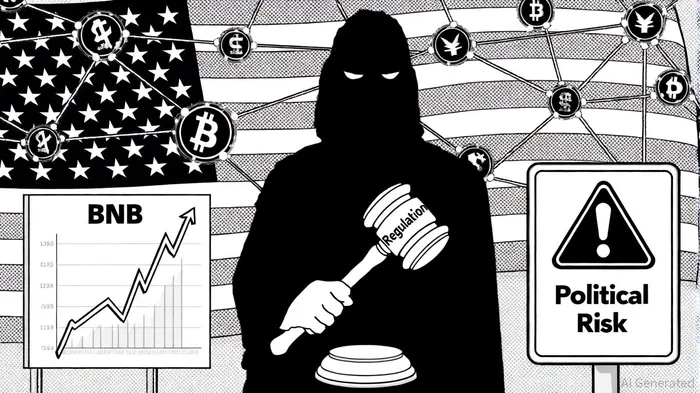
Zhao's pardon came after he served a four-month prison sentence and paid a $4.3 billion settlement for anti-money laundering violations, according to Coinpaprika. Trump's administration defended the move as a correction of "persecution," while critics like Representative Maxine Waters accused the Trump family of leveraging Zhao's financial support for their own crypto ventures, including World Liberty FinancialWLFI-- (WLFI), a DeFi platform that generated over $1 billion in profits. The pardon's immediate market impact was stark: Binance's native token, BNBBNB--, surged 8% in early trading, reflecting renewed investor optimism about a lighter regulatory environment, Coinotag reported.
This event underscores a broader trend: the Trump administration's embrace of crypto as a strategic asset. From the establishment of a national BitcoinBTC-- reserve to the passage of the GENIUS Act-a law mandating 1:1 reserve requirements for stablecoin issuers-the administration has prioritized pro-crypto policies to reinforce U.S. dollar dominance and attract institutional capital, as noted by Forbes. However, the political controversy surrounding Zhao's pardon highlights a critical risk: the potential for regulatory decisions to be perceived as politically motivated, eroding trust in the system's impartiality.
Regulatory Shifts and the Rise of Stablecoins
The GENIUS Act, enacted in July 2025, represents a pivotal regulatory development. By requiring stablecoin issuers to hold low-risk assets like U.S. Treasuries and insured deposits, the law has created a framework that balances innovation with stability, according to the World Economic Forum. This clarity has spurred institutional adoption, with Visa, PayPal, and others integrating stablecoins into cross-border payment systems, as covered by Forbes. The Trump administration's focus on stablecoins aligns with a global strategy to leverage digital assets for geopolitical influence, as seen in WLFI's USD1USD1-- stablecoin, which raised $550 million through token sales (Forbes coverage cited above).
Yet, the regulatory landscape remains fragmented. While the U.S. and EU have advanced stablecoin frameworks (e.g., MiCA in Europe), Asia's approach varies, with Singapore and Hong Kong adopting pilot regimes while Japan restricts non-bank issuers (Forbes coverage cited above). For investors, this patchwork of regulations introduces operational complexity and liquidity risks, particularly for DeFi protocols that rely on cross-border interoperability.
Political Risk and Investor Sentiment
The CZ pardon has amplified concerns about political risk in crypto. Critics argue that Trump's decision rewards a figure who pleaded guilty to enabling money laundering and suspicious transactions involving criminal actors (Representative Maxine Waters raised these concerns, cited above). This perception of "pay-to-play" corruption could deter risk-averse investors, particularly as Democrats stall stablecoin legislation like the GENIUS Act in Congress, as reported by The Block. Meanwhile, pro-crypto voices like CoinbaseCOIN-- CEO Brian Armstrong have praised the administration for "breathing life back into the industry," reflecting the polarized views on regulatory direction (The Block coverage cited above).
The Trump family's deep ties to crypto ventures further complicate the narrative. WLFI's $1 billion in pre-tax profits and the Trumps' involvement in memecoins and DeFi tokens illustrate how political actors are now directly monetizing the sector, according to CryptoFront News. For investors, this blurring of lines between regulation and personal gain raises questions about long-term stability.
Opportunities in DeFi and Stablecoins
Despite the controversies, the Trump-era regulatory environment has unlocked significant opportunities. The a16z 2025 State of Crypto report notes that the sector's market cap surpassed $4 trillion, driven by stablecoin transaction volumes of $46 trillion annually and institutional adoption of Bitcoin and EthereumETH-- ETFs. Innovations like M^0's mUSD stablecoin and real-world asset (RWA) integrations are expanding DeFi's utility, while blockchain scalability improvements (e.g., 3,400 transactions per second) are making it viable for mainstream applications (a16z report cited above).
However, security remains a critical challenge. The collapse of Bunni DEX in 2025, which lost $8.4 million to a smart contract exploit, underscores the fragility of DeFi infrastructure. Investors must weigh these risks against the potential for high returns, particularly in projects aligned with regulatory tailwinds.
Conclusion: Navigating the New Normal
The CZ pardon and Trump-era policies mark a turning point for crypto. While the regulatory clarity and institutional adoption are undeniably positive, the political controversies and security vulnerabilities cannot be ignored. Investors must adopt a nuanced approach:
- Opportunities: Stablecoins and DeFi protocols benefiting from the GENIUS Act and global regulatory alignment.
- Risks: Political favoritism, reputational damage from high-profile scandals, and DeFi's inherent security flaws.
As the sector evolves, the key will be balancing innovation with accountability. For now, the Trump administration's pro-crypto stance has created a fertile ground for growth-but one where political risk remains a volatile undercurrent.





Comentarios
Aún no hay comentarios