
The Trump-Media-TAE Fusion Merger: A High-Stakes Bet on AI-Powered Energy and Political Influence
The $6 billion all-stock merger between Trump MediaDJT-- & Technology Group (TMTG) and TAE Technologies represents a bold, high-risk, high-reward pivot from a social media-centric enterprise to a fusion energy behemoth. This transaction, announced in December 2025, aims to create one of the first publicly traded fusion power companies, positioning the U.S. at the forefront of a global race to commercialize clean energy for AI-driven industries. For investors, the deal raises critical questions about strategic alignment, financial viability, and geopolitical risks in a rapidly evolving energy and technology landscape.
Strategic Implications: Fusion as the Fuel for AI's Energy Appetite
The merger is framed as a response to the surging demand for energy from AI data centers, which are projected to consume 2,200 terawatt-hours annually by 2030. TAE Technologies, a pioneer in Field-Reversed Configuration (FRC) fusion, has demonstrated breakthroughs such as its "Norm" machine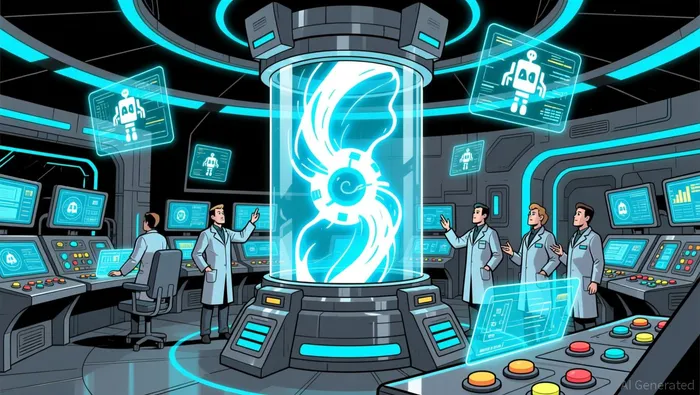 , which achieved stable plasma at 70 million °C using neutral beam injection, bypassing complex startup systems. This technology, combined with AI-driven optimization from Google, positions TAE as a leader in scalable fusion solutions.
However, the competitive landscape is fierce. Companies like Commonwealth Fusion Systems (CFS) and Helion Energy, backed by $2 billion and $1.03 billion respectively, are advancing tokamak and magnetized target fusion designs with aggressive commercialization timelines. TAE's hydrogen-boron fuel approach, while theoretically safer and waste-free, faces technical hurdles in achieving net energy gain at scale. The merger's success hinges on TAE's ability to outpace rivals and deliver its first 50 MWe plant by 2026, a timeline that remains untested in the fusion sector.
Financial Realities: A Cash-Infused Gamble
TMTG's financials paint a mixed picture. While the company reported $3.1 billion in pro forma financial assets and a robust cash ratio of 4.31 as of Q3 2025, it also posted a $54.8 million net loss in the same period, largely due to derivative liabilities. The merger structure includes $200 million in upfront cash and an additional $100 million contingent on SEC filings, providing TAE with critical liquidity but exposing TMTG to regulatory delays.
For investors, the key risk lies in TMTG's limited revenue base-$2.68 million in nine-month revenue for 2025-and its reliance on TAE's unproven commercialization roadmap. TAE's $1.3 billion in private capital, including backing from Chevron and Goldman Sachs, suggests confidence in its technology, but fusion projects are notoriously capital-intensive. The combined entity's ability to secure further funding or navigate cost overruns will be pivotal.
Geopolitical Chess: U.S. vs. China in the Fusion and AI Race
The merger aligns with broader U.S. geopolitical strategies to counter China's dominance in clean energy and AI. Beijing has allocated $2.1 billion to state-owned fusion entities, like China Fusion Energy Co., prioritizing commercialization timelines that could outpace U.S. efforts. Meanwhile, the TrumpDJT-- administration's deregulatory approach-exemplified by its 90-point "AI Action Plan"-seeks to accelerate innovation but risks undermining safety standards and long-term oversight.
China's state-led model, with its ability to rapidly scale infrastructure and supply chains, poses a significant challenge. U.S. fusion firms, including TAE, have called for federal subsidies to match China's investment levels, but the Trump administration's cuts to science funding may leave American companies at a disadvantage. For the TMTG-TAE merger to succeed, it will need to navigate not only technical and financial risks but also the shifting sands of global policy.
Conclusion: A High-Stakes Play for a Post-Carbon Future
The Trump-Media-TAE merger is a visionary bet on fusion's potential to power the AI revolution, but its success depends on navigating a thorny landscape of technical, financial, and geopolitical challenges. While TAE's breakthroughs and TMTG's financial firepower offer a compelling narrative, investors must weigh the risks of regulatory delays, intense competition, and China's aggressive fusion ambitions. For those willing to tolerate volatility, the deal could redefine energy markets-but only if it delivers on its audacious promises.





Comentarios
Aún no hay comentarios