
Trump Media's Fusion Merger: A High-Stakes Bet on AI-Driven Energy Dominance
The $6 billion all-stock merger between Trump MediaDJT-- & Technology Group (TMTG) and TAE Technologies has ignited a firestorm of speculation in the markets. This bold pivot from a struggling social media platform to a fusion energy venture is as audacious as it is polarizing. For investors, the question is whether this deal represents a visionary leap into the energy-AI convergence or a reckless gamble on unproven technology. Let's dissect the strategic and financial implications.
Strategic Rationale: Fusion as the Fuel for AI Supremacy
The merger's stated goal is to position the combined entity as a leader in the race to power AI infrastructure with clean, limitless energy. TAE Technologies, a pioneer in hydrogen-boron fusion, has made strides in simplifying reactor designs and leveraging AI for plasma control according to research. Its "Norm" device achieved stable plasma at 70 million °C using neutral beam injection, a breakthrough that reduces costs and complexity according to data. Meanwhile, TMTG's CEO Devin Nunes has framed fusion as critical to securing U.S. dominance in AI, given the sector's projected 30-fold surge in energy demand by 2035.
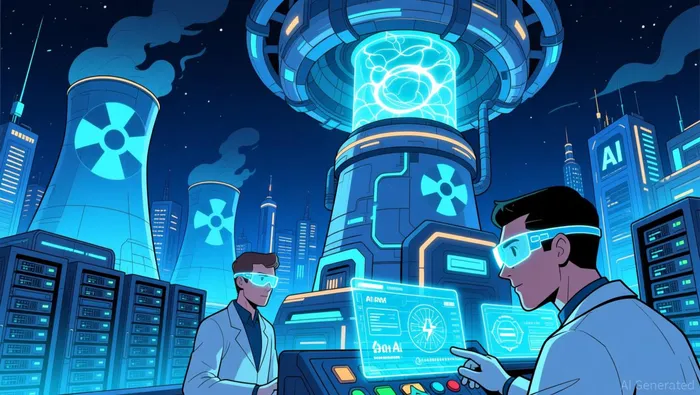 The strategic alignment is clear: TAE's fusion technology could theoretically provide the baseload power needed for AI data centers, while TMTG gains access to public markets and a high-growth narrative. TAE's roadmap includes a 50 MWe utility-scale plant by 2026 and Power Purchase Agreements with AI hyperscalers like Microsoft and Google. However, as The Verge notes, the merger imposes no binding obligation to build the plant. This ambiguity raises questions about whether the deal is more about hype than execution.
Financial Metrics: A Tale of Two Companies
TMTG's Q3 2025 financials paint a dire picture: a $54.8 million loss on $972,900 in revenue, $434 million in long-term debt, and $166 million in cash reserves. The stock's 37% post-announcement surge reflects speculative fervor but masks underlying fragility. TAE, meanwhile, has raised $1.3 billion from heavyweights like Google and Chevron according to reports, yet its path to commercialization remains unproven. The merger's $200 million cash infusion from TMTG at closing, plus an additional $100 million post-filing according to filings, could accelerate development but also strains TMTG's liquidity.
The all-stock structure-50% ownership for each shareholder-risks diluting value if TAE's technology fails to deliver. As The New York Times highlights, political entanglements (e.g., Trump's 41% stake in TMTG) could further complicate regulatory and funding dynamics according to analysis.
Technological Viability: Progress vs. Promises
TAE's hydrogen-boron approach and Field-Reversed Configuration (FRC) technology are touted as game-changers, offering minimal radioactive waste and compact designs. Recent Nature Communications papers validate progress in plasma optimization, but commercial fusion remains decades away for most experts. The company's 2031 "first power" timeline is aggressive, and even if achieved, scaling to 500 MW plants will require unprecedented capital and regulatory buy-in.
For AI applications, the timing is critical. Data centers already consume 2% of U.S. electricity according to estimates, and hyperscalers are exploring alternatives like geothermal and hydrogen. Fusion's promise of 24/7 clean energy is compelling, but TAE's focus on aneutronic fuels (which produce no neutrons) may not address the immediate needs of AI firms, which prioritize cost and scalability over theoretical purity.
Expert Skepticism and Regulatory Risks
Energy analysts caution that fusion's technical hurdles-achieving net energy gain (Q>1), materials resilience, and grid integration-remain unresolved according to experts. The Department of Energy's $500 million grant to TAE in 2024 is a vote of confidence, but public funding alone won't offset the $10–$50 billion needed for commercialization according to analysis.
Political risks loom large. Trump's influence over TMTG raises concerns about conflicts of interest, particularly with federal grants according to reports. If the merger falters, it could deter private investment in fusion and trigger regulatory scrutiny.
Verdict: Speculative All-In or Strategic Masterstroke?
This merger is a high-stakes bet. For TAE, it's a lifeline to scale fusion and capture the AI energy market. For TMTG, it's a desperate rebrand from a media liability to a "clean energy" darling. The stock's volatility will likely hinge on milestones like plant approvals and PPA signings according to analysts, but the path is fraught with uncertainty.
Investors must weigh the allure of being part of the AI-energy revolution against the reality of unproven tech and TMTG's financial fragility. If TAE delivers a working reactor by 2030, this could be a transformative play. If not, it's a cautionary tale of hype over substance. For now, the market is pricing in optimism-but history shows that fusion's promises are easier to sell than to achieve.





Comentarios
Aún no hay comentarios