
Trump's Iran Tariff Threat: A Geopolitical Weapon and Its Market Ramifications
President Trump has deployed a new trade weapon, announcing via Truth Social that any country "doing business with Iran" will face a 25% tariff on all trade with the United States. The announcement, effective immediately, was framed as a final order, yet the administration provided little clarity on its core mechanics. The president did not define what qualifies as "doing business" with Iran, leaving critical questions unanswered about which nations would be targeted, whether services would be included, and how enforcement would work. This lack of detail creates a significant legal and operational fog.
The move coincides with a severe geopolitical crisis. Iran is grappling with weeks of mass unrest sparked by economic hardship, which has evolved into a major challenge to the regime. Authorities have responded with brutal force, killing more than 480 demonstrators and arresting over 10,000 people. Trump's tariff threat appears designed to amplify pressure on Tehran during this moment of internal vulnerability, signaling a structural shift toward using trade policy as a direct instrument of geopolitical coercion.
For now, the immediate market impact is likely muted by the uncertainty. Without a clear definition or implementation plan, the policy remains a high-stakes signal rather than an executable directive. Yet the potential economic fallout is substantial. The tariff could mean a minimum 45% tariff rate on goods from China, a major trading partner of both Iran and the U.S., risking a fresh trade war. The policy sets a dangerous precedent: it equips a president with a unilateral tool to impose economic penalties on allies based on undefined commercial ties, introducing a new and unpredictable variable into global trade.
Legal Challenges and Precedents
The administration's likely legal anchor is the International Emergency Economic Powers Act (IEEPA), a tool it has already stretched in 2025 to justify sweeping tariffs. That precedent is critical. By invoking IEEPA to impose broad tariffs on imports from allies like China and Mexico, the administration has already tested the statute's boundaries, framing trade imbalances and foreign threats as national emergencies. This sets a clear, if controversial, path for the Iran tariff. The core argument would be that Iran's activities constitute a foreign threat, and any nation engaging in commerce with Tehran contributes to that threat, thereby justifying economic measures under IEEPA.
Yet the new tariff's scope introduces unprecedented legal vulnerabilities. The phrase "any and all business being done with the United States of America" is the central point of contention. This language, absent a clear definition, could theoretically extend to services, investment flows, and financial transactions, not just physical goods. That expansive interpretation raises serious constitutional questions about the limits of executive power and the potential for overreach. Courts have historically viewed tariffs as a legislative function, and using an emergency powers act to impose broad, indiscriminate duties on a wide range of economic activities is a novel and untested application.
The timeline for legal action is uncertain, but a challenge could emerge swiftly. If a trade association or a major company affected by the tariff files suit, a court ruling could come within months. The legal battle will hinge on two key points: first, whether the administration's definition of a "national emergency" sufficiently connects Iran's situation to U.S. trade with third countries; and second, whether the tariff's scope violates the non-delegation doctrine or other constitutional constraints by granting unchecked authority. The precedent from 2025 provides a framework, but the Iran tariff's broader reach makes its legal foundation more precarious. For now, the policy's untested legal footing adds another layer of uncertainty to an already volatile geopolitical and market landscape.
Geopolitical Context and Strategic Intent
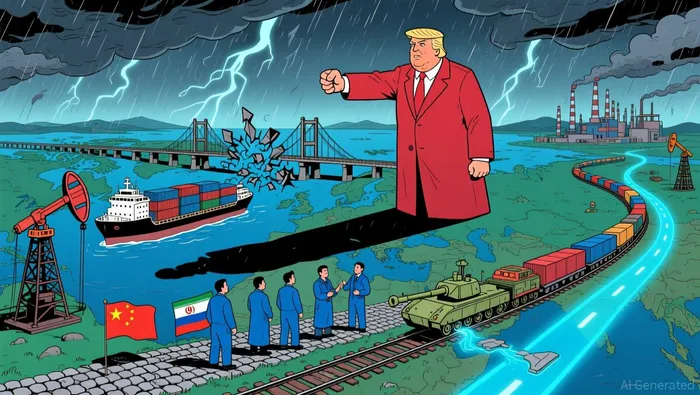
This tariff is not an isolated act but a deliberate expansion of the U.S. "maximum pressure" campaign against Iran, now weaponizing trade policy as a central foreign policy lever. The administration has long targeted Iran's shadow fleet and facilitators moving Iranian oil, but the new 25% tariff on any nation doing business with Tehran represents a qualitative shift. It aims to isolate Iran economically by threatening its trading partners, a strategy that aligns with President Trump's stated view that "Tariff is the most beautiful word in the dictionary." This policy frames trade as a primary instrument of geopolitical coercion, a core tenet of the administration's aggressive approach that combines sanctions, tariffs, and the increasing use of military force.
The strategic intent is clear: to amplify pressure on Tehran during its current moment of internal crisis. Yet the policy's effectiveness is being tested against a new geopolitical reality. Iran is actively seeking to reduce its vulnerability to U.S. pressure by deepening ties with China and Russia. A key signal of this pivot was the recent first-ever Shanghai Cooperation Organization (SCO) military exercise hosted by Iran, a major milestone in its integration into the China-Russia-led bloc. This multilateral partnership offers Tehran an alternative diplomatic and economic platform, potentially providing a shield against unilateral U.S. economic actions. The exercise demonstrated that Beijing and Moscow now see value in upgrading ties with Tehran, a decisive shift from past caution.
This creates a fundamental tension. The tariff is designed to fracture alliances and punish cooperation with Iran, but it may instead accelerate the very geopolitical realignment it seeks to counter. As Iran strengthens its position within a rival power bloc, the U.S. faces a more complex challenge. The policy's success now hinges less on its legal or economic mechanics and more on its ability to deter allies from engaging with Iran despite the strategic benefits of doing so. The coming months will test whether the threat of a 25% tariff can override the geopolitical incentives driving nations toward the SCO, or if this move simply confirms the U.S. is losing its grip on the global alignment of powers.
Financial and Trade Flow Implications
The financial shock from this tariff threat is not theoretical; it is already priced into the market's expectation of a new trade war. The immediate target is clear: nations with significant commercial ties to Iran. Major partners like China, India, the United Arab Emirates, and Turkey are the most exposed. For China, the impact is particularly severe. The new 25% tariff on its goods would be layered atop the existing 20% rate, creating a minimum effective rate of 45%. This is a stark escalation that risks unraveling the fragile trade truce negotiated last year.
The precedent for such a move is established. The administration has already used the International Emergency Economic Powers Act (IEEPA) to justify sweeping tariffs on allies, including a 10% baseline duty on all imports. This sets a dangerous template. If the legal foundation holds, the administration could apply the same broad authority to justify these new levies, treating Iran-related trade as a national emergency. The precedent is not just legal; it is economic. A trade war between the U.S. and China last year rocked global markets, and a fresh conflict would likely trigger similar volatility.
The primary channel of impact will be goods trade, but the tariff's definition leaves the door open for much broader economic damage. The phrase "on any and all business being done with the United States of America" is the critical vulnerability. While the initial focus is on imports, the language is expansive enough to encompass services, financial transactions, and investment flows. This creates a chilling effect far beyond customs gates. A company doing business with an Iranian partner could face tariffs not just on its physical exports, but potentially on its entire U.S. revenue stream. This transforms the tariff from a border measure into a tool for economic coercion that could disrupt global supply chains and financial flows.
The scale of the potential shock is immense. It introduces a new, unpredictable variable into every international contract and investment decision. For now, the uncertainty itself is a market force, adding to the volatility of an already tense geopolitical landscape. The policy sets a precedent that could be weaponized against any nation deemed to have insufficiently aligned with U.S. foreign policy objectives. In practice, this means the cost of doing business with the U.S. market becomes contingent on a nation's stance toward a third country, a fundamental shift in the rules of global commerce.
Catalysts, Scenarios, and Key Risks
The trajectory of this tariff threat now hinges on a single, critical catalyst: the issuance of formal implementing regulations. The president's "effective immediately" declaration is a political signal, but without the detailed paperwork outlining scope, exemptions, and enforcement mechanisms, the policy remains a high-stakes gamble. The market will watch for this regulatory filing as the definitive moment when the threat transitions from rhetoric to a tangible, executable directive. Until then, the uncertainty itself is the primary market force.
The immediate risk is retaliatory escalation. The administration has already demonstrated its willingness to use tariffs as a blunt instrument, imposing levies as high as 50% on Indian goods tied to their purchase of Russian oil. Targeting major partners like China, India, and Turkey for their Iran-related trade could provoke swift and severe countermeasures. For China, an additional 25% tariff on top of existing duties would directly threaten the trade truce negotiated with President Xi Jinping. Retaliation from these nations could spark a broader, multi-front trade conflict, amplifying the market volatility seen in 2025.
The long-term scenario depends on a geopolitical pivot. The policy aims to isolate Iran, but it may instead accelerate the very alignment it seeks to disrupt. Iran's recent hosting of the first-ever SCO military exercise is a clear signal of its integration into a China-Russia-led bloc. This multilateral partnership offers Tehran an alternative platform and potential shield against unilateral U.S. economic actions. If the tariff succeeds in fracturing alliances, it could backfire by solidifying Iran's position within this rival power structure, making the U.S. campaign less effective and more costly.
For investors, the forward view is one of heightened structural risk. The policy sets a dangerous precedent, using trade as a weapon to penalize allies for their commercial ties to third countries. This introduces a new, unpredictable variable into global commerce, where the cost of doing business with the U.S. market becomes contingent on a nation's foreign policy stance. The bottom line is that the market's patience for such a weaponized trade policy is finite. The catalyst is the regulation, the risk is retaliation, and the ultimate outcome will be determined by whether this move isolates Iran or, conversely, cements its place in a non-Western world order.







Comentarios
Aún no hay comentarios