
Trump's Hemispheric Shift and Its Geopolitical Impact on Emerging Market Assets
The geopolitical landscape of Latin America in 2025 is being reshaped by a dual force: the Trump administration's assertive "Monroe Doctrine 2.0" and the expanding economic and strategic influence of China and Russia. For U.S.-allied Latin American economies, this dynamic creates a complex interplay of risks and opportunities, particularly for emerging market assets such as equities, commodities, and debt. Investors must navigate a terrain where trade coercion, legal uncertainties, and shifting alliances redefine the region's economic trajectory.
Trump's Hemispheric Strategy: Coercion and Conditional Trade
President Trump's 2025 policies have prioritized reasserting U.S. dominance in the Western Hemisphere through a blend of economic coercion and selective trade agreements. The administration has imposed tariffs on key Latin American exports-such as Brazil's agricultural goods and Mexico's lithium-to pressure compliance with U.S. demands on issues like migration and judicial independence. These measures are part of a broader strategy to counter China's growing influence, exemplified by a 2026 military strike in Venezuela aimed at curbing drug cartels and signaling U.S. resolve.
However, the legal foundation of these policies is precarious. The administration's use of the International Emergency Economic Powers Act (IEEPA) to justify conditional trade agreements with countries like Argentina and Guatemala has drawn scrutiny from the U.S. Supreme Court. If invalidated, these agreements could destabilize Latin American economies reliant on preferential U.S. market access. For instance, Argentina's agricultural sector, which benefits from reduced tariffs on soybean exports, faces uncertainty if the legal challenges succeed.
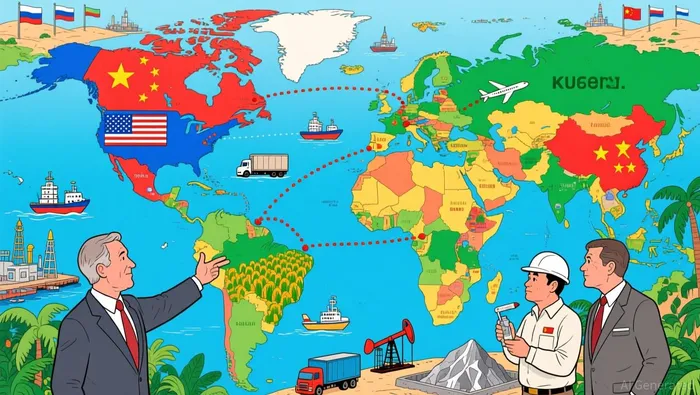
China's Strategic Deepening: Trade, Debt, and Geopolitical Leverage
China's economic footprint in Latin America has expanded dramatically, with the region becoming its largest trading partner in South America. By 2025, bilateral trade reached $518 billion, driven by U.S. tariffs that pushed Latin American countries to deepen ties with Beijing. China's $9 billion credit line for Latin American and Caribbean nations in May 2025 underscores its ambition to secure strategic resources and infrastructure projects.
In Brazil, Chinese investments in ports (e.g., COFCO's $285 million stake in the Port of Santos) and lithium mining (e.g., Ganfeng Lithium's $980 million investment in Argentina) highlight Beijing's focus on critical minerals. These projects not only enhance China's access to raw materials but also create dependencies that could influence regional policy. For example, Peru's Chancay Port, financed by COSCO Shipping, is expected to become the region's third-largest port, further entrenching Chinese economic power.
Yet, concerns persist about debt sustainability and local industry displacement. Countries like Venezuela and Argentina have accumulated significant liabilities to Chinese creditors, raising questions about long-term economic stability. Meanwhile, Chinese exports-often cheaper and more efficient- risk crowding out domestic producers in sectors like manufacturing and agriculture.
Russia's Niche Influence: Geopolitical Alliances and Energy Partnerships
Russia's role in Latin America remains niche but strategically significant. While its trade volume with the region is modest (averaging $1.8 billion monthly in 2022–2023), Moscow has deepened political and military ties with Venezuela, Cuba, and Nicaragua. In 2025, Russia and Venezuela established a direct maritime corridor to bypass U.S. sanctions, while Nicaragua deployed Russian troops and cyber intelligence systems to bolster its regime.
Energy and agro-industrial investments are central to Russia's strategy. In Mexico, Russian firms are involved in offshore oil exploration and lithium extraction, while Brazil's wheat imports from Russia highlight agricultural interdependence. However, these partnerships are constrained by logistical challenges and the U.S. capture of Venezuelan leader Nicolás Maduro in early 2026, which disrupted Moscow's regional influence.
For emerging market assets, Russian initiatives introduce compliance risks, particularly for U.S.-allied countries like Brazil and Mexico, which serve as transshipment hubs for restricted goods destined for Russia. These dynamics could indirectly affect equity and commodity markets by altering trade flows and increasing regulatory scrutiny.
Risks and Opportunities for Emerging Market Assets
The interplay of Trump's policies, Chinese investments, and Russian strategies creates a volatile environment for Latin American assets:
- Equities: U.S.-allied economies like Brazil and Mexico face short-term headwinds from Trump's tariffs, which could reduce GDP growth by 0.8–1.2% in Brazil. However, Chinese investments in infrastructure and technology offer long-term upside, particularly in sectors like renewable energy and digital platforms.
- Commodities: Latin American exports of lithium, copper, and soybeans remain critical to global supply chains. China's demand for these resources supports commodity prices, but U.S. tariffs and geopolitical tensions could disrupt trade flows.
- Debt: Emerging market debt valuations are attractive relative to U.S. credit, with high-yield sovereigns offering strong returns. However, debt sustainability concerns-particularly in China-dependent economies-pose risks if global liquidity tightens.
Conclusion: Navigating a Multipolar Latin America
The 2025 Latin American landscape is defined by a multipolar contest between U.S. coercion, Chinese economic integration, and Russian geopolitical maneuvering. For investors, the key lies in balancing short-term volatility with long-term opportunities. U.S.-allied economies must diversify trade partners and strengthen regional integration to mitigate risks from Trump's policies. Meanwhile, China's infrastructure-driven investments and Russia's niche partnerships will continue to shape the region's economic and political contours.
As the U.S. Supreme Court deliberates on the legality of IEEPA-based trade agreements and global supply chains shift under geopolitical pressures, the resilience of Latin American markets will depend on their ability to adapt to this evolving order.







Comentarios
Aún no hay comentarios