
Trump's Greenland takeover would require 'billions upon billions' spent over decades to acquire a mineral industry that doesn't yet exist, experts say
U.S. President Donald Trump’s renewed interest in acquiring Greenland has drawn global attention and raised concerns among NATO allies. Trump’s ambitions align with a long-standing American interest in the Arctic island, which began as early as 1867. Despite several formal offers, including a $100 million bid in 1946, previous administrations failed to secure Greenland.
The latest Trump proposal has prompted Denmark and other European nations to consider a coordinated response. France, in particular, is collaborating with Germany and Poland to develop a unified strategy should the U.S. attempt to take control of the island. French Foreign Minister Jean-Noel Barrot confirmed that the U.S. has ruled out a military invasion.
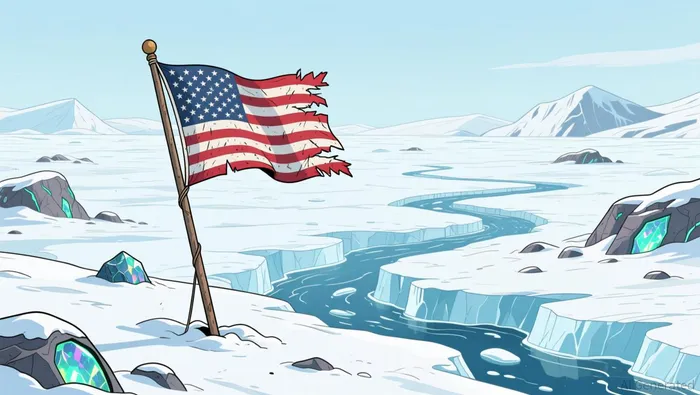
The Trump administration has positioned Greenland as a national security priority, emphasizing its strategic value in missile defense and access to rare earth minerals. The White House has not ruled out using the U.S. military to achieve its goals, a move that could destabilize the NATO alliance.
Why Did This Happen?
Trump’s renewed focus on Greenland stems from its resource potential and strategic location. Greenland possesses 39 of the 50 minerals the U.S. has classified as critical to national security. These include rare earth elements essential for defense systems, electric vehicles, and renewable energy technologies.
The U.S. military has maintained a presence in Greenland since World War II, with bases such as Pituffik playing a key role in missile defense and satellite communications. The island’s location between Europe and North America gives it a unique strategic position .
How Did Markets React?
The renewed focus on Greenland has already driven stock prices upward. Shares of Critical Metals CorpCRML-- (NASDAQ:CRML), which is developing a rare earths project in Greenland, surged 25.7% in a single day. The company is building a rare earth supply chain centered around the West and is reportedly open to U.S. investment.
Other rare earth producers, such as USA Rare Earth IncUSAR-- (USAR) and Gadolyn, have also seen increased investor interest. The industry is under pressure to develop processing capabilities outside China, which currently controls 90% of global rare-earth refining.
What Are Analysts Watching Next?
Experts remain skeptical about the feasibility of a U.S. acquisition. Greenland’s mineral industry does not yet exist, and establishing one would require billions of dollars over decades. Additionally, environmental and political risks could deter investment.
Greenland’s local population has also expressed strong opposition to becoming part of the U.S. A recent poll showed that 84% of Greenlanders want independence from Denmark but do not want to become American.
NATO leaders are closely monitoring the situation. The alliance is built on the principle of mutual defense, but a U.S. military operation against a NATO ally would challenge its unity. Danish Prime Minister Mette Frederiksen has warned that such a move could mark the end of NATO.
China has also increased its interest in Greenland, with Beijing seeking to expand its influence in the Arctic. The country has blocked exports of rare earth magnet technology and is investing in Greenland’s infrastructure.
European countries, including France and the UK, are reinforcing their support for Greenland’s autonomy. The EU signed a strategic minerals partnership with Greenland in 2023, and the UK announced trade negotiations in 2025.
The Trump administration’s actions have sparked concerns about the U.S. commitment to NATO. Trump has criticized European allies for not spending enough on defense and has questioned the alliance’s value. He has also taken a hard stance on China and Russia, framing the Greenland issue as part of a broader geopolitical strategy.
The outcome of this situation will depend on diplomatic negotiations, economic feasibility, and the political will of both the U.S. and Greenland. Any military action would face strong international opposition and could have far-reaching consequences for global stability.





Comentarios
Aún no hay comentarios