
Trump's Genesis Mission: AI's Promise vs. Power's Price
President Donald Trump signed an executive order Monday establishing the "Genesis Mission," a federal initiative to accelerate scientific innovation through artificial intelligence, marking a pivotal step in the administration's broader strategy to solidify U.S. leadership in AI development according to reports. The program, dubbed the "largest marshalling of federal scientific resources since the Apollo program," aims to harness the computing power of the Department of Energy's national labs and federal datasets to shorten discovery timelines in fields like medicine, energy, and materials science as research shows. Michael Kratsios, director of the White House Office of Science and Technology Policy, emphasized the mission's potential to "automate experiment design, accelerate simulation, and generate predictive models," enabling breakthroughs that were previously "unreachable" according to White House officials.
The initiative will leverage partnerships with private-sector leaders including Nvidia Corp.NVDA--, Advanced Micro DevicesAMD-- Inc., Dell Technologies Inc.DELL--, and Hewlett PackardHPE-- Enterprise to expand supercomputing capabilities at national labs as recent data shows. These collaborations align with recent industry trends, as 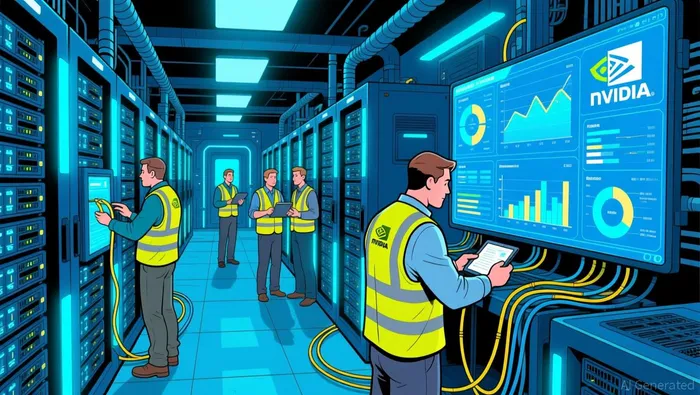 Nvidia's recent $57 billion third-quarter revenue driven by demand from hyperscalers like Microsoft and Alphabet-highlighted the surging need for AI infrastructure. However, the stock's subsequent 3.15% decline underscored market skepticism about valuations in the AI sector. Despite these concerns, the Genesis Mission positions AI as a cornerstone of economic and scientific competitiveness, with Energy Secretary Chris Wright asserting the initiative will "reverse price rises" in energy by improving grid efficiency according to officials.
The executive order reflects Trump's aggressive push to outpace global rivals, particularly China, in AI innovation. The administration has simultaneously moved to dismantle state-level regulations, advocating for a unified federal framework to streamline AI development as industry analysis shows. This strategy contrasts with recent legal challenges faced by AI startups like C3.ai Inc., which has seen its shares drop 27.4% year-to-date amid competitive pressures and execution challenges according to financial reports. Meanwhile, the Genesis Mission's focus on public-private partnerships mirrors Nvidia's own $500 billion backlog of orders for its Blackwell and Rubin GPUs, which CEO Jensen Huang called a "virtuous cycle" of sustained AI spending as reported.
Critics, however, have raised concerns about the energy demands of AI's growth. The initiative's reliance on data centers-known for their high power consumption-has sparked debates about grid strain, even as officials argue AI-driven efficiency gains could mitigate these risks according to experts. The administration's broader vision frames AI not just as a technological frontier but as a tool to address domestic challenges, from healthcare advancements to inflationary pressures as government documents state.







Comentarios
Aún no hay comentarios