
Trump's Foreign Aid Reallocation: Strategic Shifts and Investment Implications for Commodities and Defense Stocks
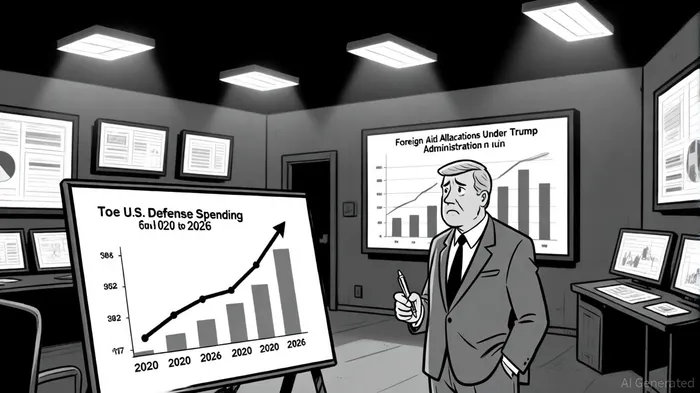
The Trump administration's 2025–2026 budget proposals mark a seismic shift in U.S. foreign aid and defense priorities, with profound implications for global commodities and defense sector equities. By reallocating $1.8 billion in foreign aid toward strategic mineral supply chains, infrastructure, and Indo-Pacific alliances, the administration is redefining foreign policy through a lens of economic and national security pragmatism [1]. This reallocation, coupled with a proposed $1 trillion defense budget for FY 2026, underscores a dual focus on militarization and resource control, creating both risks and opportunities for investors.
Defense Sector Stocks: A Boon for Innovation-Driven Contractors
The Trump administration's emphasis on “next-generation capabilities” has directly fueled gains in defense sector equities. The One, Big Beautiful Bill Act, which allocates $150 billion for shipbuilding, missile defense (e.g., the Golden Dome project), and AI-driven systems, has catalyzed a 57.8% surge in defense stocks since September 2024 [2]. Major contractors like Lockheed MartinLMT-- and Northrop GrummanNOC--, which dominate 53% of FY 2024 defense contracts, have seen valuation growth driven by contracts for hypersonic weapons and autonomous systems [3]. However, the administration's “wartime mindset” in procurement—prioritizing speed over cost—has also elevated smaller firms specializing in cybersecurity and directed energy, such as DroneShield and Austal, which are now outperforming traditional giants [4].
Historically, defense spending spikes under Republican administrations correlate with robust stock performance. For instance, post-9/11 defense budgets drove a 200% increase in Lockheed Martin's valuation between 2001 and 2008 [5]. The current fiscal environment, with its focus on rapid modernization and reduced bureaucratic hurdles, suggests a similar trajectory for firms aligned with Trump's priorities.
Critical Minerals and Commodity Volatility: A Geopolitical Chessboard
The administration's push to secure critical mineral supply chains has introduced volatility into global commodity markets. Executive Order 14265 and the 2025 Critical Minerals Action Plan aim to reduce U.S. reliance on China for rare earth elements, lithium, and cobalt, with tariffs on Canadian aluminum and steel already disrupting trade flows [6]. While these measures have spurred domestic exploration in Greenland and Africa, they have also triggered retaliatory tariffs from Canada and China, exacerbating supply chain fragility.
According to the IEA's Global Critical Minerals Outlook 2025, lithium prices fell 80% in 2024 due to oversupply, yet demand for minerals like nickel and cobalt remains constrained by geopolitical bottlenecks [7]. The administration's focus on “strategic resource nationalism” risks further price swings, particularly as China's export controls on gallium and rare earths create ripple effects across manufacturing sectors. Investors in mining equities must weigh short-term gains from U.S. policy tailwinds against long-term risks of overcapacity and retaliatory trade measures.
Strategic Alliances and Commodity Correlations
The Trump administration's pivot to the Indo-Pacific has also reshaped commodity demand dynamics. Increased defense funding for allies like Japan and India is driving infrastructure investments in critical mineral-rich regions, potentially stabilizing prices for nickel and copper in the long term [8]. Conversely, cuts to humanitarian aid programs in Latin America and Africa may weaken local economies, indirectly affecting agricultural commodity prices and labor costs for mining operations.
Conclusion: Navigating the New Geopolitical Paradigm
For investors, the Trump-era reallocation of foreign aid and defense spending presents a duality: defense stocks are poised to benefit from sustained budget growth and technological innovation, while critical mineral markets face heightened volatility due to policy-driven supply chain shifts. The key to capitalizing on these trends lies in hedging against geopolitical risks—such as retaliatory tariffs or resource nationalism—while targeting firms with diversified supply chains and strong government ties.
As the administration's “America First” agenda reshapes global economic and military landscapes, the intersection of defense and commodities will remain a critical arena for strategic investment.





Comentarios
Aún no hay comentarios