
Trump-Era Antitrust Policies and the Future of Streaming Mergers: Navigating Regulatory Risks in a Shifting Landscape
The regulatory environment for media consolidation has entered a pivotal phase as the Trump administration's antitrust policies reshape the scrutiny of major streaming mergers. With high-stakes deals like Netflix's proposed acquisition of Warner Bros.WBD-- and HBO Max assets under review, investors are grappling with the implications of a policy framework that prioritizes consumer welfare over ideological opposition to market concentration. This shift, however, is not without controversy, as critics question whether the administration's approach is genuinely pro-competition or a vehicle for politically aligned corporate interests.
A Consumer Welfare Focus, But With Political Nuances
The Trump administration has signaled a departure from the Biden-era emphasis on aggressive antitrust enforcement, instead adopting a narrower focus on mergers that demonstrably harm consumers or entrench gatekeeping power in the digital media space. According to a report by Bloomberg Law, this approach centers on evaluating whether deals lower prices, enhance product quality, or accelerate innovation, rather than treating size alone as a proxy for anticompetitive harm. This framework has already influenced the administration's stance on the Netflix-Warner Bros. deal, which critics argue could consolidate two of the three largest streaming services in the U.S., potentially stifling competition according to analysis.
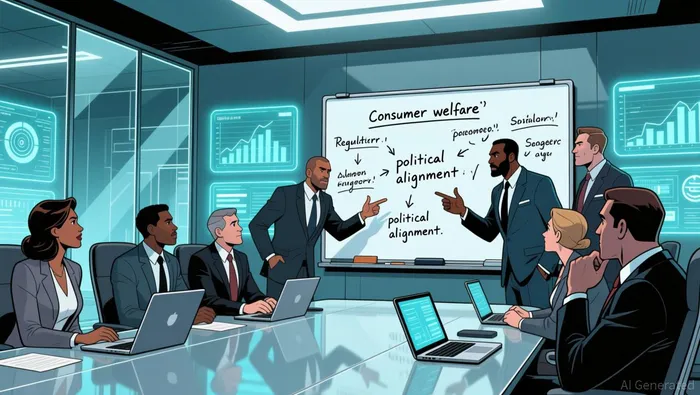 Yet the administration's enforcement priorities appear to extend beyond mere economic analysis. For instance, the proposed acquisition of Warner BrosWBD--. Discovery (WBD) by Paramount Skydance, backed by tech mogul Larry Ellison, has received apparent political favor. A Forbes analysis notes that the administration's support for this bid-despite similar antitrust concerns-has raised eyebrows, with some observers suggesting that ideological alignment and lobbying efforts may be shaping regulatory outcomes according to reporting. This duality-balancing consumer welfare with political calculus-introduces significant uncertainty for investors.
Case Studies: NetflixNFLX--, Comcast, and the Path to Approval
The Netflix-Warner Bros. deal exemplifies the administration's evolving enforcement strategy. While the administration has publicly raised concerns about Netflix's market dominance, it has not outright blocked the transaction, instead demanding assurances that the merger would not reduce competition in content creation or distribution according to reports. This contrasts with the Biden administration's tendency to prolong decisions and scrutinize hypothetical harms, a practice the Trump team has criticized as overly cautious according to analysis.
Meanwhile, Comcast's proposed acquisition of WBDWBD-- has faced its own hurdles. A Pymnts analysis highlights the administration's scrutiny of Comcast's dual role as a content producer and broadband provider, with regulators wary of vertical integration that could distort market dynamics according to reporting. The administration's nuanced approach-targeting specific antitrust risks rather than rejecting all large deals-suggests a willingness to approve mergers that align with its consumer welfare standard, even if they involve industry giants.
Skepticism and the Shadow of Partisanship
Despite the administration's emphasis on depoliticizing antitrust enforcement, skepticism persists. Techdirt's reporting underscores accusations that the administration is selectively applying its policies to benefit allies like Ellison's Paramount Skydance, while downplaying similar risks in Netflix's bid according to analysis. This perceived inconsistency could erode trust in the regulatory process and complicate long-term investment strategies. For example, if the administration is seen as favoring politically connected bidders, it may deter smaller players from pursuing mergers, further concentrating market power in the hands of a few.
Implications for Investors
For investors, the regulatory risks in media consolidation are no longer confined to traditional antitrust metrics. The Trump-era framework introduces a new layer of unpredictability, where political alignment and lobbying efforts may influence outcomes as much as economic arguments. According to a report by Global Competition Review, the administration's preference for "targeted enforcement" could lead to faster approvals for deals that meet its consumer welfare criteria, but also create a two-tier system where politically favored bidders face lower hurdles according to analysis.
This environment demands a strategic recalibration. Investors should closely monitor the administration's handling of high-profile cases like the Netflix-Warner Bros. deal, as these will set precedents for future mergers. Additionally, diversifying portfolios to include smaller streaming platforms or content creators could mitigate risks associated with regulatory favoritism toward larger consolidators.
Conclusion
The Trump administration's antitrust policies are redefining the regulatory landscape for media consolidation, with profound implications for streaming mergers. While the consumer welfare standard offers a clearer framework for evaluating deals, the interplay of political considerations introduces volatility that investors must navigate carefully. As the administration's approach unfolds, the key question remains: Will its policies foster genuine competition, or will they become tools for entrenching corporate power under the guise of pro-consumer rhetoric? The answers will shape not only the future of the streaming industry but also the broader dynamics of media ownership in the digital age.





Comentarios
Aún no hay comentarios