
Trump's Energy and Economic Strategy: A Boon for Commodity and Infrastructure Investors
The U.S. energy and economic landscape in 2025 is being reshaped by a strategic pivot under President Donald Trump, characterized by aggressive oil sanctions, a reversal of Biden-era green policies, and bold government-industry partnerships. These moves are creating both risks and opportunities for investors in commodities and infrastructure, with long-term implications that demand careful analysis.
U.S. Oil Sanctions: Geopolitical Leverage and Market Volatility
The Trump administration's sanctions on Venezuela and Russia have redefined global energy dynamics. In Venezuela, the U.S. military-backed removal of President Nicolás Maduro has exposed the country's 303 billion barrels of proven oil reserves to potential U.S. control, despite current production of just 0.8 million barrels per day due to infrastructure decay and political instability. While short-term disruptions are likely, analysts project that a stable government could attract $15–$100 billion in foreign investment to restore production to 2–3 million barrels per day over a decade. This resurgence would exacerbate an already oversupplied global oil market, potentially depressing prices and refining margins.
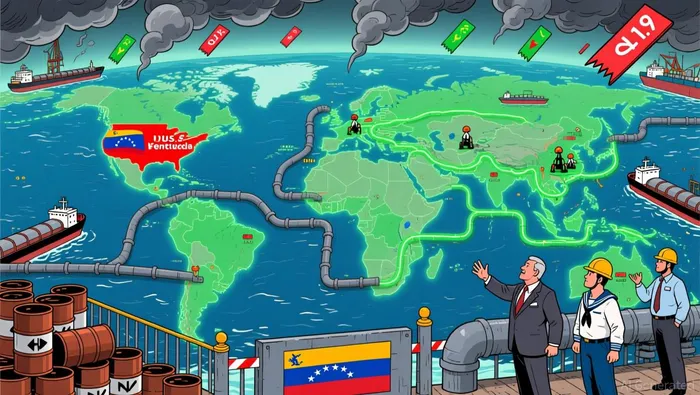 Simultaneously, sanctions on Russian oil companies like Rosneft and Lukoil aim to cut exports by 3 million barrels per day, forcing Asian buyers like India to diversify crude sources. However, enforcement remains inconsistent, with secondary sanctions struggling to curb shadow fleet trade routes. The long-term impact hinges on whether these measures permanently reduce Russian oil's share of global demand, particularly in Asia, and how OPEC+ adjusts production to fill gaps.
For investors, the key takeaway is increased volatility in oil and diesel markets, with Venezuela's heavy crude playing a critical role in global refining margins. The U.S. Gulf Coast's refineries, optimized for heavy crude, stand to benefit if Venezuela's production rebounds, but infrastructure challenges and political uncertainty will delay returns.
De-Bidenization: Fossil Fuels, Deregulation, and the Energy Transition
Trump's energy policy starkly contrasts with Biden's climate agenda. Executive actions like the "Unleashing American Energy" order prioritize fossil fuel production, LNG exports, and nuclear energy while rolling back subsidies for renewables. This shift has driven up domestic natural gas prices, contributing to an affordability crisis for households, but it also positions the U.S. as a dominant LNG supplier, with potential to undercut European buyers reliant on Russian gas.
Renewable energy faces headwinds as tax credits for solar and wind sunset, but bipartisan support for nuclear and carbon capture technologies suggests these sectors may endure. State-level green policies will likely buffer the decline in federal support, ensuring continued growth in clean power and grid infrastructure. Investors must weigh the short-term drag on renewables against long-term demand from AI-driven electrification and grid modernization.
Government-Industry Partnerships: Reshoring and Critical Minerals
The Trump administration's partnerships with private industry are central to its economic strategy. The landmark $11.1 billion Intel deal-comprising $8.9 billion in common stock and $2.2 billion in grants- highlights efforts to secure domestic semiconductor production. This aligns with broader initiatives to reshape AI and energy infrastructure, including a $1 billion investment by Hitachi Energy in U.S. grid upgrades.
Critical minerals are another focus. The U.S. Geological Survey's expansion of critical minerals to include copper and metallurgical coal, alongside the U.S.-Australia Critical Minerals Framework, aims to counter China's dominance in rare earth elements. Projects like Noveon Magnetics' collaboration with Lynas Rare Earths and the Resolution Copper mine (owned by BHP and Rio Tinto) are pivotal in securing supply chains for electric vehicles and renewable technologies.
However, reshoring carries risks. Tariffs on imported semiconductors and materials could inflate costs for AI infrastructure, while permitting delays for data centers and energy projects may slow progress. Investors should monitor how these partnerships balance national security goals with economic efficiency.
Conclusion: Navigating the New Energy Paradigm
Trump's energy and economic strategy is a double-edged sword for investors. While U.S. oil sanctions and fossil fuel subsidies offer near-term gains in traditional energy and LNG, they also heighten geopolitical risks and market volatility. The de-Bidenization of policy creates uncertainty for renewables but opens opportunities in nuclear and carbon capture. Meanwhile, government-industry partnerships in semiconductors and critical minerals promise long-term resilience but require patience to materialize.
For commodity and infrastructure investors, the path forward lies in hedging against volatility while capitalizing on structural shifts. Venezuela's oil potential, the LNG export boom, and the critical minerals race are all areas where strategic positioning could yield outsized returns-provided investors navigate the complex interplay of policy, geopolitics, and market fundamentals.







Comentarios
Aún no hay comentarios