
Trump's Emergency Powers and Market Volatility: A Sector-by-Sector Investment Analysis
President Donald Trump's second term has ushered in a new era of executive overreach, with emergency powers serving as a central tool to reshape U.S. economic and geopolitical policy. By invoking the International Emergency Economic Powers Act (IEEPA) and the National Emergencies Act (NEA), Trump has imposed sweeping tariffs, accelerated fossil fuel projects, and restructured federal agencies-all while navigating a Supreme Court that has increasingly greenlit his expansive use of emergency authority, according to a White House fact sheet. For investors, the implications are profound: markets are grappling with heightened volatility, sector-specific disruptions, and the long-term risks of a global trade environment destabilized by unilateral U.S. actions.
Manufacturing: A Double-Edged Sword
The administration's 10% baseline tariff on all imports, with escalations for countries like China (34%) and the EU (20%), is framed as a lifeline for U.S. manufacturing. The measures aim to "re-shore" industries such as automotive and metals, reducing reliance on foreign supply chains, as noted in the White House fact sheet. However, the economic costs are stark. A 2025 PESTLE analysis estimates that these tariffs could shrink U.S. GDP by 0.7% over a decade, as higher input costs ripple through industries reliant on cross-border production. For example, the automotive sector faces a 15% cost increase due to tariffs on steel and aluminum, with companies like FordF-- and General MotorsGM-- already revising supply chain strategies, according to a sector-specific analysis.
Agriculture: Retaliation and Export Shocks
While the administration touts tariffs as a tool for economic protectionism, its agricultural sector has borne early brunt. China's retaliatory halt on U.S. sorghum and poultry imports has already cost American farmers $2.3 billion in lost revenue, as the White House fact sheet indicates. Meanwhile, tariffs on Mexican imports-combined with Trump's border emergency declarations-have triggered a projected 12% decline in U.S. agricultural exports to Mexico, a critical market for corn and soybeans (see the sector-specific analysis). These shifts underscore the fragility of trade-dependent industries in a climate of escalating geopolitical friction.
Technology: Innovation vs. Inflation
The tech sector, a cornerstone of U.S. economic growth, is caught in a crossfire. Tariffs on Chinese-manufactured components have driven up production costs for companies like Apple and NVIDIA, with the latter seeing a 12% drop in Q2 2025 earnings due to supply chain bottlenecks, per the White House fact sheet. Yet, as analysts note in the sector-specific analysis, the sector's adaptability offers a silver lining: firms are accelerating domestic R&D and nearshoring efforts, potentially offsetting some of the inflationary pressures. Still, the sector's volatility remains acute, with open-source AI advancements and tariff-related news triggering sharp price swings (see the 2025 PESTLE analysis).
Energy: A Fossil-Fueled Rebound?
Trump's "national energy emergency" declaration has prioritized fossil fuel expansion, with deregulation and infrastructure projects poised to boost oil and gas production. However, tariffs on solar panels and rare earth elements-key inputs for electric vehicles-have introduced headwinds. TeslaTSLA-- and RivianRIVN-- now face a 7% production cost hike, while the American Wind Energy Association warns of delayed renewable projects due to 25% tariffs on wind turbine components, according to Cognitive Market Research. This duality-booming traditional energy sectors versus stymied clean energy-creates a fragmented landscape for investors.
Retail and Consumer Sectors: Inflationary Pressures and Profit Margins
Retailers are indirectly bearing the cost of Trump's trade policies. Energy-driven inflation is squeezing supply chains, with logistics expenses rising by 8–10% for companies like Walmart and Amazon, a trend highlighted by Cognitive Market Research. Meanwhile, lower-income consumers-already strained by a 1.9% average annual price increase per household-may reduce discretionary spending, impacting sectors like apparel and electronics, as the White House fact sheet notes. Morgan Stanley advises investors to favor defensive stocks in utilities and healthcare, which face minimal exposure to trade disruptions.
Market Volatility: A New Normal?
The VIX index, a barometer of market fear, has surged to 32 in early 2025-its highest level since the 2020 pandemic-reflecting investor anxiety over Trump's policies (see the 2025 PESTLE analysis). Legal battles, such as the Supreme Court's 21-2 approval rate of Trump's emergency rulings, add to the uncertainty (see the sector-specific analysis). For now, the administration's allies argue that these measures are necessary to restore U.S. competitiveness. Yet, as Cognitive Market Research warns, the long-term risks of a fragmented global trade system-including retaliatory tariffs and supply chain breakdowns-could outweigh short-term gains.
Investor Takeaways
- Diversification is Key: Sectors with low trade exposure, such as healthcare and utilities, offer relative stability.
- Hedge Against Volatility: ETFs like XLF (financials) and TAN (clean energy) may provide asymmetric returns amid policy shifts.
- Monitor Legal and Geopolitical Developments: The Supreme Court's stance on emergency powers and retaliatory measures from trade partners will shape market trajectories.
As Trump's second term unfolds, investors must navigate a landscape where emergency powers are not just a policy tool but a catalyst for systemic market shifts. The coming months will test whether the administration's bold strategies can balance protectionism with economic resilience-or if they will accelerate a global trade unraveling.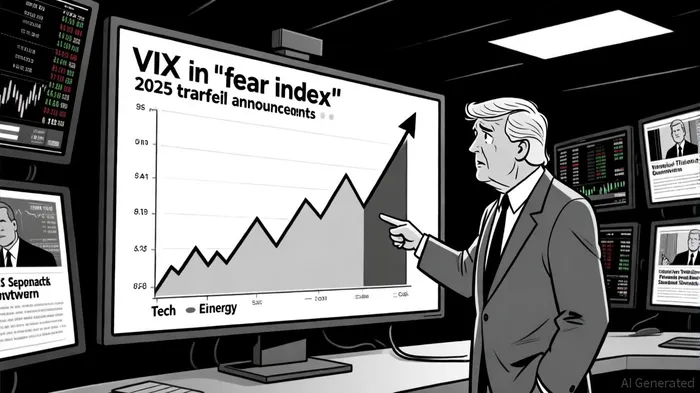





Comentarios
Aún no hay comentarios