
Trump's Economic Messaging and Its Impact on Inflation-Linked Sectors
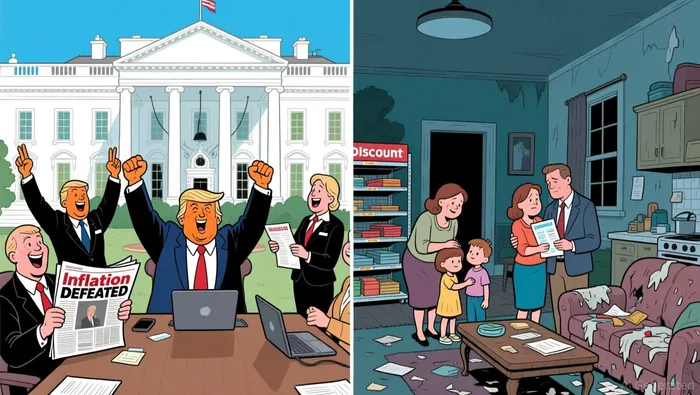
The credibility gap between Donald Trump's economic messaging and the lived reality of American households has become a defining feature of the 2025 economic landscape. While the White House insists that inflation has been "defeated" and affordability is improving, empirical data and public sentiment tell a starkly different story. This disconnect has not only eroded trust in official narratives but also created significant uncertainty for investors in inflation-sensitive sectors such as consumer staples, energy, and retail.
The Credibility Gap: A Political and Economic Disconnect
Trump's repeated dismissal of inflation concerns as a "Democrat hoax" or a "con job" has clashed with persistent price pressures in key areas of daily life. Despite a slowdown in the annual inflation rate, cumulative price levels remain far above pre-pandemic norms. Food, housing, utilities, and healthcare costs continue to rise, while wages have failed to keep pace. A Gallup poll from late 2025 revealed that 60% of Americans disapprove of Trump's economic performance, underscoring a profound disconnect between official optimism and public frustration according to the poll.
This credibility gap mirrors the backlash faced by former President Biden over his "transitory" inflation narrative, a misstep that analysts now warn Trump is repeating. The administration's focus on GDP growth and falling interest rates appears increasingly out of step with voter priorities, where housing costs, prescription drug prices, and healthcare expenses dominate concerns according to recent data.
Investor Behavior in Inflation-Sensitive Sectors
The mixed signals from Trump's economic policies have created a volatile environment for investors. In consumer staples, for example, grocery prices have surged due to tariff-driven supply chain disruptions. Fast casual restaurant stocks like Chipotle and Cava have fallen sharply year-to-date, while value-driven retailers like Dollar General and Dollar Tree have gained traction as households prioritize affordability according to market analysis.
Energy markets have also been impacted. Electricity and utility gas bills rose 6.4% year-over-year in September 2025, with electricity prices climbing nearly 40% since February 2020 according to utility reports. While the administration's push for energy independence has drawn support from some quarters, rising costs have fueled skepticism about the long-term viability of these policies.
Retailers are adapting to shifting consumer behavior. Target, for instance, has slashed prices on 3,000 items to meet demand for value-driven purchases. However, the sector's resilience is tempered by broader concerns about affordability and income inequality according to consumer research.
Market Volatility and Policy Uncertainty
Trump's aggressive tariff policies initially triggered a 15% drop in the S&P 500 from January to April 2025, reflecting investor anxiety over trade uncertainty. While the market rebounded after trade deals were finalized, the episode highlights how credibility gaps can amplify volatility. Analysts warn that as long as real wages lag behind price increases, investor confidence in inflation-sensitive sectors will remain fragile according to economic analysis.
Conclusion: Navigating the Credibility Trap
For investors, the key takeaway is clear: Trump's economic messaging, while politically convenient, has created a credibility trap that undermines long-term confidence. Sectors like consumer staples, energy, and retail are particularly vulnerable to policy-driven volatility and shifting public sentiment. As the 2026 midterms approach, the administration's ability to reconcile its narrative with on-the-ground realities will be critical-not just for economic stability, but for investor returns.







Comentarios
Aún no hay comentarios