
Trump's Economic Crossroads: Can the Market Weather the Policy Storm?
The first 100 days of any administration are a litmus test for its economic agenda. For President Trump’s second stint in office, however, the results are anything but reassuring. Weak economic data—including a GDP contraction, rising unemployment risks, and stubborn inflation—paint a challenging picture. Investors now face a critical question: Is this a temporary stumble, or a sign of deeper vulnerabilities?
GDP in Freefall: Trade Wars and Tariff Traps
The U.S. economy shrank at a 0.3% annual rate in Q1 2025, marking its worst quarterly performance since early 2022. The primary culprit? A 50.9% surge in imports as businesses stockpiled goods ahead of Trump’s new tariffs. This distorted trade dynamics, pushing the trade deficit to a record $162 billion in March. While imports temporarily depressed GDP, the underlying economy showed resilience: “final sales to private domestic purchasers”—a gauge excluding trade and inventories—grew at a 3.9% annual rate.
But the damage is spreading. Consumer spending slowed to 1.8% growth, its weakest pace since mid-2023, as households brace for tariff-driven price hikes. Meanwhile, the Federal Reserve has paused interest rate cuts amid inflation risks, even as the Atlanta Fed models predict a 2.7% contraction by late 2025.
Unemployment: The Calm Before the Storm?
The unemployment rate held steady at 4.2% in March 2025, within a narrow 4.0–4.2% range since May 2024. However, the Fed’s baseline scenario warns of an increase to 4.5% by Q3, driven by federal layoffs and stricter immigration policies. Plans to cut 220,000 probationary workers and buyouts for 75,000 federal employees could further strain labor markets.
Notably, Black and Hispanic unemployment remains elevated, with 3-month averages above 6% and 5%, respectively. The labor force participation rate has stabilized at 62.5%, but hiring activity has slowed, with the “hires rate” dropping to 3.4%—a level last seen before the pandemic.
Inflation: A Fragile Retreat
Year-on-year CPI inflation dipped to 2.4% in March 2025, down from a September 2022 peak of 9.1%. Energy prices fell 7% since Trump took office, while core inflation (excluding food and energy) held at 2.8%. But the Fed’s preferred gauge, the PCE deflator, remains elevated at 2.5%, above its 2% target.
The real threat? Tariffs. Proposed duties—25% on Canadian/Mexican imports and 20% on Chinese goods—could push consumer costs up by $4,700 annually for some households. Food prices, already volatile (egg prices jumped 15% in early 2025), face further pressure as trade disruptions bite.
Investment Implications: Navigating the Policy Crossroads
- Sector Exposure: Industries reliant on trade, such as automotive (tariffs could boost prices by 12%) and apparel (64% hikes), face headwinds. Investors should favor domestically oriented sectors like healthcare or technology.
- Fed Policy: With inflation and recession risks balanced, the Fed is unlikely to cut rates further in 2025. This supports bond markets, but equities may struggle.
- Defensive Plays: Utilities and consumer staples could outperform amid uncertainty.
- Trade-Sensitive Stocks: Short positions in companies exposed to tariffs (e.g., retailers with overseas supply chains) might capitalize on margin pressures.
Conclusion: A Policy-Driven Downturn Demands Caution
The data is clear: Trump’s economic agenda has created a perfect storm. A 0.3% GDP contraction, rising unemployment risks, and tariff-driven inflation all point to a fragile recovery. While private investment surged in Q1 (up 21.9%), this is likely a temporary blip as businesses front-load inventory ahead of punitive tariffs.
Investors should prepare for volatility. The Fed’s pause on rate cuts and the administration’s aggressive trade policies leave little room for error. With a 45% chance of recession by late 2025, defensive strategies—such as prioritizing dividend-paying stocks and short-term Treasuries—are prudent.
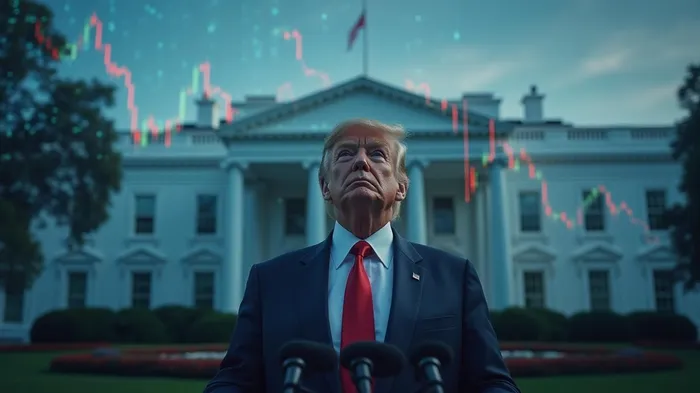
The next 100 days will test whether Trump’s policies can pivot from disruption to stability—or if the economy’s crossroads become a cliff. For now, caution remains the watchword.







Comentarios
Aún no hay comentarios