
The Trump-Driven Defense Sector Boom: Strategic Entry Points for 2027
The U.S. defense sector is poised for a transformative phase in 2027, driven by a confluence of geopolitical tensions, aggressive budgetary expansions, and industrial policy reforms under the Trump administration. With a proposed 2027 defense budget of $1.5 trillion-nearly doubling the 2026 allocation of $901 billion-investors are increasingly turning their attention to defense equities as a strategic asset class. This surge in funding, coupled with regulatory shifts targeting corporate behavior, creates both opportunities and challenges for long-term capital allocators.
Budgetary Tailwinds and Industrial Policy Reforms
The Trump administration's 2027 budget proposal underscores a prioritization of military modernization, with a focus on hypersonic weapons, AI-driven systems, and naval expansion. This includes significant investments in platforms like the F-35 fighter jet, Virginia and Columbia-class submarines, and precision munitions. However, the administration has paired this spending with stringent conditions for defense contractors. For instance, an executive order prohibits stock buybacks and dividends for firms failing to meet production benchmarks, aiming to redirect capital toward manufacturing and R&D. While this has introduced short-term volatility-Lockheed Martin and Raytheon Technologies (RTX) saw stock fluctuations in early 2026- these measures are designed to align corporate priorities with national security goals.
Geopolitical Catalysts and Sector Winners
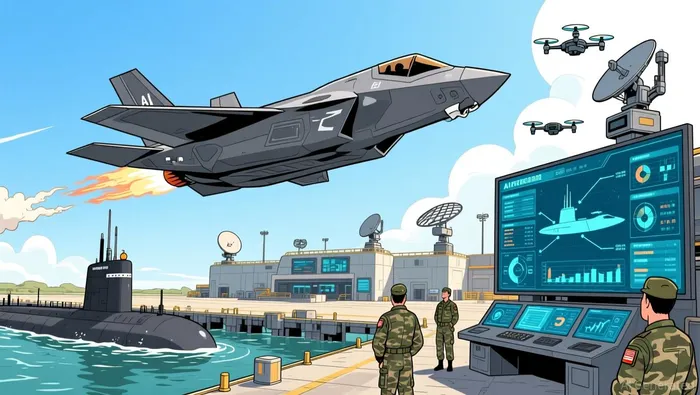 Geopolitical tensions have further amplified demand for defense capabilities. The U.S. has ramped up military aid to allies in the Indo-Pacific and Europe, while countering China's rising influence and addressing conflicts in the Middle East. Lockheed Martin, the largest recipient of Pentagon contracts with $313 billion awarded between 2020 and 2024, is a prime beneficiary of this trend. Similarly, RTX, with $145 billion in contracts, has seen robust demand for its Patriot missile systems and hypersonic technologies. These companies, along with Northrop GrummanNOC-- and General DynamicsGD--, are central to the administration's push for industrial base resilience.
Investment Implications and Strategic Entry Points
For long-term investors, the defense sector offers a compelling mix of secular growth and defensive characteristics. Aerospace and defense ETFs, such as the State Street SPDR S&P Aerospace & Defense ETF, surged 11% in early 2026 amid optimism over the proposed budget. However, the sector's performance will hinge on navigating regulatory pressures. Firms that adapt to Trump's industrial policies-by accelerating production timelines and investing in innovation-will likely outperform peers. For example, Raytheon's recent procurement challenges highlight the risks of non-compliance with administration directives.
Moreover, the U.S. defense market is projected to grow at a 4.91% CAGR through 2033, driven by autonomous defense technologies and persistent global instability. This trajectory positions defense equities as a hedge against macroeconomic uncertainties, particularly in a landscape where traditional asset classes face volatility.
Conclusion
The Trump-era defense sector boom is not merely a fiscal event but a strategic reorientation of U.S. industrial and geopolitical priorities. While regulatory headwinds may test corporate agility, the alignment of budgetary largesse with modernization imperatives creates a durable foundation for growth. Investors who focus on firms with strong government ties, technological edge, and operational efficiency-such as Lockheed MartinLMT-- and RTX-stand to benefit from this paradigm shift. As the 2027 budget takes shape, defense equities will remain a cornerstone of capital allocation in an increasingly turbulent world.





Comentarios
Aún no hay comentarios