
Trump Discloses $57.4 Million Crypto Income From World Liberty Financial
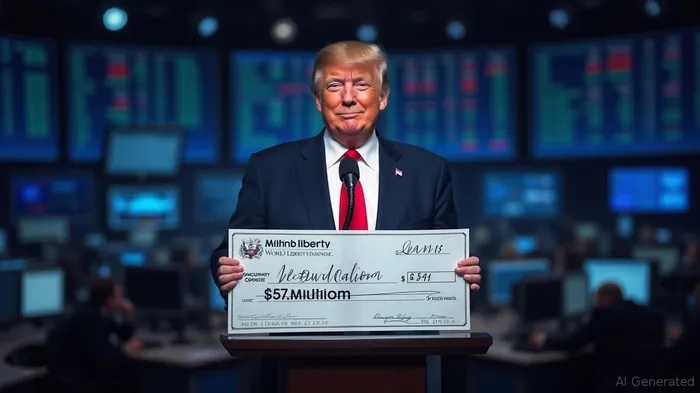
President Donald Trump has disclosed a significant income of $57.4 million from World Liberty Financial, a cryptocurrency venture that he supports alongside his sons Donald Jr. and Eric. This disclosure was made in his 2025 public financial disclosure filed with the US Office of Government Ethics on June 13. The filing reveals that Trump holds 15.75 billion governance tokens in the DeFi project, which also provide voting rights. The income, listed as "$57,437,927," does not specify whether the gains came from token sales, staking rewards, or other mechanisms. Trump's substantial holdings suggest either monetization of tokens or a high internal valuation for disclosure purposes.
World Liberty Financial has successfully completed multiple funding rounds, raising a total of approximately $550 million. The project secured $200 million in its first public token sale and an additional $250 million in the second round. Chinese entrepreneur Justin Sun was identified as the largest known investor, spending $75 million on WLFIWLFC-- tokens at $0.015 each. The project, launched in September 2024, offers DeFi services and dollar-pegged stablecoins, utilizing Aave V3 infrastructure for lending and borrowing operations. Trump's family secured 75% of revenues from WLFI token sales through corporate structures. The project has announced plans for staking features in Q1 2025, though these remain unavailable. WLFI tokens carry no economic rights and are non-transferable, serving only governance functions.
Trump's involvement in the cryptocurrency sector coincides with significant regulatory changes across his administration. The White House issued executive orders establishing a Presidential Working Group on Digital AssetDAAQ-- Markets and directing agencies to develop comprehensive crypto frameworks. The SEC launched a crypto task force under Commissioner Hester Peirce, reversing previous enforcement-heavy approaches. The administration supports stablecoin legislation and reduced regulatory barriers for crypto companies. Additionally, Trump established a Strategic Bitcoin Reserve through executive order, consolidating government-seized cryptocurrencies under Treasury management. The reserve aims to position Bitcoin as a national store of value, with Trump stating the government will not sell deposited Bitcoin.
World Liberty Financial's governance token structure is unusual compared to traditional DeFi projects. The arrangement favors insiders through non-transferable tokens and centralized revenue distribution. Georgetown University professor Jim Angel noted that the token structure provides "no economic benefit" to public holders. Marquette University's David Krause observed that the arrangement "excludes public investors from meaningful financial participation." However, DeFi governance tokens generally showed positive momentum in 2025, benefiting from reduced regulatory uncertainty around revenue distribution to token holders.
Trump's crypto income disclosure raises questions about potential conflicts between presidential duties and financial interests. Ethics experts note the unprecedented nature of a sitting president's direct financial ties to digital assets while simultaneously setting industry policy. The disclosure comes as DeFi markets experience significant growth. Market research projects the global DeFi market will reach $351.75 billion by 2031, with governance tokens comprising approximately 15% of cryptocurrency market value as of January 2025. Traditional financial institutions increasingly embrace DeFi partnerships, driven by regulatory clarity under the Trump administration. This institutional adoption could benefit governance token holders through increased platform usage and revenue generation.
Critics argue that the concentration of voting power among large token holders undermines decentralization principles. World Liberty Financial's structure, where Trump's entities control 60% of the parent company, exemplifies these centralization concerns within supposedly decentralized protocols. The administration's pro-crypto stance may accelerate mainstream DeFi adoption while potentially creating new regulatory challenges around political influence and market manipulation. Trump's substantial crypto holdings position him to benefit directly from policies promoting digital asset growth.






Comentarios
Aún no hay comentarios