
The Trump Crypto Windfall: A New Era of Political Wealth Creation in Digital Assets?
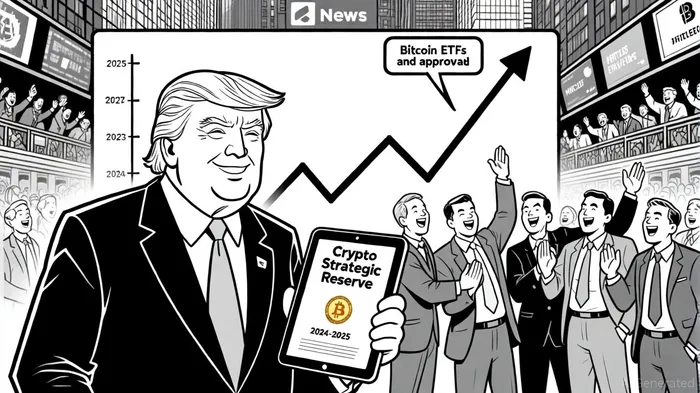
The intersection of politics and cryptocurrency has never been more volatile—or lucrative. In 2025, former President Donald Trump's aggressive foray into digital assets has redefined the landscape, blending policy, personal investment, and market manipulation into a potent mix. With a reported $600 million in crypto-related income and the U.S. positioning itself as the “crypto capital of the world,” Trump's influence has sparked a debate: Are political endorsements and policies now central to crypto wealth creation, or do they introduce new risks for investors?
Trump's Crypto Playbook: Policy, Profit, and Power
Trump's 2025 “Crypto Strategic Reserve” plan—announced in March—marked a watershed moment. By signaling the U.S. government's intent to buy and sell major cryptocurrencies like BitcoinBTC-- (BTC), EthereumETH-- (ETH), and SolanaSOL-- (SOL), the initiative triggered immediate price spikes across the board [1]. According to a report by Reuters, Trump's personal investments in crypto ventures, including World Liberty Financial and the $TRUMP meme coin, further amplified his influence, with the latter generating over $100 million in trading volume within 14 days of its launch [3].
The administration's pro-crypto executive order and the first White House Crypto Summit underscored a broader strategy: regulatory clarity and market confidence. The appointment of pro-crypto regulators like SEC Chair Paul Atkins has accelerated this shift, with data from MITrade showing Bitcoin ETFs attracting $12 billion in inflows post-approval in early 2024 [5]. Yet, as the Gini coefficient for Bitcoin ownership exceeds 0.92, critics argue that such policies entrench wealth concentration rather than democratize finance [1].
A Comparative Lens: Musk, Carney, and the Global Crypto Chessboard
Trump's actions are part of a larger trend. Elon Musk's tweets have historically driven crypto volatility, with his 2020 DogecoinDOGE-- endorsements pushing the token up 300% in a month [1]. Similarly, his proposed “American Party” in 2025, framed as pro-Bitcoin, highlights how political narratives now shape market sentiment. Meanwhile, Canada's Mark Carney, a former central banker turned political leader, has emphasized economic resilience amid U.S.-China digital rivalry, signaling how global leaders are recalibrating their crypto strategies [2].
The U.S.-China competition adds another layer. While the U.S. advances the GENIUS Act to regulate stablecoins, China's e-CNY initiatives threaten to reshape cross-border finance. For emerging markets, this rivalry risks undermining domestic monetary policy and increasing dependency on external systems [2].
Investment Implications: Opportunity or Overreach?
For investors, the rise of “political crypto” presents dual-edged opportunities. On one hand, Trump's policies have legitimized digital assets, attracting institutional capital and spurring innovation. On the other, the reliance on political endorsements introduces volatility. For instance, the $TRUMP meme coin's price surged 12% after a single tweet from its namesake, only to face sharp corrections due to speculative trading and whale activity [2].
Regulatory shifts also carry risks. While the SEC's “Project Crypto” aims to modernize securities laws, ambiguities around liquid staking and token classification persist [3]. Investors must weigh these uncertainties against the potential for long-term gains, particularly as global adoption of stablecoins—pegged to the U.S. dollar—accelerates [4].
Conclusion: Navigating the New Normal
The TrumpTRUMP-- crypto windfall exemplifies a paradigm shift: political figures are no longer peripheral to crypto markets but central architects. However, this entanglement raises ethical and economic questions. As the Gini coefficient data reveals, wealth concentration in crypto remains stark, challenging the sector's promise of financial inclusion [1]. For investors, the key lies in balancing optimism about regulatory progress with caution against overreliance on political narratives.
In this new era, diversification, due diligence, and a nuanced understanding of geopolitical dynamics will be critical. After all, the next crypto windfall may come from a tweet—or a regulatory crackdown.






Comentarios
Aún no hay comentarios