
The Trump Crypto Playbook: Conflicts, Adoption, and the Future of Bitcoin Regulation
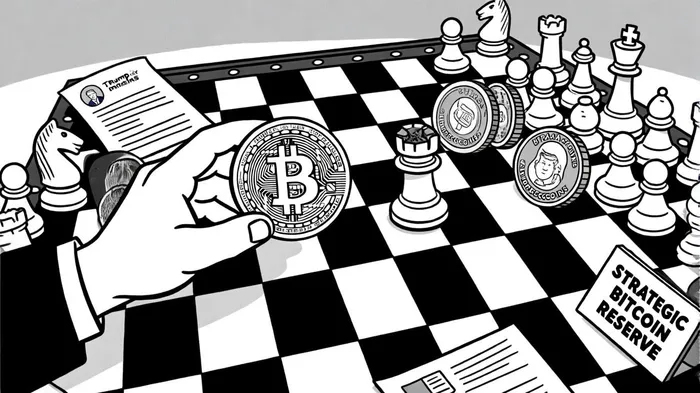
The Trump administration's approach to cryptocurrency has redefined the intersection of politics, regulation, and institutional finance. By leveraging executive authority and legislative momentum, the administration has accelerated Bitcoin's institutional adoption while simultaneously entangling its policies with the Trump family's direct financial interests. This duality—between fostering innovation and enabling self-enrichment—has created a volatile landscape for investors, regulators, and global markets.
The Trump Crypto Empire and Policy Overlap
The Trump family's entanglement with crypto is no longer a side hustle. World Liberty FinancialWLFI-- (WLF), a decentralized finance platform co-founded by Trump's sons, has become a central pillar of their wealth accumulation. The Trumps reportedly own 60% of WLF and 75% of revenue from token sales, including the $WLFI token and the USD1USD1-- stablecoin [1]. These ventures, coupled with the launch of the $TRUMP memecoinMEME--, have generated over $5 billion in paper profits, according to reports [2].
This financial stake has directly influenced regulatory decisions. For instance, the administration's January 2025 executive order banning the creation of a U.S. central bank digital currency (CBDC) and revoking Biden-era crypto regulations aligns with the Trump family's interest in promoting private, dollar-backed stablecoins like USD1 [3]. Similarly, the Strategic BitcoinBTC-- Reserve—established via Executive Order 14233—has been criticized for legitimizing Bitcoin as a government asset while allowing the Trumps to profit from its adoption through their ventures [4].
Regulatory Rollbacks and Institutional Adoption
The Trump administration's deregulatory agenda has created a fertile ground for institutional adoption of Bitcoin. The GENIUS Act, signed into law in July 2025, established the first federal regulatory framework for stablecoins, mandating 100% reserve backing and transparency [5]. This act, coupled with the repeal of SAB 121 (which now allows banks to custody crypto assets), has spurred major financial institutions like JPMorganJPM-- and Citibank to expand their crypto offerings [6].
However, these policies have been criticized for prioritizing private interests over public safeguards. The administration's appointment of Paul Atkins, a crypto advocate, as SEC chair has shifted the agency's focus from enforcement to deregulation [7]. Meanwhile, the Strategic Bitcoin Reserve's lack of transparency—such as unclear acquisition mechanisms and safeguards against market manipulation—has raised concerns about potential conflicts of interest [8].
Global Reactions and Systemic Risks
The U.S. has positioned itself as the “crypto capital of the world” through these policies, but global responses have been mixed. Countries like South Korea and the UAE have accelerated their own crypto strategies in response to U.S. moves, while European regulators have expressed caution over the Trump administration's perceived favoritism toward private crypto interests [9].
Systemic risks remain unaddressed. The administration's report on digital assetDAAQ-- markets, while emphasizing innovation, lacks robust stress-testing for market volatility and consumer protection measures [10]. Critics argue that the binary classification of digital assets as either securities or commodities ignores their hybrid nature, potentially creating regulatory loopholes [11].
Conclusion: A High-Stakes Game of Chess
The Trump administration's crypto policies reflect a high-stakes game where political power and financial gain are intertwined. While these policies have undeniably accelerated Bitcoin's institutional adoption, they also risk undermining public trust and regulatory integrity. For investors, the key question is whether the administration's pro-crypto agenda will foster long-term stability or exacerbate systemic risks.






Comentarios
Aún no hay comentarios