
Trump's Brazil Visit: Implications for U.S.-Latin America Trade and Investment Opportunities
Trump's Brazil Visit: Implications for U.S.-Latin America Trade and Investment Opportunities
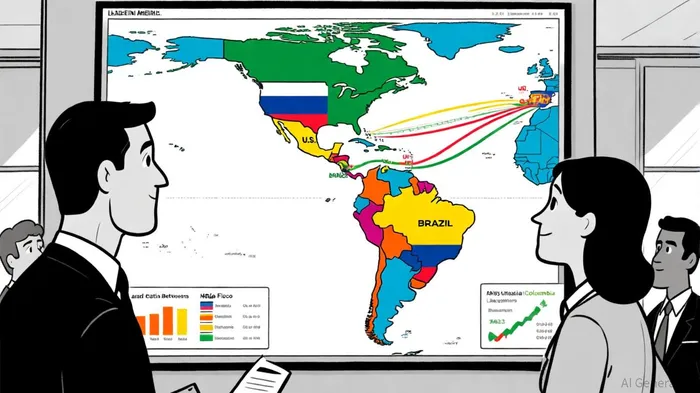
The recent U.S. imposition of 50% tariffs on Brazilian imports under President Donald J. Trump has ignited a geopolitical and economic recalibration across Latin America. This move, framed as a response to perceived threats to U.S. national security and economic interests from Brazil's judicial and political actions, has sent ripples through global commodity markets and emerging equities. The tariffs, which target high-profile sectors like coffee and industrial equipment while exempting energy and aviation parts, underscore a strategic balancing act between political posturing and economic pragmatism. For investors, the fallout presents both risks and opportunities in a region already grappling with shifting trade dynamics.
Sectoral Impacts: Winners, Losers, and Strategic Exemptions
The U.S. tariffs have disproportionately affected Brazil's export-dependent industries. EmbraerERJ-- SA, the country's largest aircraft manufacturer, faces a potential $9 million price hike per jet for U.S. buyers, threatening its 45% share of commercial jet exports to the U.S., according to Oxan. Similarly, WEG SA, a leading industrial equipment producer, is projected to see a 24% drop in free cash flow as it reroutes exports to Mexico and India, according to S&P Global. Coffee producers, which account for 30% of U.S. imports, are particularly vulnerable, with tariffs making Brazilian coffee up to 30% pricier than alternatives from Colombia or Vietnam, per The Global Statistics.
However, the Trump administration's selective approach has shielded critical sectors. Energy exports, aviation parts, and industrial materials remain exempt, preserving supply chain stability for U.S. manufacturers reliant on Brazilian inputs like steel and metallurgical coal, as AS/COA notes. This strategic exemption highlights the administration's intent to avoid disrupting industries that underpin U.S. manufacturing and energy security. For investors, the divergence in sectoral impacts suggests a nuanced approach: shorting overexposed equities like Embraer while hedging against volatility in energy-linked assets.
Regional Rebalancing: Latin America's Trade Diversification Playbook
The U.S.-Brazil trade tensions have accelerated a broader regional shift toward trade diversification. Brazil, now seeking alternative markets in China and the Middle East, has leveraged its Economic Reciprocity Law to threaten countermeasures without fully escalating tensions, according to JPMorgan Private Bank. Meanwhile, Mexico has renegotiated USMCA terms to maintain tariff preferences, securing its position as a key U.S. manufacturing hub. Countries like Chile and Peru, with existing free trade agreements, have seen minimal direct impacts, as their exports of copper and oil remain largely exempt, Americas Quarterly reports.
This realignment has created new investment opportunities. For instance, Costa Rica's political stability and renewable energy infrastructure have made it an attractive nearshoring destination for U.S. firms seeking to bypass tariffs, per CSIS. Similarly, Colombia's agricultural sector is poised to benefit from trade diversion, as U.S. buyers seek alternatives to Brazilian soybeans and orange juice, according to Oxford Economics. Investors should also monitor Argentina and Ecuador, where fiscal policies and commodity price fluctuations could drive asymmetric returns.
Equity Market Volatility and Commodity Price Shifts
Emerging market equities in Latin America have exhibited mixed performance. The Ibovespa index initially rose 0.95% following tariff exemptions on key exports, but volatility persists as investors weigh Brazil's GDP contraction risks (estimated at 0.1–0.2%) and potential job losses exceeding 100,000, Valor reports. In contrast, diversified firms like Suzano Papel e Celulose SA and Marfrig Alimentos SA are expected to maintain dividend payouts due to their global operations, offering defensive appeal, according to S&P Global.
Commodity prices have also been reshaped by the trade tensions. While copper prices remain depressed for Chilean exporters, Brazil's agricultural commodities face downward pressure from reduced U.S. demand. However, strategic commodities like rare earths and lithium, critical for U.S. green energy goals, could see renewed interest in Brazil and Argentina, where resource nationalism is tempered by geopolitical pragmatism, according to NumberAnalytics.
Strategic Opportunities Amid Uncertainty
For investors, the U.S.-Brazil trade standoff underscores the importance of hedging against geopolitical volatility while capitalizing on regional asymmetries. Key opportunities include:
1. Diversified Equities: Firms with global supply chains, such as Suzano and Marfrig, offer resilience against sector-specific tariffs.
2. Trade Diversification Plays: Mexico's manufacturing sector and Costa Rica's nearshoring potential present growth avenues.
3. Commodity Arbitrage: Strategic metals and agricultural alternatives to Brazilian exports (e.g., Colombian coffee) could benefit from trade diversion.
However, risks remain. The Trump administration's unpredictable trade policies and Brazil's potential retaliatory measures could exacerbate market volatility. Investors should prioritize liquidity and sectoral diversification to navigate this landscape.
Conclusion
The U.S.-Brazil trade tensions are a microcosm of broader geopolitical shifts reshaping Latin America's economic architecture. While the immediate impacts are uneven, the long-term trajectory points to a region increasingly assertive in its trade strategies and investment priorities. For investors, the key lies in balancing caution with opportunism-leveraging sectoral disparities and regional realignments to build resilient portfolios in an era of strategic uncertainty.





Comentarios
Aún no hay comentarios