
The Trump Billionaires Club Game and Its Potential to Revive the TRUMP Memecoin
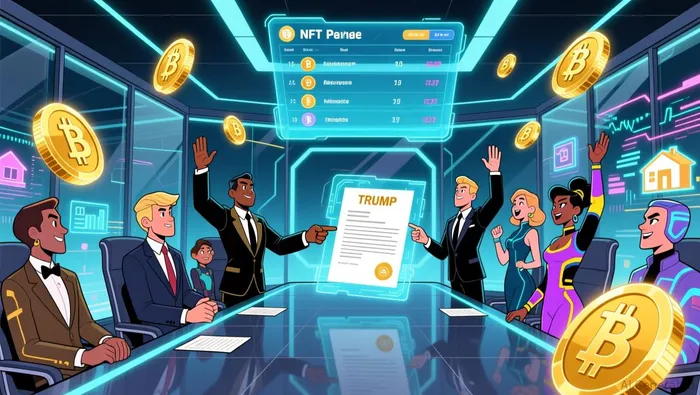
The launch of Trump Billionaires Club, a play-to-earn (P2E) mobile game tied to the TRUMPTRUMP-- memecoinMEME--, represents a bold attempt to reinvigorate a token that has seen its value plummet by 87% since its peak according to Bloomberg. Developed by Freedom 45 Games under a licensing agreement with Donald Trump's name and likeness, the game blends blockchain mechanics with a 3D business simulation reminiscent of Monopoly. Players can purchase virtual properties, trade NFT collectibles, and climb a competitive leaderboard for a chance to win a $1 million prize pool as reported by CoinPaper. The TRUMP token, which serves as the game's primary currency, is central to its design, raising the question: Can gamification catalyze a retail-driven revival for a memecoin in a saturated and speculative crypto market?
Blockchain Integration and Game Mechanics
The game's mechanics are designed to drive token utility. Users can earn, trade, and spend TRUMP tokens within the platform, with transactions facilitated by blockchain technology. Open Loot support-a feature allowing players to trade in-game assets as NFTs-adds a layer of scarcity and ownership. The game's accessibility across iOS, Android, and web browsers, coupled with support for traditional currency, general cryptocurrencies, and TRUMP tokens, aims to lower entry barriers for retail investors.
 However, the integration of blockchain into gaming is not without precedent. Play-to-earn models have previously struggled with scalability and user retention, as seen in projects like Axie Infinity, which saw a sharp decline in active users after an initial frenzy. For Trump Billionaires Club, the challenge lies in balancing speculative appeal with long-term engagement. The game's success hinges on whether players will view TRUMP tokens as a valuable in-game asset or merely a vehicle for short-term profit.
A History of Trump-Linked Crypto Volatility
To assess the game's potential, it is critical to examine the track record of Trump's previous crypto ventures. According to reports, the MAGA Memecoin, launched in 2024, generated $315 million for Trump and his affiliates, with the Trump Organization reportedly holding 80% of the TRUMP token supply under a three-year vesting schedule. Early insiders reaped over $1.1 billion in profits, while 764,000 wallets recorded losses. This pattern of extreme volatility-driven by social media hype and celebrity influence-has become a hallmark of Trump's crypto projects.
The TRUMP memecoin's decline to a 12-month low in late 2025 underscores the limitations of relying on retail speculation. Despite high-profile events, such as a private dinner with Trump hosted by promoter Bill Zanker, the token has failed to sustain value. This raises concerns about whether Trump Billionaires Club will follow a similar trajectory. As one analyst noted, "Gamification might attract attention, but it won't fix the underlying issue: a lack of fundamental utility in a token that's already been discredited by the market" according to CNN.
Strategic Implications and Market Realities
The game's developers are betting on a dual strategy: leveraging Trump's brand to drive retail participation and using blockchain's perceived innovation to differentiate the project. However, the crypto market is now saturated with P2E games and memecoins, many of which have failed to deliver on their promises. For example, the WLFI token, part of Trump's DeFi firm World Liberty FinancialWLFI--, lost 95% of its value within a year.
Retail investors, already wary of memecoins after the collapse of projects like DogecoinDOGE-- and Shiba InuSHIB--, may be hesitant to repeat past mistakes. According to a Bloomberg report, the TRUMP token's recent 87% drop has forced promoters to pivot toward gamification as a last-ditch effort to revive interest. Yet, this approach risks further eroding trust, particularly given the regulatory scrutiny Trump's ventures have faced over conflicts of interest and insider profits as reported by CNBC.
Forecast: A High-Risk, High-Reward Proposition
The likelihood of Trump Billionaires Club reviving the TRUMP memecoin depends on three factors: the game's ability to sustain user engagement, the broader market's appetite for speculative assets, and regulatory developments. While the game's $1 million prize pool and Trump's promotional reach on platforms like X could generate short-term buzz, long-term success requires a shift from hype-driven speculation to meaningful utility.
Historical data suggests this is unlikely. As of November 2025, TRUMP's market cap remains a fraction of its $15 billion peak according to CNBC, and trading volumes have stagnated. Unless the game introduces novel mechanics-such as cross-platform NFT integration or real-world asset backing-it is probable that the token will continue its downward trend.
Conclusion
The Trump Billionaires Club game exemplifies the enduring allure of gamification in crypto, but its potential to revive the TRUMP memecoin is constrained by the same forces that have undermined previous Trump-linked projects: volatility, regulatory risk, and a lack of sustainable value. While the game may attract a wave of retail investors eager to capitalize on nostalgia or celebrity influence, the broader market's skepticism suggests that this revival will be short-lived. For investors, the lesson remains clear: in a saturated and speculative market, gamification alone cannot substitute for fundamentals.






Comentarios
Aún no hay comentarios