
Trump-Backed Crypto Ventures: Political Influence, Market Volatility, and the Road to a "Crypto Capital"
The intersection of politics and cryptocurrency has never been more pronounced than under the TrumpTRUMP-- administration, where a combination of legislative action, high-profile endorsements, and family-led ventures has reshaped the digital asset landscape. As the U.S. aims to solidify its position as the "crypto capital of the world," the market's response to Trump-backed initiatives reveals a complex interplay of optimism, volatility, and regulatory experimentation.
Legislative Foundations: The GENIUS Act and Regulatory Clarity
In July 2025, President Donald Trump signed the GENIUS Act, a landmark piece of legislation designed to establish a federal regulatory framework for stablecoins according to White House officials. This act mandated that stablecoins be fully backed by liquid assets like U.S. dollars or short-term Treasuries, aiming to bolster consumer confidence while reinforcing the dollar's dominance in global finance. According to a report by the White House, the legislation also sought to eliminate regulatory ambiguity, enabling innovation in tokenized assets and digital banking as stated in the report.
However, critics argue that the act's leniency toward stablecoin issuers could amplify systemic risks. warns that the lack of stringent oversight might lead to a "next financial crisis," particularly as stablecoins grow in market size and influence. This duality-regulatory clarity versus systemic risk-has become a defining feature of Trump's cryptoBTC-- policy.
Trump-Backed Projects: From Memecoins to Tokenized Real Estate
The Trump family's foray into crypto extends beyond policy. The "Official Trump (TRUMP)" meme coin, launched in 2025, reached an all-time high of $75.26, leveraging the former president's political brand to attract retail investors. Similarly, American Bitcoin Corp., co-founded by Eric Trump, saw a temporary surge after merging with Gryphon Digital in May 2025 but later plummeted by over 50% in December 2025.
World Liberty Financial (WLFI), another Trump-backed venture, has experienced dramatic volatility, with its token dropping 51% from its 2025 peak. Meanwhile, the Trump Organization announced the world's first tokenized hotel development in the Maldives, allowing investors to participate in luxury real estate through digital tokens. While these projects highlight the administration's push for innovation, they also underscore the speculative nature of crypto-linked ventures.
Market Sentiment and Investor Behavior
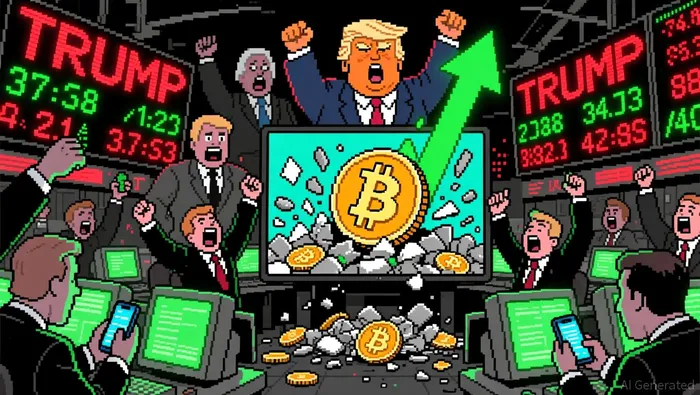
The market's reaction to Trump's crypto initiatives has been mixed. BitcoinBTC--, which briefly hit $100,000 in early 2025, fell to $82,000 by late November 2025, erasing most of its gains. Trump-linked assets, however, have fared worse, with some projects declining by over 90%. This divergence suggests that while political endorsements may initially boost sentiment, broader macroeconomic factors-such as trade tensions and interest rate uncertainty-ultimately dictate market outcomes as reported by the New York Times.
Academic research further illuminates this dynamic. A 2025 study by David Krause found that Bitcoin's returns are most responsive to high-impact political events, such as Trump's November 2024 industry meeting and Election Day, which generated abnormal returns of +5.63% and +1.07%, respectively. Conversely, routine political sentiment, like approval ratings, has had minimal influence according to the study. This asymmetry highlights the unpredictable nature of crypto markets under political influence.
Regulatory Risks and Consumer Sentiment
Despite the volatility, consumer sentiment remains cautiously optimistic. revealed that 60% of Americans familiar with crypto believe its value will rise during Trump's second term, with many anticipating broader adoption. This optimism is partly fueled by the administration's decision to halt SEC enforcement actions against crypto projects and integrate digital assets into the banking system.
Yet, the rapid regulatory shifts have raised concerns. The Trump administration's creation of a Strategic Bitcoin Reserve and its push to tokenize real-world assets-such as the Maldives hotel-reflect a bold vision for crypto's future according to research from Galaxy. However, the absence of long-term oversight mechanisms could leave the market vulnerable to instability, particularly if stablecoins dominate the ecosystem as warned by .
Conclusion: Balancing Opportunity and Risk
Trump-backed crypto ventures exemplify the dual-edged nature of political influence in digital assets. While the administration's policies have fostered innovation and regulatory clarity, they have also amplified market volatility and systemic risks. For investors, the key lies in distinguishing between politically driven hype and sustainable technological progress. As the U.S. races to become the "crypto capital," the long-term success of these ventures will depend not only on Trump's policies but also on the resilience of the underlying assets and the global market's evolving appetite for risk.






Comentarios
Aún no hay comentarios