
The Trump Administration's Strategic Push for AI and Supply Chain Resilience: Implications for Investors
The AI Action Plan: Infrastructure, Ideology, and Industrial Policy
The July 2025 release of Winning the Race: America's AI Action Plan marked a pivotal shift in federal engagement with AI. By streamlining permitting for data centers and fostering public-private partnerships, the administration has accelerated the deployment of AI infrastructure, a critical enabler of supply chain resilience, according to a Inside Government Contracts report. According to a Logistics Viewpoints analysis, these measures aim to reduce dependency on foreign technologies while embedding AI into logistics and manufacturing systems through predictive analytics and automation.
However, the plan's ideological mandates-requiring AI systems procured by the federal government to be "truth-seeking" and "ideologically neutral"-introduce a layer of complexity. While ostensibly aimed at curbing bias, these rules have sparked debates about their practical implications for innovation and vendor diversity. For investors, this signals a need to scrutinize companies aligning with-or resisting-these regulatory contours.
Defense and Border Security: The $150 Billion Bet
The Trump Administration's One Big Beautiful Bill, allocating over $150 billion to disruptive defense technologies, has become a cornerstone of national security-driven capital allocation, according to a SSBCrack report. This funding has turbocharged demand for agentic AI, biometric intelligence, and edge-orchestrated IoT systems, with firms like BigBearBBAI--.ai securing contracts to develop platforms such as ConductorOS for swarming drone operations.
Simultaneously, the Department of Homeland Security's $6.2 billion investment in border technology underscores a broader strategy to weaponize AI for supply chain control, the report notes. Yet, the sector is not without turbulence. C3.ai's Q1 2025 net loss of $116.8 million and its leadership transition have rattled markets, illustrating the volatility of AI-driven defense stocks, according to a Tech2 report. Investors must balance the allure of high-growth defense tech with the risks of operational fragility.
Semiconductors and Rare Earths: The New Frontlines of Resilience
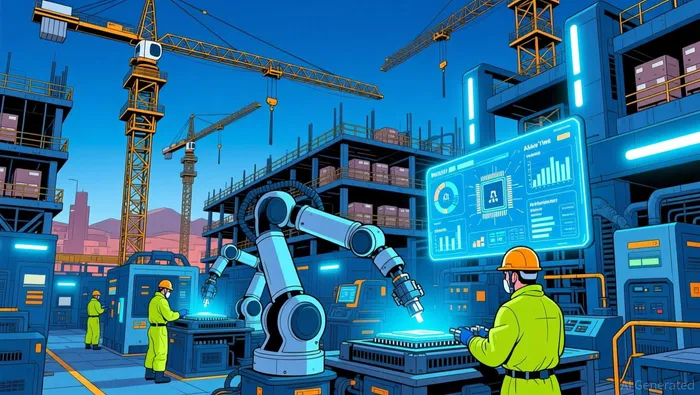
The administration's emphasis on semiconductors has materialized in a dramatic reshoring effort. TSMC's accelerated plans to build six fabrication plants in Arizona-backed by Apple's $600 billion commitment to U.S. manufacturing-highlight the administration's success in attracting critical infrastructure investment, according to an ICLARIFIED analysis. Meanwhile, partnerships like Noveon Magnetics and Solvay's collaboration to secure rare earth materials for high-performance magnets signal a parallel push to insulate supply chains for robotics and electric vehicles, the ICLRIFIED analysis notes.
For investors, this bifurcates opportunities: long-term gains in semiconductor manufacturing (TSMC, ASML) and mid-term bets on rare earth material suppliers (e.g., Noveon) are both viable, though the latter carries geopolitical and technical execution risks.
Robotics and Automation: The Quiet Revolution
While semiconductors dominate headlines, robotics and automation are quietly reshaping manufacturing. General Motors' 2027 plan to eliminate China-sourced components reflects a broader trend of supply chain diversification, the Morningstar report notes. Similarly, SoftBank's acquisitions of ABB Robotics and continued funding of OpenAI position it as a gatekeeper in the AI-robotics convergence.
Investors should also note the role of private equity in this space. Veritas Capital's acquisition of MetroStar-a firm specializing in AI-enabled national security solutions-demonstrates the growing privatization of tech-driven resilience initiatives, the Morningstar report notes.
Navigating the Risks: Volatility and Regulatory Whiplash
The AI and national security sectors are not without pitfalls. C3.ai's struggles and the COAI Index's November 2025 plunge, noted in a Bitget report, underscore the fragility of investor sentiment in a field dominated by unproven technologies and shifting regulations. Additionally, the administration's reliance on tariffs as a tool for reshoring-recently defended by Trump as a matter of "national security"-introduces macroeconomic uncertainty.
Conclusion: Positioning for the Long Game
For investors, the Trump Administration's 2025 strategy offers a clear playbook: prioritize sectors where national security and industrial policy intersect. Semiconductors, rare earth materials, and defense-grade AI are prime candidates, though each demands rigorous due diligence. The key is to balance exposure to high-growth, government-backed initiatives with hedging against regulatory and operational volatility.
As the administration's policies crystallize into action, the next frontier of American innovation-and investment-will be defined by those who can navigate the delicate balance between geopolitical ambition and technological pragmatism.







Comentarios
Aún no hay comentarios