
The Trump Administration's Shift in University Funding: A New Era for AI, AVs, and U.S. Tech Leadership
The Trump Administration's strategic reallocation of capital toward artificial intelligence (AI), autonomous vehicles (AVs), and tech leadership has created a seismic shift in university funding and research priorities. By prioritizing innovation, infrastructure, and workforce development, the administration has laid the groundwork for a new era of U.S. technological dominance. For investors, this represents a golden opportunity to capitalize on emerging sectors and institutions poised to benefit from this transformative agenda.
Strategic Policy Shifts: From Executive Orders to Infrastructure
The administration's approach began with a series of executive orders designed to streamline AI adoption and infrastructure development. Executive Order 13859 (2019) and its successor emphasized deregulation and innovation, rescinding Biden-era safeguards to accelerate AI deployment. These orders were complemented by the Genesis Mission, a $320 million initiative launched in November 2025 to integrate AI into scientific research. By leveraging federal datasets and partnering with national labs like Argonne, the mission aims to automate workflows and boost productivity in fields like biotechnology and energy. 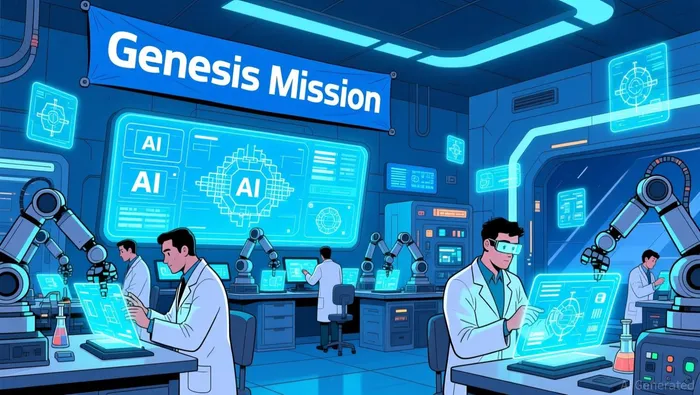
Infrastructure also became a focal point. Executive Order 14318 streamlined permitting for data centers, a critical enabler for AI and AV development. This move, coupled with the Stargate AI infrastructure partnership-a $500 billion investment in AI infrastructure-signals a commitment to building the physical and digital backbone for next-generation technologies. According to analysis, the partnership represents a significant shift in federal investment strategy.
Capital Reallocation: Funding the Future of AI and AVs
Federal budgets under Trump saw a dramatic uptick in AI and IT R&D spending. For FY25, the National Science Foundation (NSF) requested $2.05 billion for AI research, while the Department of Defense (DOD) allocated $2.035 billion for advanced robotics and communication networks. The U.S. Tech Force, a 1,000-member initiative involving tech giants like Amazon, AppleAAPL--, and MicrosoftMSFT--, further underscores the administration's push to bridge public and private sector capabilities. According to CNBC, the program aims to accelerate innovation through public-private collaboration.
Universities are not left out. The Department of Education's $50 million in grants through the Fund for the Improvement of Postsecondary Education (FIPSE) is directed toward AI-driven teaching tools and STEM workforce development. Meanwhile, the American Science and Security Platform, managed by the Department of Energy, provides high-performance computing resources to universities and research institutions, fostering collaboration with private-sector partners like NVIDIANVDA-- and IBM.
Emerging Investment Opportunities
The administration's policies have created clear pathways for investors to target high-growth areas:
AI-Enabled Research Institutions: Universities and national labs receiving Genesis Mission funding-such as Argonne National Lab and the American Science Cloud-are prime candidates for long-term investment. According to analysis, these entities are not only advancing scientific discovery but also becoming hubs for AI-driven innovation.
Public-Private Partnerships: The U.S. Tech Force and collaborations between DOE and tech firms like NVIDIA highlight the potential for joint ventures. Investors should monitor partnerships that combine federal resources with private-sector agility, particularly in quantum computing and autonomous systems.
Infrastructure Providers: Companies involved in data center development, high-performance computing, and AI infrastructure (e.g., NVIDIA, Microsoft) stand to benefit from the administration's push to accelerate permitting and expand AI-ready infrastructure. According to reports, the federal government is streamlining regulations to support private-sector growth.
Education and Workforce Development: With $50 million allocated to AI education grants, edtech firms and platforms offering AI literacy programs are well-positioned to scale. According to Meritalk, the administration's emphasis on K-12 AI integration also opens opportunities for startups focused on STEM education.
Risks and Considerations
While the opportunities are substantial, investors must remain cautious. The Genesis Mission's success hinges on sustained Congressional funding, and some projects-like an NSF-backed AI initiative for weather modeling-have already faced abrupt cancellations. Additionally, the administration's deregulatory stance may attract regulatory pushback, particularly in states with stricter AI laws.
Conclusion
The Trump Administration's strategic reallocation of capital toward AI, AVs, and tech leadership has redefined the landscape for university research and innovation. By prioritizing infrastructure, education, and public-private partnerships, the administration has created a fertile ground for investors to capitalize on emerging opportunities. For those willing to navigate the risks, the rewards could be transformative-both in terms of financial returns and the broader goal of securing U.S. technological leadership in the 21st century.







Comentarios
Aún no hay comentarios