
The Trump Administration's Rollback of Fuel Economy Standards and Its Implications for Automakers and EV Investors
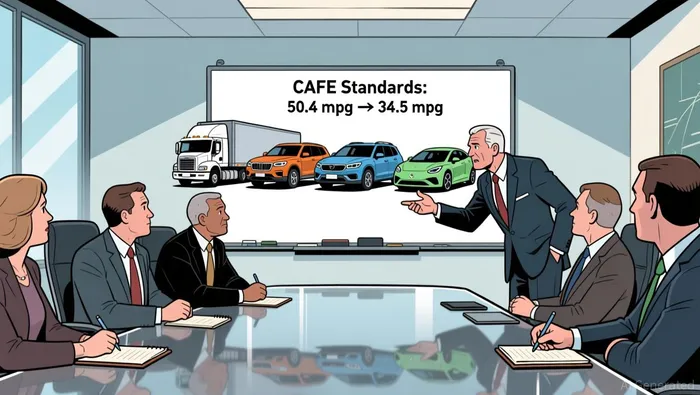
The Trump administration's recent rollback of fuel economy standards represents a seismic shift in U.S. automotive policy, with profound implications for automakers and clean energy investors. By resetting Corporate Average Fuel Economy (CAFE) targets from Biden-era goals of 50.4 mpg by 2031 to a more modest 34.5 mpg, the administration has signaled a retreat from aggressive emissions reduction mandates and a pivot toward market-driven vehicle production. This policy shift, which excludes electric vehicles (EVs) and credit trading programs from CAFE calculations, raises critical questions about risk and opportunity for stakeholders in the auto and clean energy sectors.
Automakers: Reduced Compliance Costs, but Heightened Regulatory Uncertainty
For traditional automakers, the rollback offers immediate relief from the financial and operational pressures of meeting stringent efficiency targets. The Biden administration's CAFE rules, which required a 2% annual improvement in fuel economy for passenger cars and 4% for light trucks from 2027 to 2031, were widely criticized as unrealistic and costly. By reverting to a 0.5% annual improvement baseline, the Trump administration has effectively lowered compliance burdens, allowing automakers like FordF-- and StellantisSTLA-- to prioritize production of larger, more profitable vehicles such as trucks and SUVs.
 However, this reprieve comes with risks. The rollback creates regulatory fragmentation, as California-a state with historically influential emissions standards-has signaled its intent to maintain or even strengthen its own rules. Automakers now face a patchwork of state-level requirements, which could complicate compliance and increase long-term costs. For example, companies operating in both Trump-aligned and Biden-aligned states may need to produce dual fleets, diluting economies of scale. Additionally, the rollback's focus on "real-world market conditions" assumes sustained consumer demand for gas-powered vehicles, a bet that could backfire if fuel prices rise or public sentiment shifts toward sustainability.
EV Investors: A Stalled Transition, but Niche Opportunities Remain
The rollback's exclusion of EVs from CAFE calculations marks a direct assault on federal incentives for electrification. By removing EVs as a compliance tool, the administration has effectively deprioritized the transition to zero-emission vehicles, which could slow adoption rates and reduce R&D investment in battery technology and charging infrastructure. This poses a significant risk for EV investors, particularly those betting on startups or suppliers reliant on government subsidies.
Yet, the EV sector is not without opportunities. While federal support has waned, private-sector innovation and consumer demand for EVs-driven by falling battery costs and environmental awareness-remain robust. Companies like TeslaTSLA-- and Rivian, which have established strong brand equity and direct-to-consumer sales channels, may still thrive despite the regulatory headwinds. Moreover, international markets, particularly in Europe and China, continue to enforce stringent emissions rules, creating export opportunities for U.S. EV manufacturers. Investors should also monitor state-level initiatives, such as California's Advanced Clean Cars II program, which mandates 35% EV sales by 2026. These regional efforts could mitigate some of the rollback's negative impacts.
Broader Market Implications: A Rebalance of Power
The rollback underscores a broader ideological realignment in the auto industry. Automakers that have historically resisted electrification-such as Ford and Stellantis-now find themselves in a more favorable regulatory environment. Conversely, companies heavily invested in EVs and clean energy infrastructure may face margin compression unless they diversify into hybrid or internal combustion engine (ICE) technologies. For investors, this rebalance necessitates a nuanced approach: hedging against regulatory volatility while capitalizing on long-term trends like urbanization and decarbonization.
Conclusion: Navigating a Fragmented Landscape
The Trump administration's CAFE rollback is a double-edged sword. For automakers, it reduces short-term compliance costs but introduces long-term regulatory complexity. For EV investors, it dampens federal momentum for electrification but leaves room for market-driven growth. The key for investors lies in assessing regional dynamics, technological resilience, and the adaptability of individual companies. As the auto industry navigates this fragmented landscape, those who can balance regulatory risk with innovation will likely emerge as winners.





Comentarios
Aún no hay comentarios