
Trump's $40-50 Oil Preference vs. Shale Economics: A Collision Course for 2025
The energy markets are on the brinkBCO-- of a historic clash—one pitting the political calculus of a U.S. president against the hard realities of shale economics. As Goldman Sachs’ groundbreaking analysis of Donald Trump’s social media activity reveals, the White House’s preference for oil prices between $40 and $50 per barrel directly contradicts the survival needs of America’s shale drillers, which require prices above $60 to sustain growth. This divergence isn’t just theoretical: with West Texas Intermediate (WTI) currently trading at $63—a level still $13 above Trump’s comfort zone—the stage is set for a seismic reckoning in 2025.
The Rhetorical Preference: Trump’s Social Media as a Market Indicator
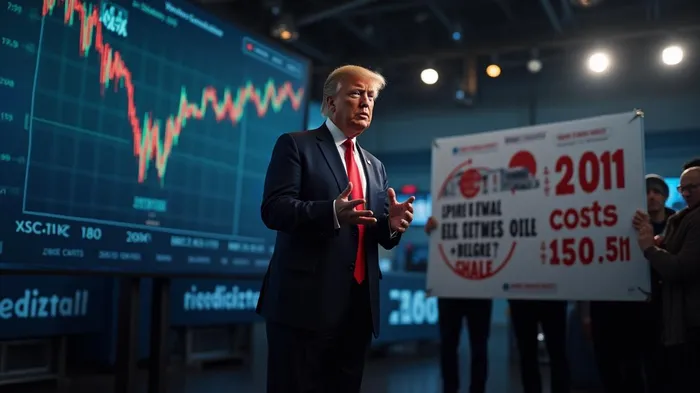
Goldman’s analysis of over 1,000 of Trump’s posts since 2009—nearly 900 of which addressed energy—paints a clear picture. The president’s “propensity to post about oil prices bottoms” when WTI stabilizes between $40 and $50, signaling his view of this range as optimal. When prices rise above $50, his rhetoric shifts to calls for lower prices or celebrations of declines—a strategy rooted in his “cheap energy” campaign promise and inflation-fighting agenda. Conversely, when prices dip below $30, he advocates for higher prices to protect U.S. producers.
This isn’t just political theater; traders treat his social media activity as a market-moving signal. As Goldman notes, the correlation between his posts and price movements has become a barometer for geopolitical risk. But here’s the rub: shale drillers, the backbone of U.S. energy dominance, require prices above $51 per barrel to break even, with many needing $60+ for sustained growth.
Shale’s Breakeven Crisis: A Structural Headwind
The math is stark. U.S. shale producers—already grappling with declining well productivity and rising costs—are now operating in a margin-squeezed environment. Even at today’s $63 WTI price, the average breakeven for shale remains just over $51, but the cost to drill in the Permian Basin, for example, has surged to $60 per barrel. This gap creates a “collision course” between Trump’s rhetoric and the sector’s viability.
Goldman’s forecast—$56 average for 2025 and $52 in 2026—suggests prices are on track to fall sharply toward the lower end of Trump’s preferred range. If realized, this would force shale drillers into a brutal reckoning: cut capital spending, slash dividends, or consolidate. The result? A wave of mergers, bankruptcies, or asset sales—events that will disproportionately punish smaller E&P (exploration and production) firms.
The Current Crossroads: $63 WTI—A Fragile Equilibrium
Today’s $63 WTI price is a temporary truce, buoyed by the U.S.-China trade deal’s 90-day tariff ceasefire and optimism over global demand. But this is fragile. The market is vulnerable to three critical risks:
- Geopolitical De-escalation: If the U.S.-China truce holds, it could further reduce prices by easing supply chain bottlenecks and slowing inflation—both of which align with Trump’s price preference.
- Rising Inventories: Traders anticipate a 4.3-million-barrel crude inventory build, as reported by the American Petroleum Institute (API), which could pressure prices downward.
- OPEC+ Overhang: The cartel’s decision to ease production cuts by 400,000 barrels per day monthly will amplify oversupply fears, especially if demand growth slows.
The Investment Play: Betting Against Shale’s Survival
The collision between Trump’s $40–50 preference and shale’s breakeven needs creates a clear trade: position for a price collapse toward $40–50, and profit from the sector’s unraveling.
- Short U.S. E&P Stocks: The Energy Select Sector SPDR Fund (XOP), which tracks oil and gas E&Ps, has underperformed the S&P 500 by 15% year-to-date. A drop in oil prices would exacerbate this underperformance.
- Inverse Oil ETFs: Instruments like the ProShares UltraShort Oil & Gas (USAO) or the VelocityShares 3x Inverse Crude ETN (DWTI) offer leveraged exposure to declining prices.
- Avoid High-Cost Shale Producers: Companies with breakeven costs above $60, such as Pioneer Natural Resources (PXD) or Diamondback Energy (FANG), face the sharpest downside.
The Political-Economic Paradox: Energy Dominance vs. Cheap Energy
Trump’s “energy dominance” agenda—built on boosting U.S. oil exports and reducing reliance on OPEC—is at odds with his rhetorical push for sub-$50 oil. The shale industry, which delivers nearly 60% of U.S. oil production, cannot survive indefinitely at prices below $50. This contradiction creates a self-defeating cycle: lower prices weaken shale, which undermines U.S. energy independence—a key pillar of the administration’s foreign policy.
The market’s resolution? A brutal reckoning where the shale sector consolidates, and only the largest, lowest-cost producers survive. For investors, this is a textbook case of strategic market divergence—a gap between political signaling and economic reality that creates asymmetric risk.
Conclusion: The $40–50 Zone Isn’t a Comfort Zone—It’s a Death Zone
The data is clear: a drop to $40–50 WTI would force shale drillers into a liquidity crisis, triggering a wave of industry consolidation and asset sales. With Goldman’s forecast pointing toward this range by 2026, and the current $63 price already vulnerable to de-escalating geopolitics, the time to position for this collision is now.
Investors who ignore this divergence do so at their peril. The choice is simple: bet on the market’s reality—or pay the price when Trump’s rhetoric meets shale’s economics.







Comentarios
Aún no hay comentarios