
Trump's 30% EU Tariffs and the Erosion of European Equity Bullishness
The looming U.S. tariffs on EU goods—set to take effect on August 1, 2025—mark a critical inflection pointIPCX-- for European equities. While markets have historically shrugged off trade threats, Goldman Sachs' stark GDP warnings and the EU's delayed countermeasures now expose glaring sector-specific vulnerabilities. Investors must act swiftly to hedge against revaluation risks in cyclicals, banks, and German exporters, while pivoting toward defensive strategies.
Sector-Specific Vulnerabilities: Where the Pain Will Hit
1. Cyclicals: The First Casualty
The tariff regime will disproportionately impact cyclical sectors like automotive, machinery861013--, and industrial goods. German exporters—particularly heavyweights such as BMW, Mercedes-Benz, and Siemens—face a double whammy:
- Direct Costs: A 30% tariff on exports to the U.S. will erode profit margins. Goldman SachsGS-- estimates the eurozone's GDP could shrink by 1.2% by late 2026 if tariffs are fully implemented.
- Indirect Effects: Supply chain disruptions and retaliatory EU tariffs on U.S. agricultural and tech imports could trigger a broader economic slowdown.
2. Banks: The Fragile Middlemen
European banks, already grappling with weak loan growth and regulatory headwinds, now face heightened credit risk. The ECB's Financial Stability Review warns that tariff-driven trade declines could push Stage 2 loan ratios (loans at risk of default) toward 10% of total assets, up from 8.4% in 2020. Key vulnerabilities include:
- Exposure to Trade-Dependent Firms: Banks like Deutsche BankDB-- and Société Générale have significant loan portfolios tied to export-heavy industries.
- Market Volatility: Tariff uncertainty has already caused equity underwriting revenues to drop by 5-10% for European investment banks in Q2 2025.
3. German Exporters: The Achilles' Heel
Germany's €84 billion trade surplus with the U.S. (2024) makes its economy uniquely exposed. Sectors like automotive, pharmaceuticals, and machinery could see revenue declines of 5-10% if tariffs bite. The Stoxx Germany 30 Index has already underperformed broader European benchmarks by 300 basis points year-to-date, reflecting investor pessimism.
Tactical Hedging: Defending Portfolios Against the Tariff Tsunami
1. Shift to U.S. Dollar-Hedged Equities
The U.S. dollar is likely to strengthen as the Fed delays rate cuts in the face of tariff-driven inflation. Investors should consider:
- ETF Plays: Allocate to funds like HEWY (Euro hedged to USD) to mitigate currency risk.
- Sector Focus: Favor U.S.-based multinationals (e.g., AppleAAPL--, Microsoft) with minimal European exposure but global pricing power.
2. Short the Euro: A Direct Play on Trade Tensions
The euro has already lost 2% against the dollar since Trump's tariff announcement, and further declines are likely if trade talks fail. Shorting the euro via futures or inverse ETFs (e.g., EUJ) offers a straightforward hedge.
3. Pivot to Defensive Sectors
- Utilities and Healthcare: These sectors offer stable dividends and lower sensitivity to trade cycles.
- Gold: A classic safe haven, with GLD likely to outperform as geopolitical risks rise.
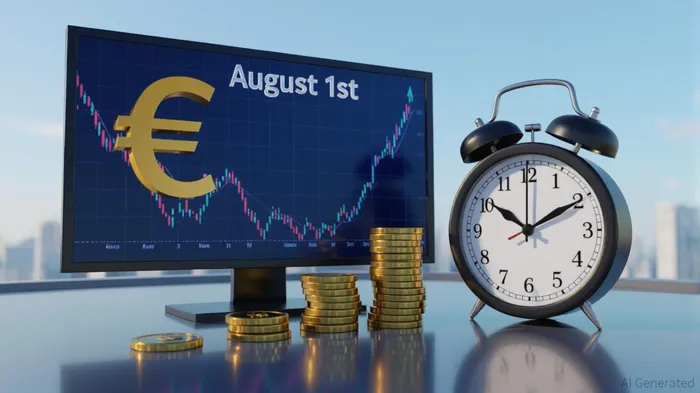
Urgency: Rebalance Before August 1st
The August 1st deadline is a critical inflection point. If tariffs are imposed:
- Cyclicals and banks will underperform, with the Stoxx Europe 600 possibly dropping 5-8% in the short term.
- The Euro could weaken further, benefiting dollar-hedged strategies.
Investors must act now:
1. Trim exposure to German exporters and cyclical stocks.
2. Hedge currency risk via EUR/USD shorts or hedged ETFs.
3. Reallocate to defensive assets to preserve capital amid volatility.
Conclusion: The Tariff Tipping Point
The EU-U.S. tariff saga is no longer theoretical—it is a countdown to economic dislocation. With Goldman Sachs' GDP warnings ringing loud and the EU's countermeasures poised to escalate tensions, investors ignoring sector-specific risks are gambling861167-- with their portfolios. The time to rebalance is now. Prioritize defensive plays, hedge currency exposure, and brace for a market reckoning ahead of August 1st.





Comentarios
Aún no hay comentarios