
Trump's 25% Tariff Threat on Iran's Trade Partners: Implications for Global Energy, Sanctions, and Commodity Markets
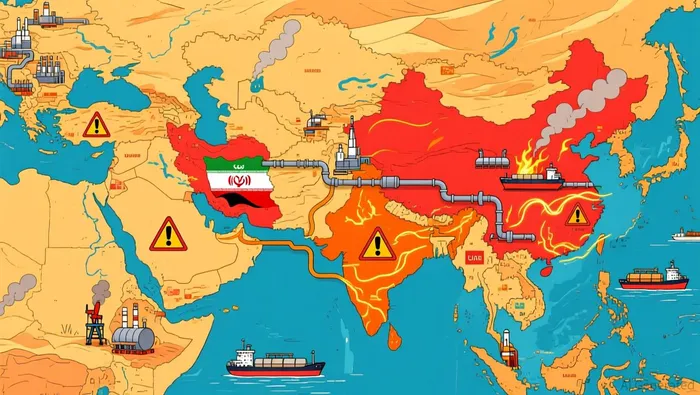
The U.S. trade landscape has entered a new phase of geopolitical tension, as President Donald Trump's 25% tariff threat against countries trading with Iran reverberates across global energy markets and sanctions frameworks. Announced in January 2026 as a "final and conclusive" executive action, the policy aims to isolate Iran amid its violent crackdown on anti-regime protests, which activists report have left over 500 dead and 10,000 arrested. By targeting key trade partners like China, India, and the United Arab Emirates (UAE), the tariffs could disrupt energy flows, amplify commodity price volatility, and test the durability of U.S. sanctions regimes.
China: The Linchpin of Iranian Oil Exports
China's economic dependency on Iran is unparalleled, absorbing 80-90% of Iran's oil exports in 2025. Despite U.S. sanctions, Beijing has sustained and even expanded its crude imports through tactics like ship-to-ship transfers and transshipment via third countries, according to analysis. In March 2025 alone, China imported 1.91 million barrels per day of Iranian crude. The 25% tariff, however, introduces a critical inflection point.
For China, the tariffs could force a costly recalibration of energy sourcing. With 90% of its crude needs met through imports in 2025, Beijing may accelerate diversification efforts, including increased purchases from Russia, Africa, and the U.S. itself. Yet such shifts risk straining relations with Gulf producers, who view China's growing influence in the region as a challenge to U.S. hegemony. The economic toll could also be severe: A 2.3% rise in U.S. consumer prices and a 0.6% GDP contraction are projected under similar tariff scenarios.
India: A Fragile Energy Lifeline
India's energy security is equally precarious. In 2025, 38% of its crude oil and 52% of its LNG imports pass through the Strait of Hormuz, a chokepoint Iran has recently threatened to block. While India's direct imports from Iran have waned- averaging 2 million barrels per day in 2025-the country has signaled renewed interest in resuming purchases, including $111 million worth of Iranian crude in 2025.
The 25% tariff could force India to choose between higher energy costs and compliance with U.S. demands. With oil imports accounting for 89% of its total demand, New Delhi may prioritize diversification, accelerating investments in Russian oil and U.S. LNG. However, this strategy risks inflating India's trade deficit, which hit $137 billion in FY2025. The geopolitical stakes are equally high: A closed Strait of Hormuz would disrupt 1.9 million barrels of India's daily oil imports, compelling New Delhi to deepen ties with Gulf states to offset U.S. pressure.
UAE: A Transit Hub Under Scrutiny
The UAE's role as a transshipment hub for Iranian oil makes it a unique case. In November 2025, the UAE imported 153,243 barrels per day of Iranian crude, a volume that, while smaller than China's, is critical for Iran's sanctions-busting operations. The UAE also imported $1.094 billion worth of Iranian non-oil goods in early 2025, making it Iran's third-largest trading partner.
The 25% tariff could disrupt this dynamic. By penalizing UAE trade with Iran, the U.S. risks alienating a key ally in the Gulf, which has already diversified its energy investments, including a $130 billion push into oil and gas supply. However, the UAE's strategic depth-bolstered by its East-West pipeline and Fujairah refinery- may insulate it from immediate shocks. For now, Abu Dhabi appears to balance U.S. demands with its economic ties to Iran, but prolonged tariffs could force a realignment of priorities.







Comentarios
Aún no hay comentarios