
Trump's $2,000 Tariff Dividend: Market Sentiment, Fiscal Policy, and the Path Forward
The Proposal: Structure and Ambiguities
President Trump announced the dividend in November 2025, emphasizing that it would exclude "high-income individuals" and be funded by tariffs on imported goods, as reported by the Economic Times. The plan mirrors Senator Josh Hawley's earlier $600 tariff rebate proposal but scales the payout significantly. However, critical details remain unaddressed: How will income thresholds be defined? Will the payment be a one-time stimulus or recurring? And how will Congress, which must approve the legislation, reconcile the plan with existing fiscal constraints?
The administration's rhetoric frames the dividend as a win-win: Americans receive cash, and tariffs generate revenue to shrink the national debt. Yet, as noted by the Tax Foundation, tariffs often lead to higher consumer prices and reduced economic efficiency, as detailed in the Tax Foundation blog. This tension between political messaging and economic reality underscores the proposal's complexity.
Economic Projections: Winners, Losers, and Long-Term Risks
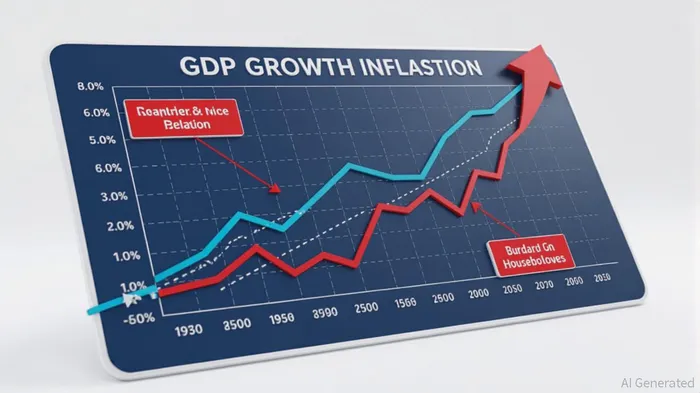
Expert analyses paint a mixed picture. According to the Tax Foundation and the Peterson Institute for International Economics (PIIE), Trump's tariffs are projected to reduce U.S. GDP growth by 0.23 percentage points in 2025 and 0.62 percentage points in 2026, as detailed in the Tax Foundation blog. Over the next decade, the cumulative impact could lower GDP by 0.8% before foreign retaliation. These projections suggest that while the dividend might provide short-term relief to households, the broader economy could face structural headwinds.
A key concern is the regressive nature of tariffs. While the dividend excludes high-income earners, the Tax Foundation estimates that the average U.S. household will face a $1,300 to $1,600 annual tax burden due to higher prices on imported goods, as detailed in the Tax Foundation blog. This creates a paradox: the policy aims to benefit middle- and lower-income Americans but may inadvertently increase their costs of living.
Market Sentiment: Polarization and Uncertainty
Market sentiment has been deeply polarized. A Pew Research Center study reveals that 55% of Americans believe the long-term effects of Trump's tariff policies will be negative for the country and themselves, as noted in the Tax Foundation blog. This skepticism is reflected in stock market volatility, particularly in sectors reliant on global supply chains, such as manufacturing and retail.
Meanwhile, the cryptocurrency sector has shown a nuanced reaction. The Trump administration's establishment of a Strategic BitcoinBTC-- Reserve and its rollback of Biden-era SEC actions have boosted crypto market sentiment, as reported by CryptoRank. However, the ongoing legal battles over tariffs-now before the Supreme Court-introduce uncertainty that could dampen investor confidence across asset classes.
Fiscal Policy Challenges: Legal Scrutiny and Congressional Hurdles
The proposal's legality is under intense scrutiny. The Supreme Court has questioned whether Trump's use of the International Emergency Economic Powers Act (IEEPA) to justify tariffs is constitutionally sound, as reported by CryptoRank. If the Court rules against the administration, the entire framework for the dividend could collapse.
Congressional approval also remains uncertain. While Trump's base may support the dividend, bipartisan consensus is unlikely given the policy's economic risks and the current political climate. Additionally, the IRS's Uniform Capitalization (UNICAP) rules complicate the accounting of tariff revenue, creating compliance risks for businesses and tax professionals, as detailed in the Tax Foundation blog.
Conclusion: A High-Stakes Gamble
Trump's $2,000 tariff dividend represents a bold but precarious experiment in fiscal policy. While it could provide immediate financial relief to millions, the long-term economic costs-higher inflation, reduced GDP growth, and legal uncertainty-pose significant risks. Investors must weigh these factors against the administration's broader agenda, including its pro-crypto stance and regulatory rollbacks.
For now, the proposal remains a work in progress. As Congress deliberates and the Supreme Court deliberates, market participants should monitor developments closely. The outcome will not only shape the 2025 economic landscape but also test the viability of using tariffs as a tool for both fiscal and political gain.






Comentarios
Aún no hay comentarios