
Trump's 130% China Tariff Policy and Its Impact on Global Supply Chains: Immediate Opportunities in Nearshoring and Domestic Manufacturing ETFs
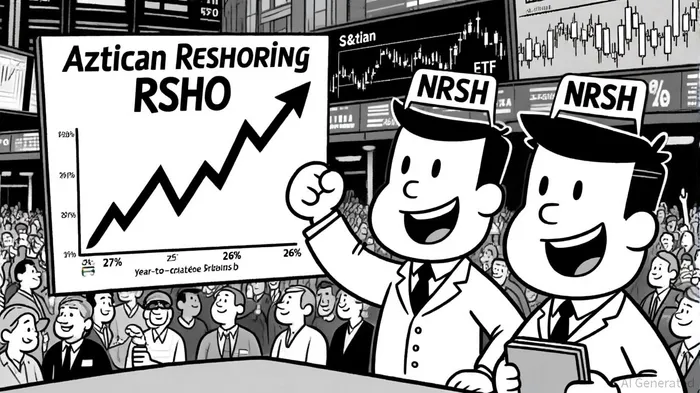
The Trump administration's 2025 tariff surge-ranging from 10% to 50% on global imports, according to the National Law Review-has ignited a seismic shift in global supply chains, accelerating a wave of nearshoring and domestic manufacturing revival. While the 130% China tariff policy (a sector-specific escalation within the broader framework) has drawn headlines for its disruptive potential, it has also created fertile ground for investors seeking to capitalize on the reshoring boom. Exchange-traded funds (ETFs) focused on U.S. and North American industrial and manufacturing firms are emerging as strategic vehicles to harness this transition, with products like the Tema American Reshoring ETF (RSHO) and the Aztlan Nearshoring ETF (NRSH) outperforming broader markets, an ETF.com report notes.
Reshoring as a Policy-Driven Trend
The administration's tariff strategy, combined with bipartisan industrial policies such as the $1.85 trillion Inflation Reduction Act (IRA), CHIPS Act, and Infrastructure Investment and Jobs Act (IIJA), has incentivized companies to reevaluate global sourcing. Over 2 million reshoring job announcements and $1.7 trillion in domestic manufacturing investments since early 2024 underscore the scale of this shift, as reported by the National Law Review. Multinationals like ABB and Eaton have redirected capital to U.S. facilities, leveraging federal subsidies and automation advancements to offset labor shortages and high costs, according to a GoOver.ai report.
ETFs as Gateways to Reshoring Opportunities
The Tema Reshoring ETF (RSHO), launched in May 2023, has gained 27% in 2024 by targeting small- and mid-cap U.S. firms in industrials, materials, and semiconductors. Its active management strategy prioritizes companies directly benefiting from supply chain reconfiguration, such as infrastructure builders and semiconductor manufacturers. Similarly, the Aztlan Nearshoring ETF (NRSH), launched in November 2023, has delivered a 26% year-to-date return in 2025 by focusing on North American firms in logistics, cybersecurity, and transportation. NRSH's diversified portfolio-57% U.S., 23% Mexico, 20% Canada-reflects the regional dynamics of nearshoring, while its 0.75% expense ratio positions it as a cost-effective option for investors, per Aztlan's NRSH page.
Challenges and Strategic Considerations
While tariffs have spurred reshoring, challenges persist. High production costs and labor shortages remain barriers for some industries, according to a Finviz analysis. However, federal incentives and automation are mitigating these headwinds, making U.S. manufacturing increasingly competitive, as noted in the GoOver.ai report. For investors, a balanced approach is critical: pairing reshoring ETFs with defensive sectors like utilities and consumer staples can hedge against economic volatility, as recommended in a Kiplinger guide. Gold and TIPS are also recommended as inflation hedges, given the potential for tariff-driven price pressures, as discussed in the GoOver.ai analysis.
Portfolio Implications and Future Outlook
Investors are advised to reduce exposure to multinational tech firms reliant on overseas manufacturing, which face heightened risks from supply chain disruptions, as the GoOver.ai report highlights. Instead, domestic manufacturers with simplified supply chains-particularly small and mid-cap firms-offer resilience. The Trump-era tariff environment also favors protectionist policy beneficiaries, such as domestic steel producers and agricultural firms, though broader economic headwinds must be monitored (Kiplinger provides further context).
As reshoring accelerates, ETFs like RSHO and NRSHNRSH-- are not just capturing market share but reflecting a structural reindustrialization of the U.S. economy. For those seeking to align with long-term industrial and economic shifts, these funds represent a compelling intersection of policy, capital, and innovation.





Comentarios
Aún no hay comentarios