
Trump's 10% Credit Card Rate Cap: A Tactical Analysis of the Catalyst
The event is now live. President Trump announced a one-year cap limiting credit card interest rates to 10%, effective January 20, 2026. This is not a vague proposal; it is a specific, executable directive with a clear start date. The immediate market implication is a fundamental shock to the sector's profit model.
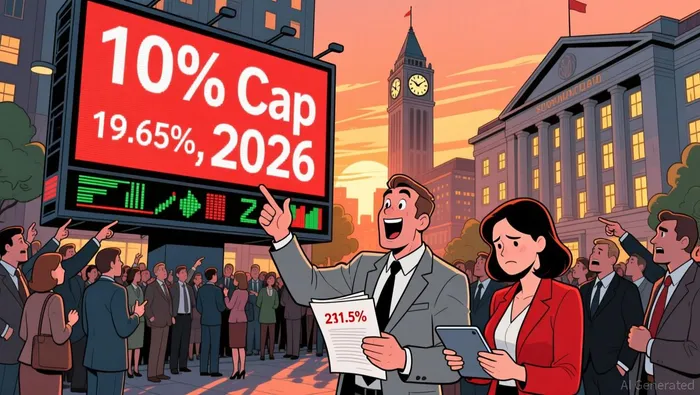
The proposal directly targets the core driver of credit card issuer earnings: the net interest margin. These companies generate the vast majority of their revenue from the high rates they charge on outstanding balances. A cap to 10% would compress those margins dramatically, as the average rate charged is currently between 19.65% and 21.5% according to the Federal Reserve. This isn't a minor adjustment; it's a structural change to the business model.
Yet the catalyst's impact is clouded by uncertainty. The president's Truth Social post provided no details on implementation or enforcement he did not provide specifics on how the government would implement it or ensure that companies comply. It's unclear if this would be executive action or require new legislation. This lack of clarity creates immediate volatility, as investors scramble to assess the real risk and potential workarounds. The market is reacting to a known event with unknown mechanics, a classic setup for mispricing.
Financial Impact: Modeling the Shock to Earnings
The immediate financial shock is quantifiable. The proposed cap would slash the net interest margin-the core profit engine-for a sector that currently earns an average rate of between 19.65% and 21.5%. A move to 10% represents a near-total collapse of that margin, directly attacking the primary source of revenue.
To model the risk, look at Discover's recent performance. In its first quarter of 2025, the company posted a net income of $1.1 billion, or $4.25 per share. That result was driven by a strong net interest margin, as its interim CEO noted. A 10% cap would compress that margin by roughly half, threatening that entire earnings stream. The scale of earnings at risk is significant for a major player.
This vulnerability is underscored by the sector's recent turbulence. Capital OneCOF--, a key competitor, reported a staggering $4.3 billion net loss in the second quarter of 2025. While that loss was heavily influenced by the integration of Discover and a massive loan reserve build, it highlights how quickly profitability can unravel under stress. For all its scale, the sector's earnings are not immune to a fundamental shift in its pricing power.
The bottom line is that the catalyst creates a clear, immediate pressure point. The proposed rule would compress a critical profitability metric by over 50%, directly threatening the bottom line of major issuers. The market must now price in the risk that this shock could materialize, turning a sector known for stable earnings into one facing a structural headwind.
The Market's Reaction: Mispricing or Overreaction?
The market's initial reaction is a classic case of uncertainty-driven volatility. The stock price has swung on the news, but the key question is whether it has already priced in the worst-case scenario. The answer hinges on a single, critical factor: the perceived likelihood of the cap becoming law versus being implemented via executive action. The president's post offered no clarity on the mechanism he did not provide specifics on how the government would implement it or ensure that companies comply. This ambiguity is the fuel for the current choppiness.
For pure-play issuers like Discover and Capital One, the risk is immediate and severe. These companies are already in the midst of a massive, costly integration. Capital One's second-quarter 2025 results showed a staggering $4.3 billion net loss, a figure heavily influenced by the Discover acquisition and a massive loan reserve build. The company is not in a position to absorb a sudden, structural compression of its net interest margin. The market may be underestimating the speed and severity of the required earnings reset for these firms, which are already facing a turbulent integration phase.
The catalyst's impact will be disproportionately felt by these pure-plays. Unlike diversified banks with multiple revenue streams, their earnings are directly tied to credit card spreads. A 10% cap would force a fundamental re-rating of their business models. The market's current pricing may reflect a hope that the cap is merely a political pledge unlikely to pass, or that it would be implemented slowly. But the president's stated goal is for it to be in place by January 20, 2026, just one year from now Trump said he hoped it would be in place Jan. 20, one year after he took office. That tight timeline leaves little room for a gradual transition.
The bottom line is that the market is reacting to a known event with unknown mechanics. If the cap is implemented through executive action, the shock to earnings would be immediate and severe, likely catching the market off guard. The current price may represent a mispricing, as the vulnerability of integrated pure-plays is not fully reflected. Yet if the cap faces a legislative fight, the stock could be overreacting to a distant risk. The setup is a tactical one: the stock is volatile, but the real opportunity-or danger-depends on which path the administration takes.
Catalysts and Risks: What to Watch Next
The immediate catalyst is set, but the real test begins now. The market's next move will be dictated by a few clear watchpoints that will confirm or deny the initial thesis of a structural earnings shock.
First, monitor for any official action on January 20, 2026. The president's post stated he hoped the cap would be in place by that date, marking the one-year anniversary of his second inauguration Trump said he hoped it would be in place Jan. 20, one year after he took office. The critical question is whether this is executive action or a new legislative bill. Watch for any executive orders, regulatory filings, or congressional hearings in the coming weeks. The mechanism will determine the speed of the shock: a sudden executive cap would be far more disruptive than a slow legislative process.
Second, track the industry's response. Strong opposition from Wall Street and the credit card companies is certain Strong opposition is certain from Wall Street in addition to the credit card companies. Look for coordinated lobbying efforts, legal challenges, and public statements from major issuers like Discover and Capital One. The industry's argument that such a plan would hurt poor people by curtailing credit lines is a key talking point they will likely amplify. Any delay or weakening of the cap through legal or political channels would be a direct negation of the initial thesis.
Finally, watch for early financial signals from the issuers themselves. The first quarterly earnings reports after the cap's effective date will be crucial. Look for management guidance that explicitly models the impact on net interest margins and profitability. Also monitor credit quality metrics like delinquency rates and charge-off ratios. A cap could force issuers to tighten lending standards, which would show up in these numbers. For a company like Discover, which recently reported a net income of $1.1 billion driven by a strong net interest margin, any guidance that suggests a material compression of that margin would be a clear warning sign.
The setup is now a tactical one. The stock's volatility reflects the uncertainty over these near-term catalysts. The path of least resistance will be determined by the first official action on January 20 and the strength of the industry's pushback.





Comentarios
Aún no hay comentarios