
Trump's 10% Credit Card Rate Cap: A Structural Challenge to the Business Model
President Trump's call for a one-year, 10% cap on credit card interest rates is not a minor regulatory adjustment. It is a direct structural intervention aimed at the core profit engine of the credit card business. Framed as a demand for immediate compliance, the policy sets a hard deadline: January 20, 2026. Trump has declared that lenders who fail to adhere would be "in violation of the law", though the mechanism for enforcement remains undefined, creating a standoff between executive assertion and industry reality.
The target is clear. The average rate Americans pay is currently between 19.65% and 21.5%, a level that has come down from recent peaks but remains near the highs of the past three decades. This is the premium that funds the entire ecosystem. The industry's profitability is built on this spread, and a mandated drop to 10% would compress margins dramatically. While researchers note the industry would still be profitable, the model would be fundamentally altered, likely forcing a scaling back of rewards programs and other perks that attract customers.
This concentrated market is particularly vulnerable. The credit card business is dominated by a handful of large issuers, making a uniform rate cap a systemic shock rather than a niche disruption. The policy's timing is also significant. It arrives as Americans are carrying $1.23 trillion in credit card debt, the highest level on record. A sudden reduction in issuer revenue could trigger a contraction in credit availability, a risk the industry has highlighted. The proposal, therefore, is a high-stakes gamble on affordability versus stability, challenging the very math that has driven the sector's expansion.
Quantifying the Financial Shock
The policy's impact can be measured in stark, mathematical terms. A 10% cap would eliminate the entire 12- to 13-percentage-point profit margin that issuers currently earn on new and existing balances. This is the core of the business model. 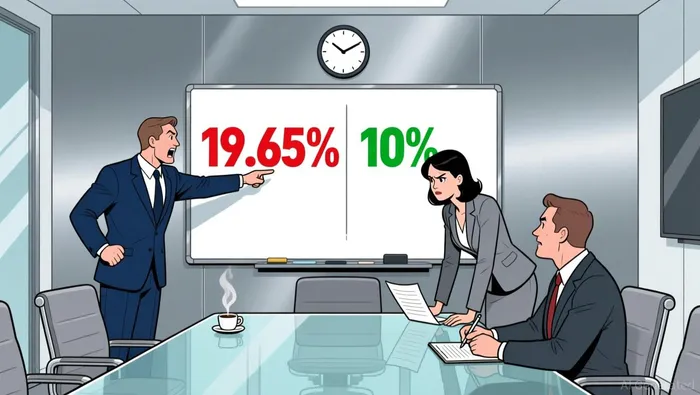 . The average rate Americans pay is 19.65%, a level that includes a 12-13% markup over the Prime Rate. A mandated drop to 10% would compress that spread to near zero, slashing interest income at scale.
The base for this potential revenue loss is immense. Americans are carrying $1.233 trillion in credit card debt, the highest level on record. Even if the cap were applied only to new balances, the sheer size of the existing debt stock means a massive portion of the industry's interest income would be at immediate risk. The math is straightforward: a 10-percentage-point reduction in the effective rate on a $1.2 trillion base translates to tens of billions in lost annualized revenue.
This shock arrives against a backdrop of already moderating growth. The market is not expanding at its previous blistering pace. TransUnion's 2026 forecast projects credit card balances to grow just 2.3% year-over-year, the smallest annual increase since 2013. This growth moderation, driven by cautious lenders and consumers navigating economic uncertainty, means the industry has less room to absorb a sudden, structural revenue cut. The policy's timing is therefore critical; it targets a sector that is already scaling back its expansion.
The Political Economy and Regulatory Risk Premium
The policy's fate hinges on a clash of powerful forces. On one side is the White House, leveraging executive authority with a firm deadline. On the other, the industry's formidable political machine, which has long enjoyed a friendly regulatory environment. The Consumer Bankers Association's warning is a direct counter to the administration's narrative, arguing that a 10% cap would reduce credit availability and leave vulnerable consumers with no choice but high-cost alternatives. This is the industry's core political argument: that the proposed cap is a populist measure that would inflict collateral damage on the very people it aims to protect.
Yet the political landscape is not one-sided. The proposal has found a legislative echo in the 10 Percent Credit Card Interest Rate Cap Act (S.381), introduced in February 2025. That bill, which includes a sunset clause on January 1, 2031, provides a potential legislative pathway. Its existence suggests the idea has bipartisan traction, but also that it is being framed as a temporary, controlled measure rather than an immediate executive mandate. This legislative context is critical: it implies the policy, if it ever becomes law, would likely be structured with more nuance and a defined end date than the current executive call.
The central vulnerability for issuers, however, is the policy's current lack of a legislative basis and unclear enforcement. President Trump has declared lenders in violation of the law if they do not comply by January 20, 2026, yet provided no explanation for how that legal violation would be established or prosecuted. This creates a profound regulatory and political risk premium. The uncertainty over whether this is a binding executive order or a non-binding request, and the potential for costly legal battles over compliance, directly affects the cost of capital. Investors will demand a higher return to compensate for this heightened, undefined risk.
The bottom line is a sector facing a dual threat. It must navigate a hostile political push from the White House while also managing the fallout from its own industry groups, which are now forced to publicly oppose a policy that could have been a political ally. This standoff injects volatility into the business model at a time when the industry is already scaling back its growth. The regulatory risk is not just about a one-year cap; it is about the precedent of executive overreach and the potential for further intervention, a shadow that will linger over valuations and strategic planning.
Catalysts, Scenarios, and Key Watchpoints
The immediate catalyst is a hard deadline. President Trump has set January 20, 2026 as the date by which lenders must comply with his 10% cap demand. He has declared that failure to meet this target would place them "in violation of the law". Yet, as of now, there is no legislative basis for that claim. The policy exists as an executive directive, creating a standoff where the industry can argue the demand is unenforceable. The first major test will be whether the administration follows through with legal action or if the deadline passes without consequence, leaving the policy in a state of regulatory limbo.
The longer-term catalyst is legislative formalization. The proposal has a potential legislative pathway in the 10 Percent Credit Card Interest Rate Cap Act (S.381), introduced in February 2025. This bill, which includes a sunset clause on January 1, 2031, provides a framework for a temporary cap. Its existence suggests the idea has bipartisan traction, but also that it is being framed as a controlled, time-limited measure rather than an immediate executive mandate. The key watchpoint is whether the administration pushes for this or a similar bill to become law before the January 20 deadline, or if it allows the executive call to fade without legislative backing.
For investors, the primary risk extends beyond the direct revenue loss. The bigger threat is a permanent shift in the regulatory and political risk premium. The current uncertainty-over whether this is a binding order or a non-starter-directly affects the cost of capital. A sector facing the potential for executive overreach and further intervention will command a higher risk premium. This is not just about a one-year cap; it is about the precedent of political interference in core financial business models. The industry's own warnings about reduced credit availability and the political pushback from Wall Street underscore this new, elevated risk profile.
Actionable intelligence points to monitoring two fronts. First, watch for any legal or regulatory moves from the administration or agencies like the CFPB in the days leading up to January 20. Second, track the progress of S.381 in Congress. A bill advancing with White House support would signal a path to formalization, while its stagnation would confirm the policy's current status as an unenforceable executive request. In either scenario, the lasting impact will be a recalibration of risk for the entire financial sector.







Comentarios
Aún no hay comentarios