
Trump's 10% Credit Card Cap: A Constitutional and Market Test
President Trump has revived a core campaign pledge, proposing a one-year cap on credit card interest rates at 10%. The plan, aimed for implementation by January 20, 2026, the first anniversary of his second term, is framed as a populist move to save Americans roughly $100 billion in interest annually. Yet the proposal immediately reveals a stark political and constitutional paradox.
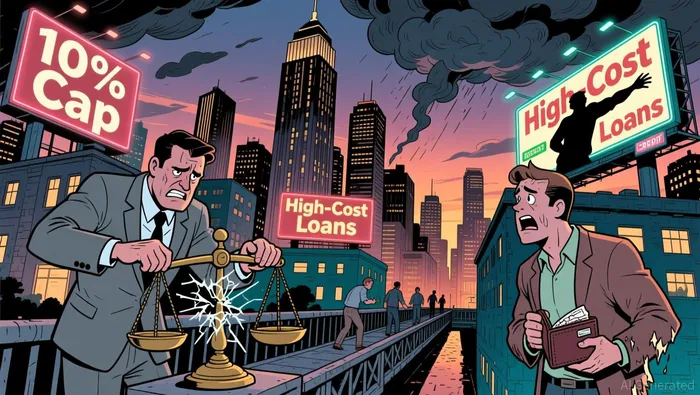
The immediate backlash is coming from the very financial sector that has been a key ally. Wall Street and the credit card industry, which donated heavily to his 2024 campaign, are mobilizing opposition. Their argument is straightforward: such a cap would force lenders to cut credit limits and close accounts for higher-risk borrowers, potentially driving consumers toward even costlier alternatives like payday loans. This creates a direct conflict between the administration's stated populist goals and its traditional economic base.
The constitutional critique adds another layer of tension. Economist Peter Schiff has labeled the move "unconstitutional" and a form of "socialist price control". This is a pointed jab, as Schiff notes it directly contradicts Trump's own past rhetoric. Just last year, the president criticized a similar policy proposed by former Vice President Kamala Harris, which targeted grocery prices. Now, the same label is being applied to his own initiative, highlighting a potential shift in the administration's economic philosophy-or a strategic calculation that overrides principle for political gain.
Financial Impact: P&L and Balance Sheet Repercussions
The proposed cap would force a fundamental recalibration of the credit card business model, impacting both the profit and loss statement and the balance sheet. The core mechanism, as warned by economist Peter Schiff, is straightforward: the proposed cap will force lenders to cut credit limits and close accounts for higher-risk borrowers. This is a direct response to the compression of net interest margins. Credit card companies currently operate on a model where high rates on revolving balances are a primary revenue driver. With rates capped at 10%, the income stream from this segment would collapse for many existing accounts, particularly those with balances carried over month-to-month.
This creates an immediate pressure point on profitability. The industry is currently making absolutely massive profits on customers at all income levels. A 10% cap would compress these margins significantly, likely triggering a defensive response from issuers. The logical outcome is a tightening of credit standards, as banks seek to protect their bottom line by lending only to the lowest-risk, most creditworthy customers. This could lead to a measurable contraction in the overall credit supply, a phenomenon Schiff and others term a potential credit crunch.
The financial impact extends beyond the P&L to the balance sheet and legal costs. The bill's provision for a private right of action for debtors to recover interest adds a new layer of operational and compliance risk. Issuers would face a surge in potential litigation from consumers seeking to reclaim interest paid above the cap, creating a significant legal liability. This is compounded by the bill's provision that creditors that knowingly violate this bill forfeit the entire interest of the debt, which could lead to large, unexpected write-offs.
In practice, this means banks would be forced to choose between two costly paths. They could absorb the margin compression, which would directly hit earnings, or they could aggressively manage their risk profile by cutting credit lines. The latter option, while protecting margins, risks alienating a broad customer base and could drive some borrowers toward even more expensive, unregulated alternatives. The bottom line is that the cap would not simply lower rates; it would compel a structural shift in how credit is extended and priced in the U.S. market.
Valuation and Scenario Implications
The investment case for this policy hinges on a trade-off between a temporary cost and the risk of a lasting shift in regulatory risk. The one-year duration is a critical constraint. It means the compression of net interest margins would be a discrete, finite event, not a permanent structural change. For now, this limits the long-term damage to bank earnings models. However, the precedent set by a government-imposed price cap introduces a new, unpredictable variable into the regulatory calculus. It signals that even a core, profitable revenue stream like credit card interest is not immune to political intervention, which could elevate the perceived risk premium for all consumer finance lending.
The more tangible financial risk lies in the potential for a credit crunch to spill over into other lending segments. As economist Peter Schiff warned, the cap would force lenders to cut credit limits and close accounts for higher-risk borrowers. This could lead to higher delinquencies not just on credit cards, but across the broader consumer credit market. When banks pull back from one segment, they often tighten standards elsewhere. This creates a contagion risk where the policy's intended beneficiaries-lower-income borrowers-end up paying more for alternative credit, potentially destabilizing the entire consumer lending ecosystem.
Ultimately, the cap's success in reducing consumer spending costs depends entirely on banks' ability to offset the lost interest income. The evidence suggests this is feasible only through aggressive revenue diversification. The industry's three main streams are merchant fees, customer fees, and interest. With interest capped, issuers would likely double down on the first two. We've seen this playbook before: when regulators capped debit card interchange fees, banks responded by removing rewards. The same dynamic is expected here, with credit card perks scaled back and fees potentially increased. For the policy to work without causing a systemic credit contraction, banks must successfully pivot to these alternative revenue sources. If they cannot, the promised savings for consumers may be offset by a broader tightening of credit access.
Catalysts, Risks, and the Constitutional Watch
The policy's fate now hinges on a few critical variables. The primary catalyst is the mechanism of implementation. President Trump has not specified whether the cap would take effect through executive action or require Congressional passage. This ambiguity is itself a strategic move, but the latter path is far more complex. A legislative bill, such as the 10 Percent Credit Card Interest Rate Cap Act introduced in February 2025, would need to navigate a divided Congress. While one Republican senator has expressed support, the proposal faces strong opposition from the financial sector and its allies. The timeline is tight, with the administration aiming for implementation by January 20, 2026. If Congress fails to act, the policy may be delayed or watered down, or the administration could attempt to impose it via regulatory fiat-a move that would immediately trigger a constitutional showdown.
The major risk to the policy's consumer benefit is an aggressive response from banks. The industry's warning that the cap would force lenders to cut credit limits and close accounts for higher-risk borrowers is a credible threat. To protect their bottom line, issuers are likely to accelerate fee increases and tighten credit standards more aggressively than anticipated. This could manifest as a rapid scaling back of rewards programs and the introduction of new account maintenance or balance transfer fees. The historical precedent is clear: when regulators capped debit card interchange fees, banks removed rewards. The same playbook is expected here, potentially dampening the net savings for consumers and driving some borrowers toward even costlier, unregulated alternatives.
Finally, the unresolved legal challenge looms large. The policy's constitutionality is already in question, with economist Peter Schiff calling it a form of "socialist price control" and "unconstitutional". If enacted, this would likely prompt immediate litigation. The outcome will depend heavily on the Consumer Financial Protection Bureau's enforcement posture. The agency has been largely nonfunctional since Trump took office, but its potential revival could be a key battleground. Any legal challenge would test the limits of federal power to set interest rates on private contracts, a precedent that could have far-reaching implications for all consumer lending markets. The watch is on for both the CFPB's stance and the first court filings.







Comentarios
Aún no hay comentarios