
Trump's 10% Cap Call: A Tactical Analysis of the Market's Reaction
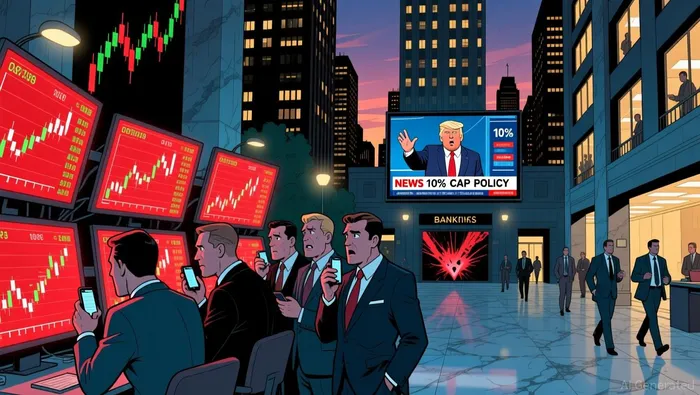
The catalyst was a specific, high-profile call. On Friday, January 9, President Trump announced on Truth Social that he was calling for a one-year cap on Credit Card Interest Rates of 10%, effective January 20, 2026. He framed it as protecting consumers from being "ripped off," but provided no details on how the cap would be enforced or legally implemented. The market's immediate reaction was a sharp sell-off in financial stocks, signaling that investors viewed this as a tangible threat to earnings.
Bank shares fell across the board on Monday. JPMorgan ChaseJPM-- was down 3.2% and Bank of America fell 2.5%, with CitigroupC-- dropping 3.7% and Wells FargoWFC-- declining 1.5%. The pain was even more severe for specialized lenders, with Synchrony FinancialSYF--, Bread FinancialBFH--, and Capital OneCOF-- shares falling between 8% and 11%. Payment processors also felt the pressure, as American ExpressAXP-- tumbled 3.8% and VisaV-- and MastercardMA-- each slipped 1.8%.
The core financial threat is clear. Credit cards are a major profit center, generating over $150 billion annually in swipe fees and billions more in interest income. A mandated 10% cap would directly attack this revenue stream, compressing margins for the issuers. While analysts noted that such a cap would require a bill passed by Congress-a path that appears unlikely-the market's move suggests investors are pricing in the possibility of political pressure and regulatory risk, treating the president's call as a serious catalyst for potential change.
The Feasibility Reality Check
The market's sharp reaction underscores the perceived threat, but the proposal faces steep legal and practical hurdles. Analysts and industry groups are unanimous on the first point: this would require an Act of Congress, not an executive order. As UBS Global noted, such a measure could only be enacted by Congress with passage unlikely. The president's call, while politically charged, lacks the legal machinery to force a cap without legislative approval.
The banking industry's warning is more specific. A joint statement from major trade groups like the American Bankers Association argues that a 10% cap would be devastating for millions of American families and small businesses who rely on and value their credit cards. Their core argument is that such a cap would drastically reduce credit availability, pushing consumers toward less regulated and more costly alternatives like pawn shops or payday lenders. This is the critical risk: a policy meant to help could inadvertently harm the very borrowers it targets by cutting off access to affordable credit.
There is a parallel legislative effort, but it is temporary and structured differently. A Senate bill, S.381, was introduced in February 2025 and would cap rates at 10% for a limited time, sunsetting in 2031. It includes provisions for forfeiting interest and private lawsuits, which adds a layer of enforcement but also potential legal friction. The existence of this bill shows the concept has traction, but its temporary nature and complex mechanics highlight the challenges of turning a political pledge into lasting law.
The bottom line is that the immediate catalyst is a political call, not a legal mandate. The market is pricing in regulatory risk, but the path to implementation is long and uncertain. For now, the industry's unified stance-that a cap would backfire by reducing credit access-provides a strong counter-narrative to the president's affordability pitch.
The Tactical Trade Setup
The market's reaction prices in a high probability of implementation, but the actual threat to bank earnings is more nuanced. The primary risk is to net interest income from revolving credit, a major profit center. A 10% cap would directly compress margins for issuers, with analysts noting the move could see a big hit on margins if implemented. The scale is significant: Americans paid $160 billion in interest charges on credit cards last year, and a cap could save consumers roughly $100 billion in interest a year. For banks, that's a direct hit to a core revenue stream.
Yet the probability of a swift, sweeping implementation is low. The proposal requires an Act of Congress, a path that analysts see as unlikely. The banking industry's unified opposition, citing the risk of curtailing or eliminating credit lines, adds a powerful political counterweight. While a bipartisan Senate bill exists, it is temporary and complex, highlighting the legislative hurdles. The market's sharp sell-off in specialized lenders-where shares fell between 8% and 11%-suggests investors are treating the president's call as a serious near-term catalyst, potentially overestimating the near-term threat.
The tactical setup is a classic mispricing between political rhetoric and legislative reality. The event created a clear, immediate risk to a specific earnings component. But the mechanics of enforcement and the strength of industry opposition make a quick, clean implementation improbable. For a tactical investor, this creates a potential opportunity: the market has priced in a high likelihood of a damaging policy, but the legal and political barriers remain substantial. The trade hinges on whether the political pressure will overcome these hurdles before the next earnings season, or if the initial panic was an overreaction to a proposal that faces a long, uncertain legislative journey.
Near-Term Catalysts to Watch
The market's initial sell-off was a reaction to a political call. The next phase depends on concrete signals that either validate the threat or confirm it as a non-starter. Investors must monitor three specific catalysts to see if the risk profile changes.
First, watch for any formal legislative or executive details. President Trump has not clarified whether he will work with Congress, sign an executive order, or pursue another path. The absence of a clear mechanism is a major overhang. A key signal will be if a Republican senator, as mentioned in one report, speaks with the president and would work on a bill with his "full support". This would move the proposal from rhetoric to a tangible legislative process. Conversely, if no bill is introduced or the president's office remains silent, the proposal risks fading into background noise.
Second, track specific bank guidance on the potential impact. The market is pricing in a major hit to net interest income, but the exact magnitude for individual issuers remains unknown. The next earnings calls will be critical. Watch for management commentary on credit card portfolio sensitivity, potential fee adjustments, or any forward-looking statements about the risk. The industry's joint statement warns that a cap would reduce credit availability and be devastating for millions of American families. If banks begin to quantify this risk in their guidance, it will provide a clearer picture of the earnings pressure.
Finally, monitor the stance of key allies and regulators. The Consumer Financial Protection Bureau (CFPB) is a crucial enforcement player. The existing bipartisan Senate bill, S.381, explicitly subjects violations to civil liability under the Truth in Lending Act, which is enforced by the CFPB and FTC. If the CFPB signals it would actively pursue violators, it adds a layer of credibility to the threat. On the political side, watch for any shift from Republican allies who may be wary of alienating their financial industry donors. The banking industry's unified opposition is a powerful counterweight; any cracks in that coalition would be a notable development.
The bottom line is that the catalyst is now a waiting game. The market has priced in the political risk, but the setup remains a mispricing between that risk and the high probability of legislative inertia. The next few weeks will reveal whether the president's call leads to a formal proposal or simply fades.





Comentarios
Aún no hay comentarios