
Truist's Hold Rating on KeyCorp Amid AI and Energy Megatrends: Assessing Regional Banks' Strategic Relevance
The financial landscape in 2025 is being reshaped by two converging megatrends: the exponential growth of artificial intelligence (AI) and the urgent need for energy infrastructure modernization. Against this backdrop, Truist Securities has maintained a "Hold" rating on KeyCorpKEY-- (NYSE: KEY), despite raising its price target to $22 per share-a 4.94% projected upside from its recent closing price of $21.19. This decision reflects a nuanced assessment of KeyCorp's strategic positioning in an era where regional banks are increasingly called upon to finance AI-driven energy demands while navigating complex operational and regulatory challenges.
KeyCorp's Strategic Alignment with AI and Energy Trends
KeyCorp's strategic initiatives in 2025 underscore its recognition of the symbiotic relationship between AI and energy infrastructure. The bank has identified 40 AI proofs of concept to enhance operational efficiency, focusing on cybersecurity, fraud mitigation, and automation. These efforts align with broader industry trends, as nearly 70% of middle-market companies prioritize AI investments to streamline operations and improve decision-making. However, KeyCorp's most critical strategic pivot lies in its approach to energy infrastructure.
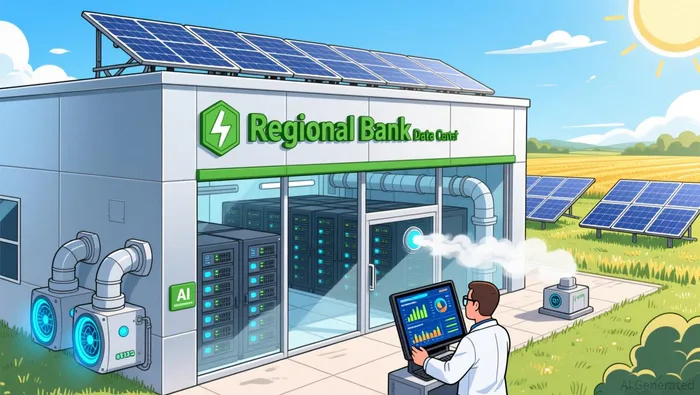 As AI adoption accelerates, data centers-power-hungry hubs of computation-are driving unprecedented energy demand. Goldman Sachs projects global data center power needs will surge by 165% by 2030. KeyCorp is addressing this by advocating for a diversified energy portfolio, combining renewables with traditional sources like nuclear and natural gas to ensure grid reliability. According to KeyCorp's Q3 2025 earnings report, the bank highlighted its commitment to this vision, with plans to repurchase $100 million of common stock in Q4 2025, signaling confidence in its ability to fund long-term infrastructure investments.
Regional Banks as Catalysts for Energy Transition
KeyCorp's strategy mirrors broader trends among regional banks, which are uniquely positioned to finance the energy transition required by AI-driven infrastructure. According to a report by RBC Capital Markets, data center operators are shifting from the "follow-the-fiber" model to the "follow-the-power" model, prioritizing regions with abundant renewable energy, such as the Pacific Northwest. KeyCorp's expansion into Seattle and Portland aligns with this trend, leveraging its regional footprint to support clients in energy-intensive sectors.
However, the path is not without hurdles. The Department of Energy notes that integrating nuclear energy with renewables could reduce generation and transmission costs by 37%, but achieving this requires overcoming policy and infrastructure bottlenecks. For regional banks, this means balancing near-term energy demand with long-term decarbonization goals-a challenge that KeyCorp's strategic focus on capital discipline and organic growth aims to address.
Financial Performance and Analyst Sentiment
Truist's "Hold" recommendation is tempered by KeyCorp's robust financial performance. The bank's CET1 ratio of 11.8% and plans to exceed $100 million in share repurchases in Q4 2025 demonstrate its commitment to capital allocation and shareholder returns. Institutional ownership has also strengthened, with Wellington Management Group increasing its stake and Bank of Nova Scotia maintaining a 14.91% position. Analysts project KeyCorp's non-GAAP EPS to reach $2.68 in 2025, supported by a projected 40.16% revenue increase.
Despite these positives, Truist's cautious stance reflects broader industry risks. Regional banks face pressure from commercial real estate (CRE) loan distress, particularly in office properties, and must navigate deposit rate competition in a tightening yield curve environment. According to Deloitte's industry outlook, regional banks are increasingly challenged by these headwinds. For KeyCorp, the challenge lies in maintaining profitability while scaling AI-driven initiatives and energy infrastructure financing.
Broader Implications for Regional Banks
KeyCorp's experience highlights the dual role of regional banks in the AI era: as both enablers of technological progress and stewards of energy transition. While larger institutions may dominate AI R&D, regional banks like KeyCorp are critical in financing the infrastructure that powers AI ecosystems. This includes not only data centers but also the energy grids and renewable projects that sustain them.
Yet, the sector's success hinges on collaboration. As Deloitte notes, 72% of infrastructure developers view grid capacity as a "very or extremely challenging" issue, with interconnection delays and supply chain disruptions complicating project timelines. Policymakers and regulators must play a role in streamlining approvals and incentivizing investments in dispatchable energy sources like nuclear and geothermal.
Conclusion: A Calculated Hold in a High-Stakes Environment
Truist's "Hold" rating on KeyCorp is a measured response to a complex landscape. While the bank's strategic alignment with AI and energy trends is commendable, its ability to capitalize on these opportunities depends on navigating operational, regulatory, and market risks. The raised price target of $22 reflects confidence in KeyCorp's resilience, but the broader industry's success in powering the AI economy will require sustained innovation, capital discipline, and policy support. For investors, KeyCorp represents a case study in the evolving role of regional banks-neither too large to be agile nor too small to be irrelevant-in an era defined by technological and energy upheaval.







Comentarios
Aún no hay comentarios