
Troy Nehls' Retirement Signals Policy Continuity for GOP Growth Strategy
The retirement of Texas Rep. Troy Nehls according to reports marks both a potential vulnerability for the GOP and a carefully engineered continuity mechanism. While over 20 other Republican lawmakers have exited Congress as reported-often amid internal tensions or distancing from Trump-Nehls' twin brother Trever emerges as a direct ideological successor in the GOP-leaning 22nd District. This deliberate succession contrasts sharply with the broader wave of departures that threaten legislative cohesion.
Nehls' dual committee assignments make this transition politically significant. On the Judiciary Committee, he influenced business regulations critical to Trump-aligned priorities like immigration enforcement. His Transportation Committee role positioned him to shape infrastructure legislation-a key policy lever for economic growth. Retaining these committee positions through the Nehls brothers would preserve Trump's legislative agenda in these domains.
The district's loyalty underscores the strategy's viability. Nehls won reelection by 24 points in 2024, reflecting durable local support for his Trump-aligned stance. Trever's candidacy inherits this advantage, avoiding the political disruption seen in other retirements. However, risks linger: Trever lacks congressional experience, and the broader exodus of Trump-aligned Republicans weakens the movement's capacity to advance complex agendas.
Still, the Nehls succession plan exemplifies how Trump-aligned incumbents can neutralize departure risks. 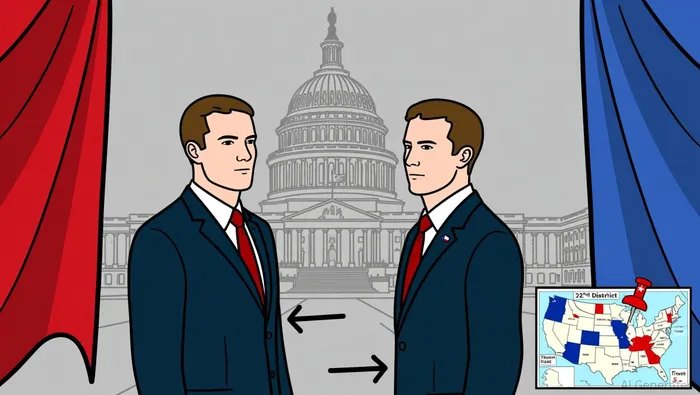 By embedding ideological continuity at the district level, the GOP may mitigate the erosion of its legislative pipeline-even as other factions fracture.
Market Impact Mechanics: Policy Certainty vs. Gridlock Risk
Rep. Troy Nehls' 24-point victory margin in his Texas district demonstrated strong local backing for Trump-aligned priorities, suggesting reduced near-term volatility in regions tied to his agenda. But this single data point doesn't override broader systemic risks.
According to market analysis, a 72% probability of Democratic House takeover now dominates political calculus, intensifying gridlock fears and market concerns. Internal GOP friction compounds this through high-profile departures like Marjorie Taylor Greene's resignation, which threatens to disrupt legislative momentum on critical fiscal matters.
Investors face competing realities: district loyalty offers pockets of policy certainty while systemic fragmentation raises shutdown risks through stalled spending negotiations. The tension between localized Trump alignment and full congressional control creates an uneven landscape where regional stability coexists with national uncertainty.
Market volatility could spike if gridlock stalls infrastructure funding or defense appropriations. Yet the twin brothers' succession in Nehls' district tempers worst-case scenarios by preserving ideological continuity. Ultimately, short-term district-level stability provides little insulation from broader fiscal impasses.
Political Catalysts and Market Scenarios
Texas Representative Troy Nehls' retirement and his twin brother Trever's GOP candidacy signals a strategic pipeline in the 22nd District, signaling continued alignment with hardline immigration and trade policies. This succession coincides with a broader wave of 39 House retirements, but GOP internal fractures-exemplified by Marjorie Taylor Greene's resignation according to reports-threaten legislative cohesion. With a 72% probability of Democratic House control in 2026, two distinct growth scenarios emerge.
Under a Trump-aligned continuity scenario, deregulation momentum could lift energy, manufacturing, and housing sectors through reduced compliance costs and border enforcement. Immigration crackdowns might squeeze labor-dependent industries like agriculture and hospitality while boosting domestic automation demand. However, gridlock risks loom if party divisions derail year-end spending bills. Infrastructure projects and immigration-linked businesses could face delays or funding cuts, sparking sell-offs amid shutdown fears.
GOP tensions-visible in Nehls' twin succession and Greene's Epstein dispute-create uncertainty around policy execution. Midterm election outcomes and spending negotiations will test whether deregulatory momentum translates to tangible growth or stalls against partisan fragmentation. Investors should monitor legislative coalition-building amid this dual-path dynamic.







Comentarios
Aún no hay comentarios