
Tronox's $400M Debt Offering: A Strategic Turnaround or a Warning Signal?
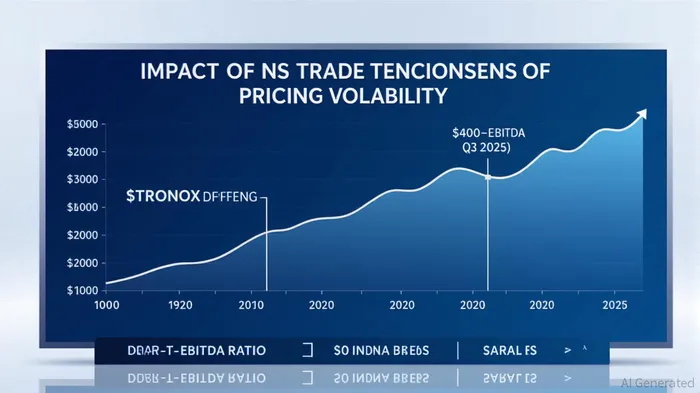
Tronox's proposed $400 million debt offering has sparked debate among investors about whether it signals a calculated restructuring or a desperate attempt to stabilize a faltering business. The move, announced in early 2025, aims to refinance existing debt under revolving credit facilities and fund cost-cutting initiatives, with excess proceeds allocated to general corporate purposes [2]. However, the offering comes amid a downgrade of Tronox's debt by both Moody'sMCO-- and S&P Global Ratings, reflecting concerns over earnings deterioration and elevated leverage [4].
Strategic Rationale: Cost-Cutting and Refinancing
Tronox's management has framed the debt offering as part of a broader strategy to strengthen its balance sheet. The company has launched a cost improvement program targeting $125–175 million in annual savings by 2026, which it claims will offset weak market conditions [5]. These savings, combined with projected 2025 revenue of $3.0–3.4 billion and Adjusted EBITDA of $525–625 million, suggest a disciplined approach to managing cash flow [5]. By refinancing high-cost debt, TronoxTROX-- could reduce interest expenses and extend maturities, providing breathing room amid a challenging titanium dioxide (TiO₂) market.
Market Headwinds: A Weakened Industry Landscape
The TiO₂ market in 2025 remains fragile, shaped by global trade tensions and supply-demand imbalances. The US-China trade dispute has disrupted traditional supply chains, forcing manufacturers to re-evaluate sourcing strategies and accept higher costs [2]. Additionally, the Kroll process—still the industry standard for titanium extraction—remains energy-intensive and capital-heavy, limiting flexibility for smaller producers [1]. While Tronox's vertical integration (spanning nine pigment plants and six mines) offers a cost advantage, its reliance on this outdated process exposes it to margin pressures if energy prices rise further [3].
Operational Viability: Strengths and Risks
Tronox's vertical integration and sustainability initiatives—such as reducing carbon emissions and optimizing mining operations—position it as a leader in the TiO₂ sector [1]. However, the debt offering raises questions about its ability to execute its cost-cutting plan without sacrificing operational flexibility. The proposed $400 million in new debt, while refinancing existing obligations, could strain liquidity if the savings program falls short of targets. Moreover, the offering's success hinges on favorable market conditions, with Bloomberg noting that “investor appetite for industrial debt remains cautious” [4].
Conclusion: A Calculated Gamble
Tronox's debt offering represents a high-stakes bet on its ability to navigate a weakened TiO₂ market. If the cost improvement program delivers as promised, the refinancing could stabilize its balance sheet and position the company for long-term growth. However, the downgrades by major rating agencies and the volatile trade environment underscore the risks of over-leveraging in a sector already grappling with structural challenges. Investors must weigh Tronox's operational strengths against the likelihood of further margin compression and geopolitical shocks.





Comentarios
Aún no hay comentarios