
TRON (TRX): Navigating Centralization Risks Amid a Surge in Growth Potential
Centralization as a Double-Edged Sword
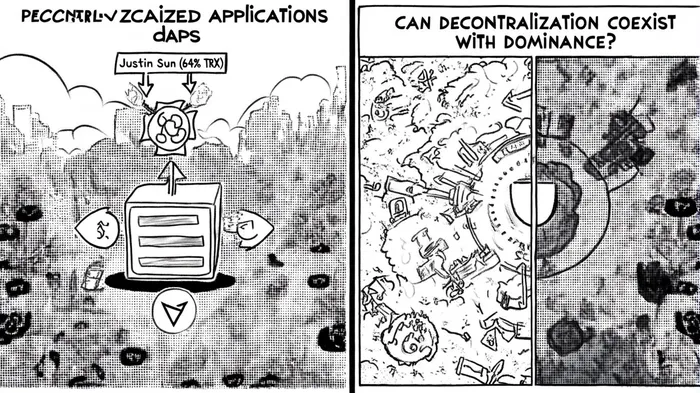
According to a report by Bloomberg, Justin Sun, the founder of TronTRX-- (TRX), reportedly controls approximately 64% of the TRXTRX-- supply[2]. This staggering concentration of ownership directly contradicts the foundational principles of blockchain decentralization, raising red flags for investors. Such control grants Sun disproportionate influence over governance decisions, market dynamics, and the Tron ecosystem's trajectory[3]. For context, holding 64% of a token's supply is akin to a single entity owning 64% of a public company's shares—a scenario that would trigger immediate regulatory scrutiny in traditional finance.
The controversy has escalated into a legal battle with Bloomberg, with a recent court ruling rejecting Sun's attempt to block the report[4]. Despite these allegations, TRX's price has shown minimal volatility, suggesting either market apathy or a belief that Sun's control does not currently threaten the network's stability[3]. However, the risk of centralization remains acute: a single entity could theoretically manipulate governance votes, alter protocol rules, or even double-spend transactions if incentives misalign.
Growth Drivers: A Network on the Rise
While centralization risks loom, TRON's growth potential in 2025 is undeniable. The platform hosts 50.6% of all USDT ($80.3 billion) and plans a $200 million expansion of its USD1USD1-- stablecoin, directly increasing TRX's utility through gasGAS-- fees and staking collateral[1]. Daily USDT transfers on TRON average $23.7 billion, cementing its role in cross-border settlements[1].
Technological advancements further bolster optimism. The v4.8.0 mainnet upgrade enhances scalability and compatibility, while partnerships with MoonPay (TRON wallet integration) and Everclear (DeFi expansion) improve accessibility[1]. Institutional adoption in Asia, where TRX is viewed as a transactional backbone, adds another layer of resilience[3]. Additionally, TRON's fee-burn model has reduced its supply at a steady pace, enhancing scarcity[3].
The Tension Between Risk and Reward
TRON's Delegated Proof of Stake (DPoS) governance model, which allows TRX holders to elect 27 Super Representatives, theoretically balances efficiency and decentralization[2]. However, the reality is stark: large TRX holders, including Sun, can disproportionately influence SR elections and governance decisions[2]. This tension is epitomized by the 2024 controversy over the unauthorized removal of 12,000 BTC from the USDD stablecoin reserve—a governance failure that exposed systemic vulnerabilities[2].
For investors, the calculus is complex. On one hand, TRON's ecosystem growth—145,000 DAOs managing collective treasuries in 2025[2]—and its dominance in stablecoin infrastructure suggest a network effect that could outpace regulatory or governance risks. On the other, the centralization of power in Sun's hands remains a fundamental flaw, particularly as regulatory scrutiny intensifies globally[1].
Investor Considerations: Bullish Sentiment vs. Structural Risks
Market sentiment remains cautiously optimistic, with 82% of traders holding a bullish outlook on TRX[4]. Yet, this optimism must be tempered by structural risks. Regulatory challenges—particularly around stablecoins and political ties—and the unresolved legal battle with Sun introduce uncertainty[3].
For risk-averse investors, the centralization risk may outweigh the growth potential. For those prioritizing scalability and adoption, TRON's ecosystem expansion could justify the trade-off. However, the lack of a clear roadmap to dilute Sun's control—a critical factor for long-term trust—remains a sticking point.
Conclusion
TRON (TRX) stands at a crossroads. Its technological advancements and institutional adoption paint a compelling picture of a blockchain poised for mass adoption. Yet, the shadow of Justin Sun's 64% supply control cannot be ignored. Investors must weigh the allure of growth against the existential risks of centralization. In a market where decentralization is sacrosanct, TRON's future hinges on whether it can reconcile these two forces—or if one will ultimately eclipse the other.





Comentarios
Aún no hay comentarios